
Why Vietnam Is a Hidden Gem for Gravity Casting
When companies look beyond traditional manufacturing hubs, they increasingly discover that Vietnam gravity casting offers a uniquely advantageous mix of cost, capability, and flexibility. As global demand grows for precision-cast metal parts, Vietnam is quietly emerging as a go-to destination. In this article, we explore why gravity casting in Vietnam deserves more attention than it currently gets.
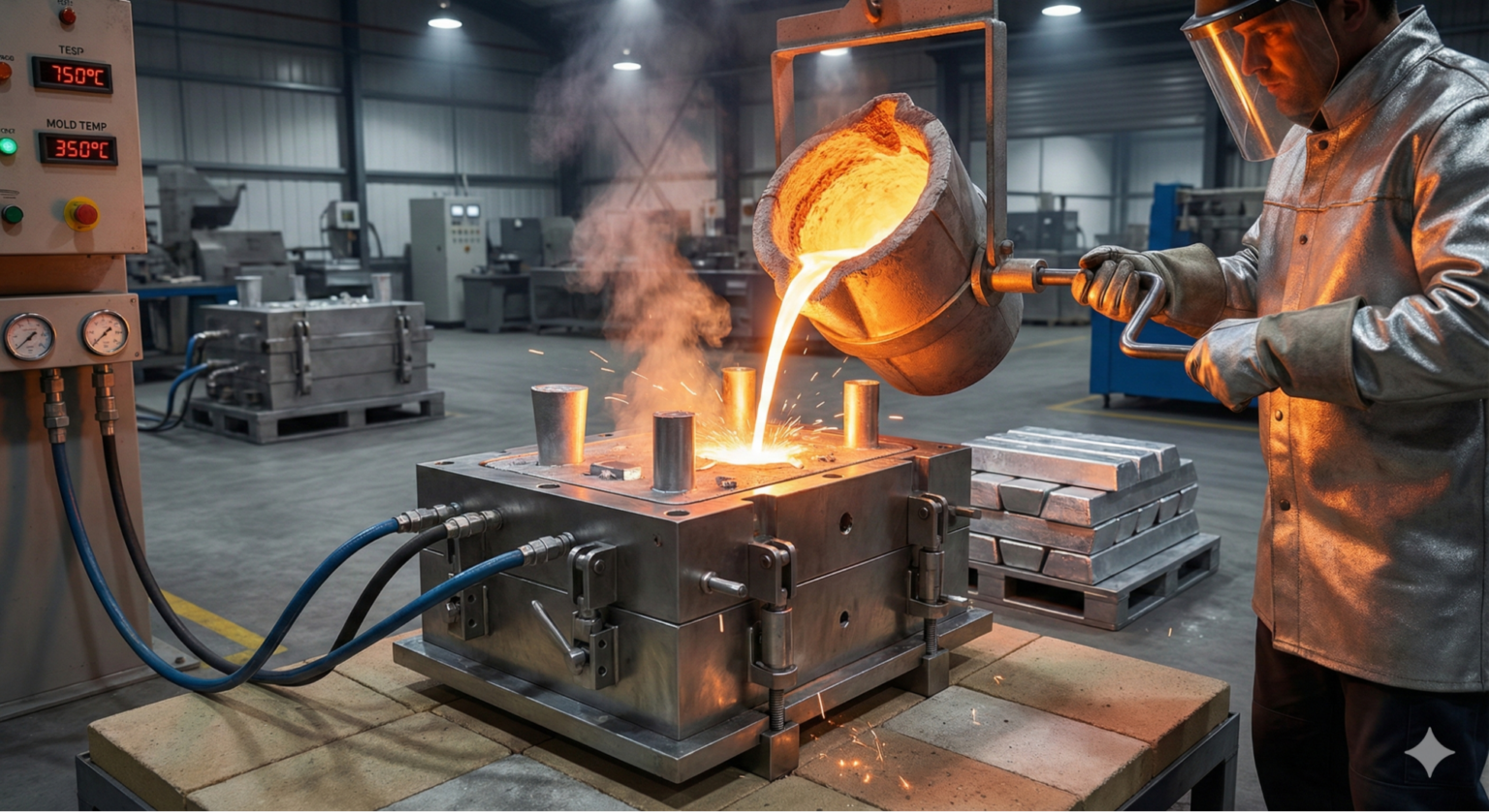
Gravity casting (also called permanent mold casting) is a process where molten metal is poured into a reusable metal mold without external pressure. It sits between sand casting (lower tooling cost, rougher finish) and high-pressure die casting (higher tooling cost, highest throughput).
Core advantages include:
- Better mechanical properties than sand casting due to faster cooling in metal molds
- Improved surface finish and dimensional repeatability vs. sand casting
- Longer mold life and lower porosity than sand casting
- Lower capital/tooling cost and less porosity risk than high-pressure die casting for medium volumes
Why Vietnam for Gravity Casting?
1. Competitive Cost Structure Without Sacrificing Quality
Vietnam offers significantly lower labor and overhead costs while still maintaining dependable casting quality. Many foundries operate with international standards in mind, giving buyers an attractive combination of cost savings and consistent performance across a wide range of gravity-cast metal parts.
2. Skilled Workforce and Growing Industrial Expertise
The country’s casting sector has rapidly modernized, with foundries investing in better equipment, training, and process control. As a result, Vietnam now supports more complex and higher-tolerance gravity castings for industries like automotive, machinery, and heavy equipment.
3. Material Flexibility & Suitability for Medium-to-Large Castings
Vietnamese foundries handle a wide variety of alloys and specialize in gravity casting parts that benefit from strength, durability, and medium-to-large dimensions. This makes Vietnam well-suited for components such as housings, fittings, and industrial equipment parts that don’t require ultra-thin walls.
4. Strategic Export Location and Supply-Chain Accessibility
With strong logistics links and an export-oriented manufacturing base, Vietnam offers shorter lead times and simpler global shipping compared with more distant industrial hubs. Many gravity-casting suppliers already work with international buyers, making onboarding smoother and more predictable.
5. Modernizing Infrastructure and Increasing Capabilities
Vietnam’s foundry industry has shifted from small artisanal operations to facilities equipped with modern melting systems, improved molding technology, and integrated machining. This ongoing upgrade boosts reliability and expands the types of projects that can be supported locally.
Qualitative regional comparison (indicative)
| Factor | Vietnam | China | India | Thailand |
| Tooling Cost | Low–Medium | Medium | Low | Medium |
| Casting + Machining Cost | Low–Medium | Medium | Low–Medium | Medium |
| Quality Systems Maturity | High (growing) | High | Medium–High | High |
| Export Logistics | Strong | Strong | Medium | Strong |
| FTA Coverage | Broad | Broad | Broad | Broad |
Conclusion
For manufacturers seeking dependable, cost-efficient casting solutions, gravity casting Vietnam stands out as a powerful and often overlooked option. With improving capabilities, competitive pricing, and a globally connected industrial base, Vietnam is well-positioned to support high-quality gravity-cast components while strengthening supply-chain resilience. As sourcing strategies evolve, Vietnam’s gravity-casting sector offers the flexibility and value that modern manufacturing demands.