
1045 Carbon Steel: Definition, Chemical Composition, Mechanical Properties, Applications
1045 carbon steel is a medium-carbon steel grade widely used in engineering and manufacturing due to its balanced combination of strength, toughness, and machinability. Containing approximately 0.43–0.50% carbon, it offers significantly higher strength than low-carbon steels while remaining cost-effective and versatile.
This guide explains what 1045 carbon steel is, its chemical and mechanical properties, how it performs under different heat treatments, and where it is commonly used. You’ll also learn about its advantages, limitations, and how it compares to other steel grades.
What Is 1045 Carbon Steel?
1045 carbon steel is a plain medium-carbon steel classified under the AISI/SAE system. It is primarily composed of iron and carbon, with small amounts of manganese and trace elements.
Unlike alloy steels, 1045 does not rely on chromium or nickel for performance. Instead, its strength comes from its carbon content and heat treatment capability, making it ideal for mechanical components subjected to moderate stress and wear.
Key defining characteristics include:
- Medium carbon content for higher strength
- Good response to heat treatment
- Moderate machinability and weldability
- Limited corrosion resistance without coatings
Chemical Composition of 1045 Carbon Steel
The chemical composition of 1045 carbon steel directly influences its hardness, strength, and heat-treating behavior.
Typical Chemical Composition Table
| Element | Percentage (%) | Function |
|---|---|---|
| Carbon (C) | 0.43 – 0.50 | Increases strength and hardness |
| Manganese (Mn) | 0.60 – 0.90 | Improves toughness and hardenability |
| Silicon (Si) | 0.15 – 0.40 | Strengthens ferrite structure |
| Phosphorus (P) | ≤ 0.04 | Residual impurity |
| Sulfur (S) | ≤ 0.05 | Improves machinability |
| Iron (Fe) | Balance | Base metal |
According to SteelPRO Group and MetalZenith, this composition allows 1045 steel to achieve higher mechanical strength than low-carbon grades like 1018, while remaining easier to process than high-carbon steels.
Physical Properties of 1045 Carbon Steel
The physical properties of 1045 carbon steel make it suitable for structural and rotating components.
Key Physical Properties
- Density: ~7.85 g/cm³
- Melting Point: 1450–1525°C
- Modulus of Elasticity: ~210 GPa
- Thermal Conductivity: Moderate
These properties allow 1045 steel to maintain dimensional stability under load and heat, which is critical for shafts, axles, and machine components.
Mechanical Properties of 1045 Carbon Steel
The mechanical performance of 1045 carbon steel varies depending on whether it is hot-rolled, normalized, or heat-treated.
Mechanical Properties (Normalized Condition)
| Property | Typical Value |
|---|---|
| Tensile Strength | 570–700 MPa |
| Yield Strength | 310–450 MPa |
| Elongation | 12–20% |
| Hardness | 170–210 HB |
| Impact Energy | 25–35 J |
These values position 1045 steel as a middle-ground material—stronger than mild steel but not as brittle as high-carbon alternatives.
Microstructure of 1045 Carbon Steel
In its untreated state, 1045 carbon steel consists primarily of ferrite and pearlite.
- Ferrite: Provides ductility
- Pearlite: Provides strength and wear resistance
When quenched and tempered, the microstructure transforms partially into martensite, significantly increasing hardness and strength.
A 2023 materials science study published on ScienceDirect found that heat-treated 1045 steel exhibits significantly refined grain structures, improving fatigue and compressive strength.
Heat Treatment of 1045 Carbon Steel
Heat treatment plays a crucial role in tailoring the properties of 1045 carbon steel.
Common Heat Treatment Processes
Annealing
- Softens the steel
- Improves machinability
- Reduces internal stress
Normalizing
- Refines grain structure
- Improves strength and uniformity
Quenching and Tempering
- Increases hardness and tensile strength
- Achieves up to 800–1000 MPa tensile strength
Induction or Flame Hardening
- Hardens surface only
- Retains a tough, ductile core
While heat treatment improves performance, excessive hardening may reduce ductility if not controlled properly.
Machinability and Weldability
1045 carbon steel offers moderate machinability, especially in annealed or normalized conditions.
Machinability
- Rated ~55–65% compared to free-machining steel
- Suitable for turning, milling, and drilling
Weldability
- Fair but requires preheating and post-weld heat treatment
- Risk of cracking due to carbon content
While easier to machine than high-carbon steels, 1045 requires more care than low-carbon steels during welding.
Corrosion Resistance of 1045 Carbon Steel
1045 carbon steel has limited corrosion resistance because it lacks alloying elements such as chromium or nickel that protect against oxidation.
Why 1045 Steel Rusts Easily
- High iron content reacts with moisture and oxygen
- No passive oxide layer forms naturally
- Accelerated corrosion in humid or marine environments
According to Rapid-Protos and Langhe Industry, untreated 1045 steel will oxidize quickly when exposed to water or chemicals, making surface protection essential.
Common Corrosion Protection Methods
- Painting or powder coating
- Oil or grease coatings
- Electroplating (nickel or chrome)
- Hot-dip galvanizing
While these treatments increase service life, they also add cost—an important tradeoff when selecting materials.
Applications of 1045 Carbon Steel
1045 carbon steel is widely used across industries that require strength, durability, and cost efficiency.
Industrial and Mechanical Applications
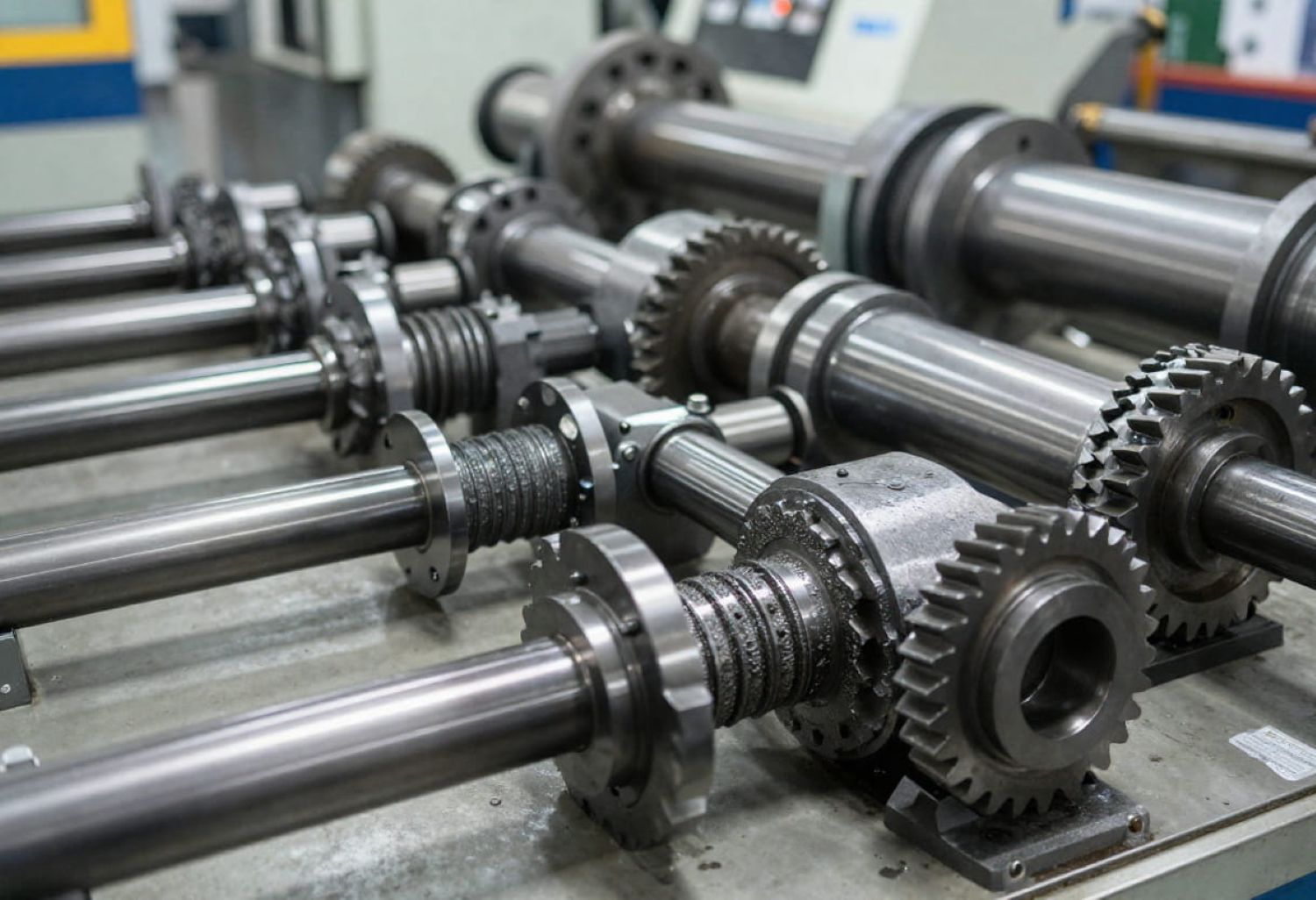
- Transmission shafts
- Axles and spindles
- Gears and sprockets
- Connecting rods
These components benefit from 1045’s ability to withstand repeated stress without excessive deformation.
Automotive Applications
- Crankshafts
- Steering components
- Suspension parts
Automotive manufacturers favor 1045 steel because it can be heat-treated for fatigue resistance while remaining affordable for mass production.
Agricultural and Heavy Equipment
- Tractor pins and shafts
- Hydraulic components
- Wear-resistant machine parts
Tooling and Fabrication
- Bolts and studs
- Rollers and pins
- Medium-duty tooling components
FindTop reports that 1045 steel is often selected when 1018 steel lacks strength but alloy steels would be unnecessarily expensive.
Advantages of 1045 Carbon Steel
The popularity of 1045 carbon steel stems from its balanced performance profile.
Key Benefits
- High strength-to-cost ratio
- Good response to heat treatment
- Versatile machining capability
- Wide availability worldwide
Compared to alloy steels, 1045 offers lower material and processing costs, making it ideal for general engineering use.
Limitations and Drawbacks
Despite its advantages, 1045 carbon steel has notable limitations.
Primary Limitations
- Poor corrosion resistance
- Moderate weldability
- Lower wear resistance than alloy steels
- Not ideal for extreme temperatures
While alloy steels like 4140 outperform 1045 in demanding environments, they come with higher costs and more complex processing requirements.
1045 Carbon Steel vs Other Steel Grades
Understanding how 1045 compares to other steels helps engineers make informed material decisions.
Comparison Table
| Steel Grade | Carbon Content | Strength | Weldability | Cost |
|---|---|---|---|---|
| 1018 | ~0.18% | Low | Excellent | Low |
| 1045 | ~0.45% | Medium-High | Moderate | Medium |
| 4140 | ~0.40% + alloy | High | Moderate | High |
Key takeaway:
- Choose 1018 for fabrication and welding
- Choose 1045 for strength-driven components
- Choose 4140 for high-stress, fatigue-critical parts
Common Buyer FAQs
Is 1045 carbon steel good for machining?
Yes, especially in annealed condition. However, it is harder to machine than low-carbon steels.
Can 1045 steel be hardened?
Yes. Quenching and tempering significantly increase hardness and strength.
Is 1045 steel suitable for outdoor use?
Only with protective coatings, as it corrodes easily.
Is 1045 steel stronger than mild steel?
Yes. It offers significantly higher tensile and yield strength than mild steels like 1018.
Conclusion
1045 carbon steel is a versatile, medium-carbon steel that offers an excellent balance between strength, toughness, and cost. Its ability to respond to heat treatment makes it suitable for a wide range of industrial, automotive, and mechanical applications.
While it lacks corrosion resistance and requires care during welding, these limitations are often offset by surface treatments and proper processing. For engineers seeking a reliable, cost-effective steel for load-bearing components, 1045 remains one of the most practical choices available.
1045 carbon steel remains one of the most practical and widely used medium-carbon steels due to its strong balance of mechanical performance, heat-treat responsiveness, and cost efficiency. Its versatility makes it a dependable choice for shafts, axles, gears, and other load-bearing components where higher strength than mild steel is required without the added expense of alloy grades. When paired with proper heat treatment and surface protection, 1045 steel delivers consistent performance across demanding industrial environments.
At Align Manufacturing, we work closely with clients to select and process materials like 1045 carbon steel to meet real-world application requirements—especially for precision components such as oil and gas gears, where durability, dimensional accuracy, and reliability are critical. By combining material expertise with controlled manufacturing processes, we help ensure that every component performs as intended throughout its service life. If you’re evaluating carbon steel options for mechanical or energy-sector applications, our engineering team is ready to support your next production challenge.