
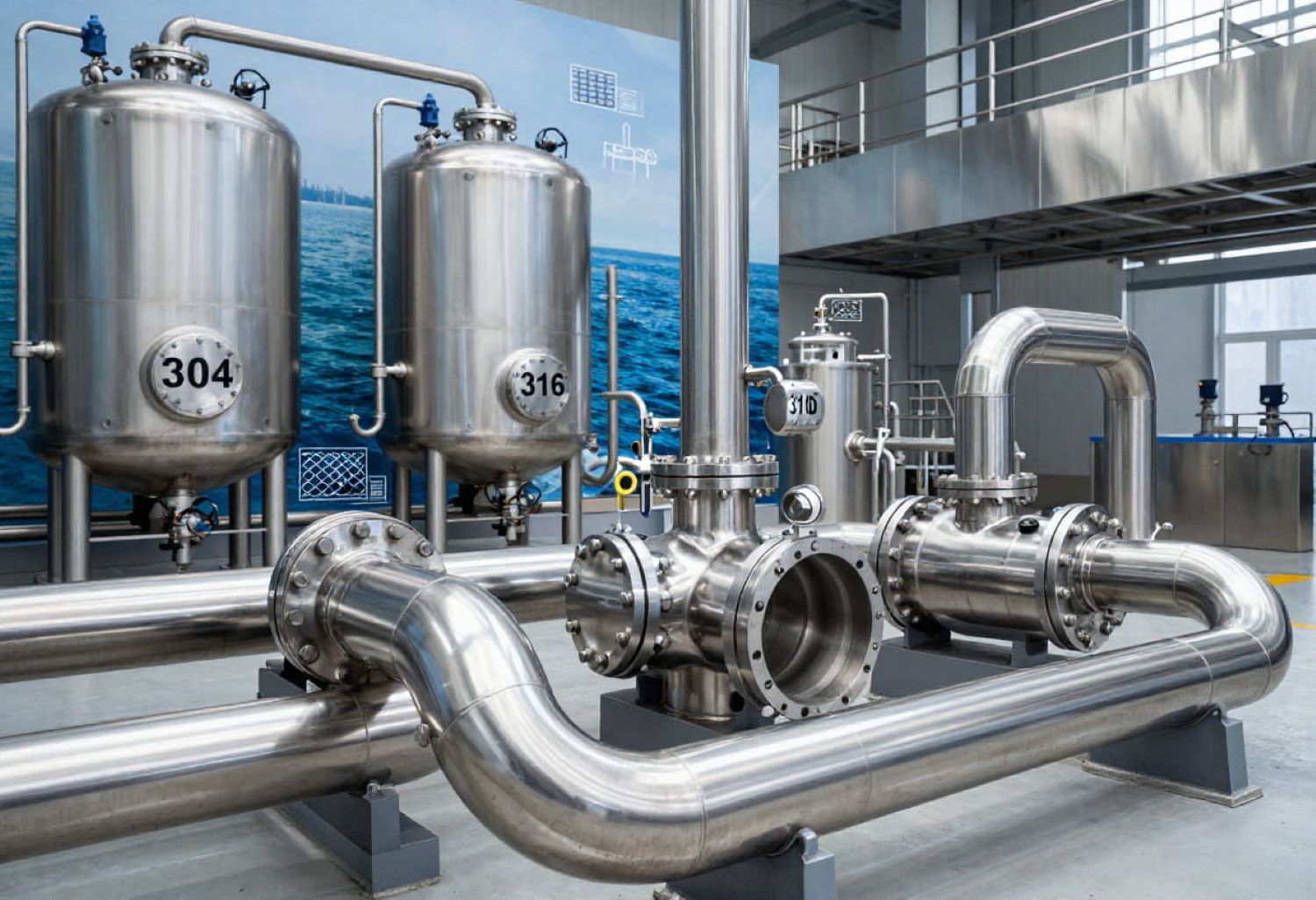
Understanding Austenitic Stainless Steel: Definition, Grades, Properties, Applications
Austenitic stainless steel is a widely used class of stainless steel known for its exceptional corrosion resistance, strength, and versatility across industries. It is characterized by a face-centered cubic (FCC) crystal structure stabilized primarily by chromium and nickel, making it suitable for demanding environments such as food processing, marine, medical, and chemical applications. According to materials industry data, austenitic stainless steels account for over 50% of global stainless steel production, with grades like 304 and 316 dominating commercial use.
This article explores what austenitic stainless steel is, its core properties, major grades, and real-world applications, followed by material selection considerations, limitations, and industry standards.
What Is Austenitic Stainless Steel?
Austenitic stainless steel is a category of stainless steel alloys defined by their austenitic microstructure, which provides high ductility, toughness, and corrosion resistance. This structure is achieved through alloying elements such as chromium and nickel, which stabilize the FCC lattice at room temperature.
Unlike ferritic or martensitic stainless steels, austenitic grades are generally non-magnetic in their annealed state and cannot be hardened through heat treatment, relying instead on cold working for strength enhancement.
Chemical Composition of Austenitic Stainless Steel
The performance of austenitic stainless steel is primarily determined by its alloying elements.
Key Alloying Elements
- Chromium (16–26%)
Forms a passive oxide layer that protects against corrosion. - Nickel (6–22%)
Stabilizes the austenitic structure and improves toughness. - Molybdenum (0–3%)
Enhances resistance to pitting and crevice corrosion, especially in chloride environments. - Carbon (≤0.08% or ≤0.03% for low-carbon grades)
Lower carbon improves weldability and reduces intergranular corrosion.
Entity–Attribute–Outcome Example:
(Chromium → forms → corrosion-resistant passive film)
Key Properties of Austenitic Stainless Steel
1. Corrosion Resistance
Austenitic stainless steel offers excellent resistance to atmospheric, chemical, and aqueous corrosion. The chromium-rich passive layer self-heals when damaged, making the material highly durable.
- Grade 316 performs especially well in marine and chemical environments due to molybdenum content.
- According to materials engineering studies, molybdenum increases pitting resistance in chloride-rich conditions by up to 3× compared to grade 304.
2. Mechanical Strength and Ductility
Austenitic stainless steels are known for their high ductility and toughness, even at extremely low temperatures.
- Retains strength at cryogenic temperatures (below –196°C)
- Can be strengthened through cold working
- Exhibits excellent impact resistance
While martensitic steels can be harder, they lack the ductility and corrosion resistance of austenitic grades—highlighting an important engineering trade-off.
3. Weldability and Fabrication
Austenitic stainless steels are among the most weldable stainless steel families.
- Low-carbon variants such as 304L and 316L reduce the risk of weld sensitization.
- Stabilized grades like 321 and 347 prevent carbide precipitation during high-temperature welding.
This makes them ideal for pressure vessels, piping systems, and fabricated structures.
4. Temperature Performance
Austenitic stainless steels maintain structural integrity across a wide temperature range.
| Temperature Range | Performance |
|---|---|
| Cryogenic | Excellent toughness |
| Ambient | Optimal corrosion resistance |
| High-temperature (up to 870°C) | Oxidation resistance |
Grades such as 310 and 310S are specifically designed for high-temperature service in furnaces and heat exchangers.
Major Austenitic Stainless Steel Grades
Austenitic stainless steels are primarily grouped within the 300 series, each grade optimized for specific performance needs.
Grade 304 / 304L
Grade 304 is the most widely used austenitic stainless steel, often referred to as 18-8 stainless steel due to its composition.
- Composition: ~18% chromium, ~8–10% nickel
- Key Benefits: General corrosion resistance, excellent formability
- Common Uses:
- Food processing equipment
- Kitchenware
- Storage tanks
- Architectural panels
304L offers lower carbon content for improved weldability.
Grade 316 / 316L
Grade 316 includes molybdenum, making it more resistant to aggressive environments.
- Key Advantage: Superior resistance to chlorides and chemicals
- Industries:
- Marine
- Chemical processing
- Pharmaceutical manufacturing
According to corrosion engineering research, 316 stainless steel can last 2–3 times longer than 304 in marine environments.
Austenitic stainless steel continues to be a cornerstone material across modern manufacturing due to its outstanding corrosion resistance, mechanical reliability, and adaptability across industries. From food processing and medical equipment to marine and chemical environments, understanding grade differences such as 304, 316, or high-alloy variants allows engineers and buyers to make informed material decisions that balance performance, durability, and cost. Selecting the right grade is not just a technical choice—it directly impacts product lifespan, safety, and long-term operational efficiency.
Grade 310 / 310S
Grade 310 is designed for high-temperature performance.
- Higher chromium and nickel content
- Exceptional oxidation resistance
- Used in furnace components, heat exchangers, and thermal processing equipment
Grade 321 and 347
These are stabilized austenitic stainless steels.
- 321: Stabilized with titanium
- 347: Stabilized with niobium
They are ideal for applications involving repeated heating cycles, such as aerospace exhaust systems and high-temperature piping.
Grade 904L
904L is a high-alloy austenitic stainless steel with copper addition.
- Outstanding resistance to sulfuric acid
- Used in chemical plants and specialty industrial applications
- Higher cost due to elevated nickel and alloy content
Applications of Austenitic Stainless Steel
Food and Beverage Industry
Austenitic stainless steel is the preferred material for hygienic environments.
- Non-reactive and easy to clean
- Complies with food safety regulations
- Grade 304 dominates food processing equipment
Chemical and Process Industries
Due to corrosion resistance, austenitic stainless steels are used in:
- Chemical storage tanks
- Heat exchangers
- Piping systems
Grade 316L is commonly specified for aggressive chemical exposure.
Marine and Offshore Applications
Marine environments expose materials to saltwater and humidity.
- Grade 316 resists pitting corrosion
- Used in boat fittings, railings, and offshore platforms
Medical and Pharmaceutical Equipment
Austenitic stainless steels are ideal for medical use because they:
- Resist sterilization chemicals
- Maintain structural integrity
- Meet biocompatibility standards
Architectural and Structural Uses
Used in:
- Facades
- Handrails
- Decorative panels
Their aesthetic finish and durability make them popular in modern architecture.
Material Selection Considerations
When selecting an austenitic stainless steel grade, engineers consider:
- Exposure environment (chlorides, chemicals)
- Operating temperature
- Weldability requirements
- Budget constraints
While higher alloy content improves performance, it also increases cost—making grade selection a balance between performance and economics.
Limitations of Austenitic Stainless Steel
Despite their advantages, austenitic stainless steels have limitations:
- Susceptible to stress corrosion cracking in specific environments
- Lower hardness compared to martensitic steels
- Higher cost due to nickel content
Understanding these trade-offs is critical for proper material selection.
Standards and Classification Systems
Austenitic stainless steels are classified using international standards:
- AISI / SAE: Common U.S. designation
- UNS: Unified numbering system (e.g., S30400)
- ASTM / EN / ISO: Performance and testing standards
These systems ensure material consistency across global supply chains.
Conclusion
Austenitic stainless steel is the most versatile and widely used stainless steel family due to its corrosion resistance, mechanical strength, and fabrication flexibility. Grades such as 304 and 316 dominate applications across food, chemical, medical, marine, and architectural industries.
Understanding the differences between grades—and matching them to operating conditions—ensures long-term performance and cost efficiency. For engineers, designers, and buyers, austenitic stainless steel remains a cornerstone material for modern industry.
At Align Manufacturing, we support manufacturers in translating material knowledge into real-world production outcomes. Whether your project involves stainless steel components, complex industrial parts, or complementary processes such as sand casting Thailand, our team focuses on precision, material suitability, and manufacturing alignment from design to delivery. By combining material expertise with regional manufacturing capabilities, Align Mfg helps ensure your components are built to perform in demanding environments—today and over the long term.