
Lost Wax Casting Process: Definition, Steps, Diagram Explanation, Applications
The lost wax casting process—also known as investment casting—is a manufacturing technique used to produce highly detailed metal components by creating a disposable wax model that is replaced with molten metal. This method has been used for over 6,000 years, from ancient bronze sculptures to modern aerospace and medical components, due to its ability to deliver exceptional precision and surface finish.
Today, lost wax casting is valued across industries for producing complex geometries, tight tolerances, and near-net-shape parts with minimal machining. In this guide, we’ll walk through the step-by-step lost wax casting process, explain each stage with diagram references, explore its advantages and applications, and address limitations and best practices.
What Is the Lost Wax Casting Process?
The lost wax casting process is a metal casting method in which a wax pattern is coated with a ceramic shell, the wax is melted out, and molten metal is poured into the resulting cavity to form a final part.
This process is especially effective for:
- Intricate shapes
- Thin walls
- Fine surface details
- Hard-to-machine metals
According to Wikipedia and multiple industrial foundries, investment casting can achieve dimensional tolerances as tight as ±0.1 mm, significantly reducing secondary machining requirements.
Why Lost Wax Casting Is Still Widely Used
The continued relevance of lost wax casting is driven by its unique combination of precision, flexibility, and material compatibility.
Key reasons industries rely on this process include:
- Ability to cast complex internal geometries
- Superior surface finish compared to sand casting
- Compatibility with ferrous and non-ferrous alloys
- Scalability from one-off art pieces to mass production
While alternative methods like die casting offer speed, they often lack the geometric freedom that lost wax casting provides.
Lost Wax Casting Process: Step-by-Step Explanation
Below is a structured breakdown of each stage in the lost wax casting process. Each step corresponds directly to common process diagrams used in manufacturing guides.
Step 1: Creating the Wax Pattern
The process begins with the creation of a wax pattern, which serves as the exact replica of the final metal part.
How it works:
- Wax is injected into a metal die or created using 3D printing
- The wax model includes all surface details, text, and geometry
- Dimensional accuracy at this stage determines final part quality
Why this step matters:
Any imperfection in the wax pattern will appear in the final metal casting. This is why high-precision wax injection and inspection are critical.
Modern foundries increasingly use 3D-printed wax or polymer patterns to improve repeatability and reduce tooling time.
Step 2: Assembling the Wax Tree (Gating System)
Once individual wax patterns are complete, they are attached to a central wax sprue to form a wax tree.
Purpose of the wax tree:
- Allows molten metal to flow evenly
- Enables multiple parts to be cast simultaneously
- Controls shrinkage and solidification behavior
Diagram reference:
In standard diagrams, this step shows multiple wax parts branching off a central channel, resembling a tree structure.
While this increases production efficiency, poor gating design can lead to defects such as porosity or incomplete fills.
Step 3: Ceramic Shell Coating
The wax tree is repeatedly dipped into a ceramic slurry and coated with fine sand or refractory material.
This step involves:
- Multiple dipping and drying cycles
- Gradual shell thickness buildup
- Use of silica or zircon-based materials
According to industrial casting suppliers, 6–9 layers are typically required to form a shell strong enough to withstand molten metal temperatures exceeding 1,400°C.
Why this step matters:
The ceramic shell becomes the final mold. Its strength, permeability, and thermal resistance directly affect surface finish and casting accuracy.
Step 4: Drying and Hardening the Ceramic Shell
After coating, the ceramic shell must fully air-dry and harden before further processing.
Key objectives of this stage:
- Remove moisture to prevent cracking
- Strengthen the shell structure
- Prepare for high-temperature exposure
This stage is often overlooked, but inadequate drying is a common cause of shell failure during metal pouring.
Step 5: Dewaxing – Removing the Wax
Once hardened, the ceramic shell undergoes dewaxing, where the wax pattern is melted and drained out.
Common dewaxing methods include:
- Steam autoclave
- Flash fire furnace
- Controlled kiln heating
The melted wax is often recovered and reused, improving sustainability.
Diagram reference:
Diagrams show molten wax flowing out of the inverted ceramic shell, leaving a hollow cavity—hence the term “lost wax.”
Step 6: Shell Firing and Mold Preparation
After dewaxing, the empty ceramic mold is fired at high temperatures to:
- Burn off wax residue
- Increase shell strength
- Preheat the mold for metal pouring
Preheating helps molten metal flow smoothly into fine details and prevents thermal shock.
Step 7: Pouring the Molten Metal
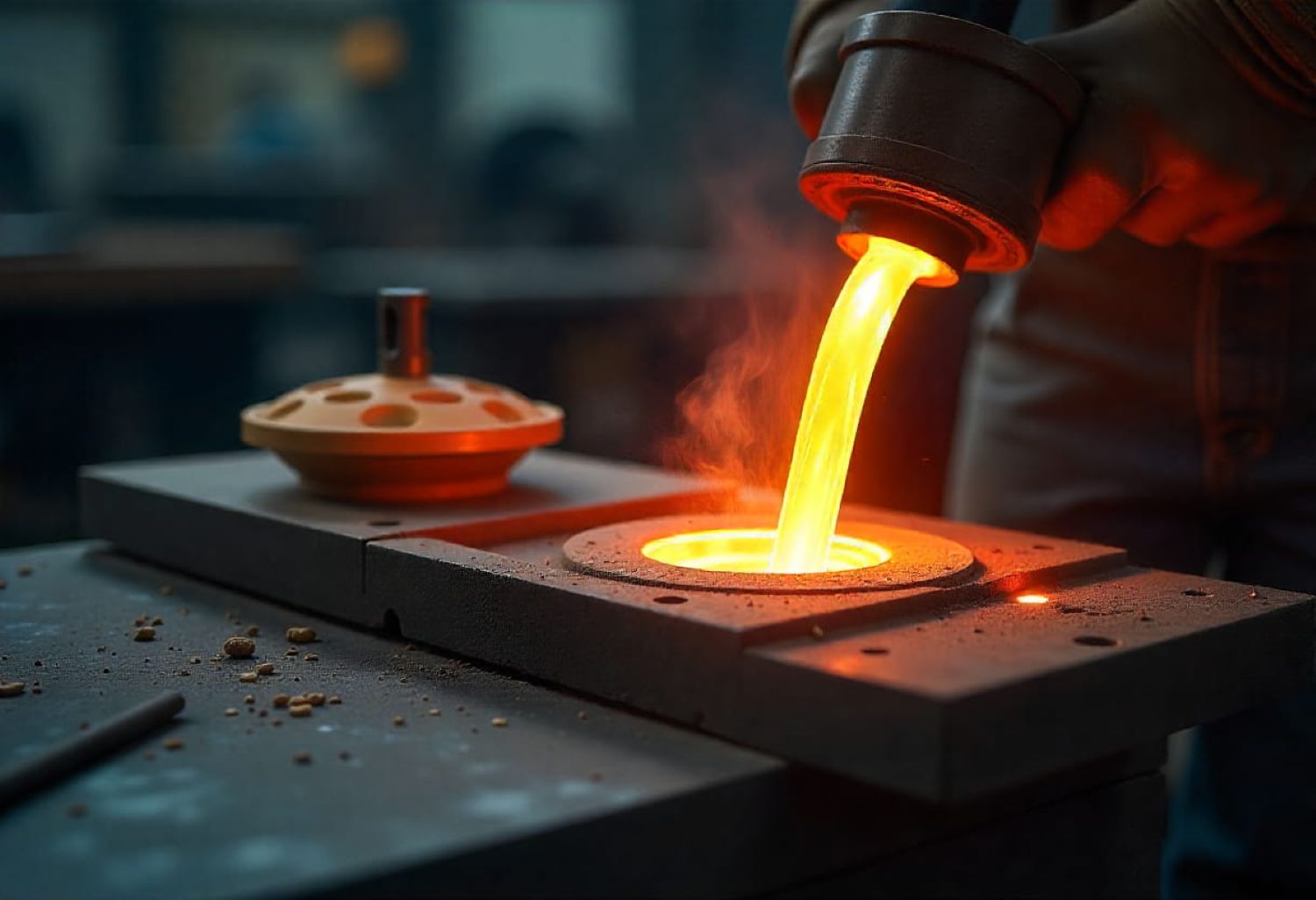
After the ceramic shell is fired and preheated, molten metal is poured into the hollow cavity left by the melted wax.
Common metals used include:
- Aluminum and aluminum alloys
- Bronze and brass
- Carbon steel and stainless steel
- Nickel-based superalloys
According to industrial casting references, metals are typically poured at temperatures ranging from 650°C (aluminum) to 1,600°C (steel and superalloys).
Why this step matters:
The temperature of both the metal and the ceramic mold determines how well fine details are filled. Poor temperature control can result in misruns, cold shuts, or surface defects.
Diagram reference:
This stage is often illustrated with molten metal flowing into the ceramic mold through the sprue system.
Step 8: Cooling and Solidification
Once poured, the molten metal is allowed to cool and solidify inside the ceramic shell.
Key factors during cooling:
- Cooling rate affects grain structure and strength
- Controlled cooling reduces internal stress
- Thicker sections cool slower than thin walls
From a metallurgical perspective, slower cooling generally improves ductility, while faster cooling can increase hardness.
Step 9: Shell Removal (Knockout Process)
After solidification, the ceramic shell is mechanically or chemically removed to reveal the raw metal casting.
Shell removal methods include:
- Vibration and hammering
- High-pressure water jets
- Chemical dissolution (for delicate parts)
Diagram reference:
Most diagrams show the ceramic shell being broken away, exposing the metal tree beneath.
This stage transitions the process from molding to finishing.
Step 10: Cutting, Finishing, and Inspection
The individual cast parts are cut from the metal tree and undergo finishing operations.
Common finishing steps include:
- Grinding and sanding
- Polishing or surface treatment
- Heat treatment for mechanical properties
- Dimensional and non-destructive testing
According to manufacturing quality standards, investment casting often achieves a surface roughness of Ra 1.6–3.2 μm, significantly smoother than sand casting.
Lost Wax Casting Diagram: Process Recap
A complete lost wax casting diagram typically includes:
- Wax pattern creation
- Wax tree assembly
- Ceramic shell coating
- Drying and hardening
- Dewaxing
- Shell firing
- Molten metal pouring
- Cooling and solidification
- Shell removal
- Finishing and inspection
Using labeled diagrams alongside each step improves understanding, especially for educational and industrial audiences.
Applications of Lost Wax Casting
Lost wax casting is widely used across multiple industries due to its precision and versatility.
Jewelry and Art
- Fine details and textures
- Custom and small-batch production
- Sculptures and ornamental pieces
Aerospace and Automotive
- Turbine blades
- Engine components
- Structural parts with tight tolerances
Medical and Industrial Equipment
- Surgical instruments
- Valve components
- Pumps and fittings
According to industry suppliers, investment casting reduces machining costs by up to 40% compared to traditional fabrication methods.
Advantages of the Lost Wax Casting Process
The benefits of lost wax casting include high accuracy, flexibility, and superior surface quality.
Key advantages:
- Excellent dimensional precision
- Ability to cast complex geometries
- Minimal material waste
- Wide range of compatible metals
These advantages make the process ideal for parts that are difficult or expensive to machine.
Limitations and Challenges
While highly effective, lost wax casting is not without drawbacks.
Potential limitations include:
- Higher upfront tooling costs
- Longer production lead times
- Not ideal for very large components
Counterpoint:
While die casting offers faster cycle times, it lacks the design freedom and material range of investment casting.
Common Defects and How to Avoid Them
Some defects can occur if the process is not properly controlled.
| Defect | Cause | Prevention |
|---|---|---|
| Porosity | Trapped gas | Proper venting |
| Cracks | Rapid cooling | Controlled cooling |
| Incomplete fill | Low pour temperature | Preheated molds |
| Surface flaws | Poor shell quality | Consistent slurry coating |
Regular inspection and process optimization significantly reduce defect rates.
Frequently Asked Questions (FAQs)
Is lost wax casting expensive?
It can be costlier upfront, but lower machining and material waste often offset initial costs.
Can lost wax casting be used for mass production?
Yes. While ideal for small batches, automated wax injection allows for scalable production.
How accurate is investment casting?
Tolerances of ±0.1 mm are common, depending on size and alloy.
Conclusion
The lost wax casting process remains one of the most reliable methods for producing complex, high-precision metal components, combining centuries-old craftsmanship with modern manufacturing control. From wax pattern creation to final inspection, each step plays a critical role in achieving consistent quality, tight tolerances, and superior surface finishes. For industries that demand reliability—such as aerospace, medical devices, and energy—this method offers a proven balance between design freedom and production efficiency, especially when supported by strong process control investment castings practices.
At Align Manufacturing, we apply this deep process understanding across a broad range of casting solutions, helping clients select the right method based on performance, cost, and application requirements. Whether you are comparing investment casting with alternatives like sand casting Thailand suppliers or evaluating regional production strategies, our team ensures every project is engineered for precision, durability, and long-term value. By combining technical expertise with regional manufacturing insight, Align Manufacturing delivers casting solutions that align seamlessly with your production goals.