
A comprehensive brass manufacturing hub covering alloy metallurgy, primary processes, secondary operations, DFM rules, QA and metrology, corrosion mechanisms, supply chain economics, sustainability, and how to partner with manufacturers.
Introduction to Brass Manufacturing Ecosystem
Brass manufacturing is a continuum: alloy design → primary shaping → machining → finishing → verification. This section defines the semantic boundaries of “brass manufacturing” (vs. copper and bronze ecosystems) and establishes how value is created from raw alloy to finished component.
What Defines Brass Manufacturing (Cu–Zn fundamentals)
Brass manufacturing consists of processes that transform copper–zinc alloys into product forms and components whose performance is determined by zinc-driven phase behavior, alloying additions, and controlled processing. Zinc content typically falls in the 5%–45% range and is the primary lever that changes ductility, machinability, hot-workability, and corrosion susceptibility.
Characteristics —
Key Material Characteristics

Machinability
Free-cutting families support high-speed turning with stable chip control.

Corrosion resistance
Brass forms protective surface films in many atmospheres, but specific mechanisms still govern failure.

Antimicrobial effect
Copper content suppresses microbial survival on touch surfaces.

Thermal/electrical behavior
Conductivity is lower than pure copper but sufficient for many connectors and housings.

Aesthetic stability
Finishing choices (polish, plating, patina) control color drift and tarnish rate.
Precision Brass Capabilities —
Where “Brass Manufacturing” Starts and Stops
Included
Cu–Zn alloy selection, forming/casting, CNC machining, finishing, joining, QA, compliance verification.
Not Included
Bronze-only manufacturing (Cu–Sn systems) unless explicitly specified as “bronze.”
Adjacent
Copper ecosystems (high-conductivity electrical copper, pure copper heat transfer) with different process drivers.
Capabilities —
The Manufacturing Value Chain
The brass value chain turns alloy chemistry into usable geometry, then converts geometry into tight tolerance, then protects function with surface engineering and validated testing. A practical way to think about this chain is: primary processes create shape, machining creates tolerance, finishing creates surface behavior, and QA proves the result.
Raw Material
alloy selection, verification, and stock preparation (bar, rod, tube, plate).
Primary Shaping
casting, forging, stamping, extrusion, cold forming.
Precision Machining
turning, Swiss machining, milling, threading.
Secondary Ops
stress relief, plating/coating, brazing/soldering, deburr.
Verification
dimensional inspection, material verification, pressure/performance tests.
Brass vs. Bronze :
Material Distinctions
Brass is defined by zinc as the principal alloying element, while bronze typically refers to copper–tin systems. This distinction is operational: Zn-driven phase changes control forming strategy in brass, while tin-centered bronzes prioritize different wear and casting behaviors.

Historical Context :
From Pittsburgh to Modern CNC
Brass production grew alongside heavy industry and later shifted toward high-repeatability CNC manufacturing. The evolution matters because modern brass supply chains are defined as much by CNC + metrology capability as by foundry capacity.
Metallurgy Fundamentals —
Brass Metallurgy
and Alloy Architecture
Metallurgy determines which manufacturing routes work, which failure modes dominate, and which compliance regimes are achievable. This parent hub provides the alloy architecture overview and routes to alloy-specific deep dives.
Phase Metallurgy —
Alpha vs Beta Phase Metallurgy
Metallurgy determines which manufacturing routes work, which failure modes dominate, and which compliance regimes are achievable. This parent hub provides the alloy architecture overview and routes to alloy-specific deep dives.
Alpha
single-phase solid solution; high ductility; excellent cold working.
Alpha–Beta
duplex; stronger; hot-forming-friendly; cold workability reduced.
Process implication
phase selection sets whether deep drawing or hot forging is the most stable route.
High-Machinability Brass —
Free-Cutting Machining Alloys (C360, C385)
Free-cutting brasses are optimized for chip control, surface finish consistency, and cycle-time reduction in turning centers and Swiss machines. Composition changes (lead, silicon, bismuth) primarily affect chip breakage and tool wear behavior.
C36000
(Free-Cutting Brass)
- Use case: high-volume precision machining, threaded parts, fittings, valves.
- Why it works: stable chip formation supports fast feeds and consistent finishes.
C388500
(Architectural Bronze / Brass family)
- Use case: architectural hardware, forged shapes with finish machining.
- Why it works: balances machinability with appearance and corrosion needs.
Eco-Brass Capabilities —
Lead-Free Alloy Innovations
(C693, LFBR)
Lead-free brass families exist to meet potable-water and environmental restrictions while retaining high machinability. Silicon- and bismuth-based formulations replace lead-driven chip control and are paired with verification practices to prove compliance.
C69300
(ECO BRASS)
silicon brass used widely for lead-free potable-water components.
LFBR families
designed to meet low-lead thresholds while remaining production-feasible.
Global Specifications —
Global Specification Standards
Brass specifications differ by region but map through designation systems (UNS, DIN/EN, ISO) that define chemistry windows and product forms. When part requirements cross borders, specifying the standard identifier and revision locks material equivalency and prevents supply-chain ambiguity.
UNS
(North America)
C36000, C46400, C69300, etc.
Common reference system in ASTM-linked procurement.
DIN / EN / ISO
(EU + International)
Examples: CuZn39Pb3 equivalents for free-cutting families.
Frequently used in European drawings and supply.
Key Alloy Comparison Table
| C36000 | Free-cutting machining brass | Chip control + high throughput turning | Fittings, threaded inserts, valve stems, connectors |
| C38500 | Architectural brass family | Appearance + formability + machinability | Architectural hardware, forged blanks + machining |
| C46400 | Naval brass | Marine corrosion control | Marine fasteners, hardware, seawater fittings |
| C48500 | Marine-oriented, higher machinability | More machining flexibility than C464 | Marine-related machined parts, fittings |
| C69300 | Lead-free silicon brass | Compliance + machinability | Potable-water components, lead-free fixtures |
Primary Methodologies —
Primary Manufacturing Methodologies
Primary processes create the part’s base geometry. This section compares methods and provides selection logic. Child pages should contain process execution detail, parameters, and case examples.
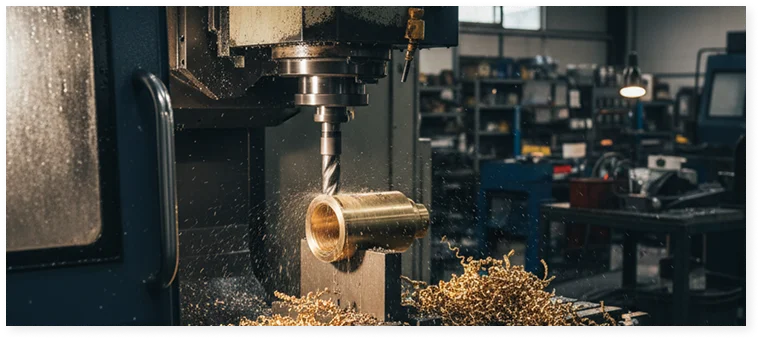
CNC Machining and Precision Turning
CNC machining produces brass components with predictable dimensional control because toolpaths and fixturing constrain variation into measurable tolerance bands. Free-machining alloys support high cutting speeds without unstable chip formation, making turning and Swiss machining common for precision parts.
- Standard CNC turning: Ggeneral-purpose components, fittings, valve bodies.
- Swiss CNC: long/slender parts where guide bushing support reduces deflection.
- 5-axis milling: reduces setups for complex geometries and improves datum consistency.
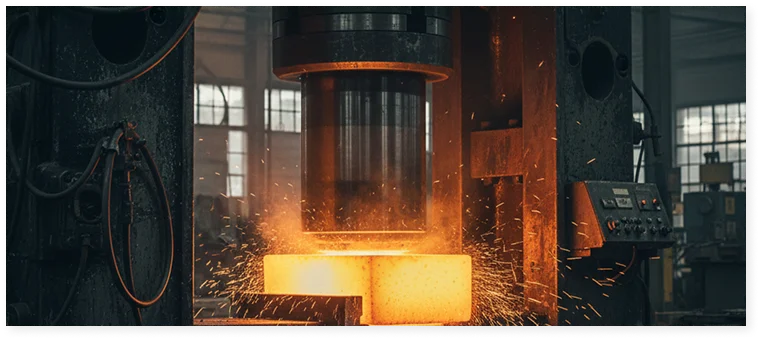
Forging and Hot Working
Forging increases structural integrity through controlled plastic deformation, often improving mechanical continuity relative to casting when parameters are managed. Forgings typically use finish machining for sealing features and threads.
- Hammer forging: flexible shapes at lower tooling investment.
- Press forging: better repeatability at medium/high volume.
- Roll forging: long shapes (stems/rods) with favorable grain flow.
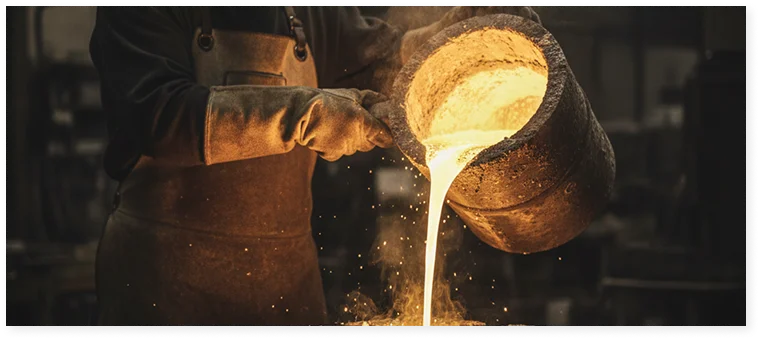
Casting Technologies
Casting forms brass geometry by solidifying liquid metal into near-net shapes. It enables complex 3D forms but requires control of shrinkage, porosity, hot tearing, and machining allowances where tight datums are required.
- Investment casting: best for intricate shapes and thinner sections with better surface finish.
- Sand casting: economical for larger parts with wider tolerances.
- Note on die casting: often associated with zinc alloys; “true brass” die casting is uncommon compared with other routes.
Stamping and Cold Forming
Stamping and cold forming deliver high throughput for sheet and wire-based brass components. Design must respect bend radii, grain direction, and residual stress to prevent cracking and stress corrosion issues.
- Progressive die stamping: connectors, brackets, shields at high rate.
- Cold heading: fastener-like features without material removal.
- Deep drawing: cups/enclosures; cartridge brass families are typical.
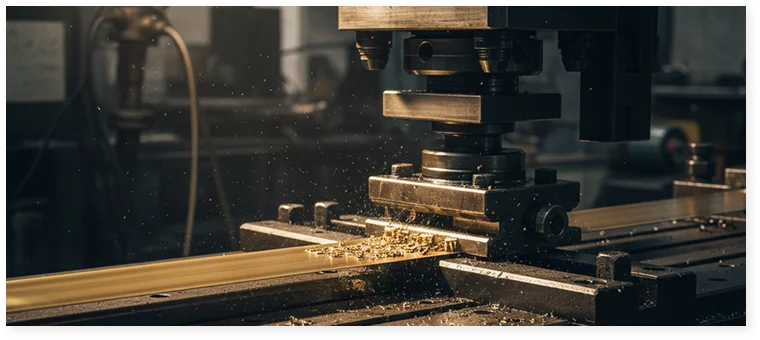
Extrusion for Architectural Profiles
Extrusion produces continuous brass profiles with consistent cross-sections and is widely used for architectural sections and long bars. Critical datums are often finish-machined when tight tolerance systems are required.
- Direct extrusion: common, cost-effective, die-limited complexity.
- Indirect extrusion: reduced friction; better for complex hollows; higher tooling cost.
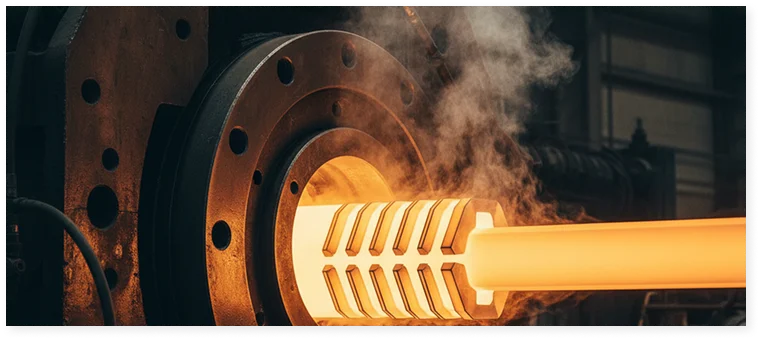
Process Selection Matrix
Process selection is a decision tree driven by measurable requirements: volume, tolerance, geometry, surface needs, and compliance. Use this matrix to route readers to method-specific child pages.
| Best volume range | Low → medium | Medium → high | Low → high | high | Medium → high |
| Geometry strength | Complex features | Strong net-shapes | Highly complex 3D | Sheet/wire forms | Continuous profiles |
| Tolerance strategy | Direct to spec | Machine critical faces | Machine datums | Controlled by tooling | Machine datums |
| Tooling economics | Low fixture cost | Higher die cost | Medium tooling | Highest tooling | Die cost varies |
Global Specifications —
Decision Framework
1. <1,000/YEAR
CNC for flexibility and fast iteration.
2. 1,000–10,000/year
evaluate forging vs casting based on geometry + strength.
3. >10,000/year
stamping (sheet/wire) or investment casting for complex volume.
4. Tight tolerances
CNC or forge/cast + finish machining on datums.
5. Continuous profile
extrusion + machining where required.
Secondary Operations —
Secondary Operations and Post-Processing
Secondary operations convert shaped blanks into finished components by controlling surface behavior, stress state, join integrity, and functional threading performance.
Surface Engineering and Finishes
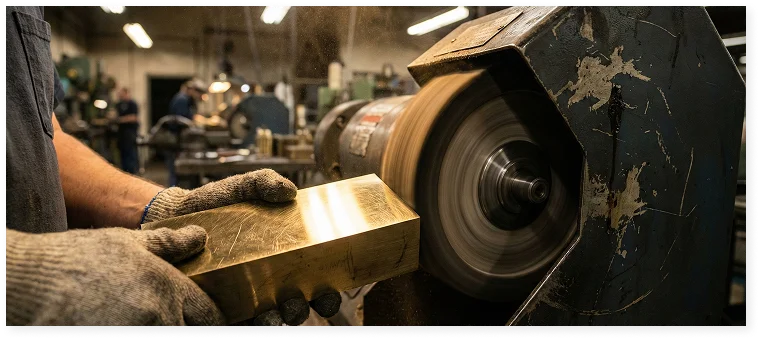
Surface engineering changes how brass behaves in service by altering friction, corrosion kinetics, contact behavior, and appearance stability. Finishes also consume tolerance; design must separate cosmetic areas from datum-critical surfaces.
Mechanical finishes
- Polishing (decorative reflectivity)
- Brushing (satin texture)
- Tumbling (deburr + uniform matte)
- Blasting (texture + bonding prep)
Coating systems
- Electroplating (Ni/Cr, Ag, etc.)
- Powder coating (durable color film)
- PVD (wear-focused thin films)
Heat Treatment and Stress Relief
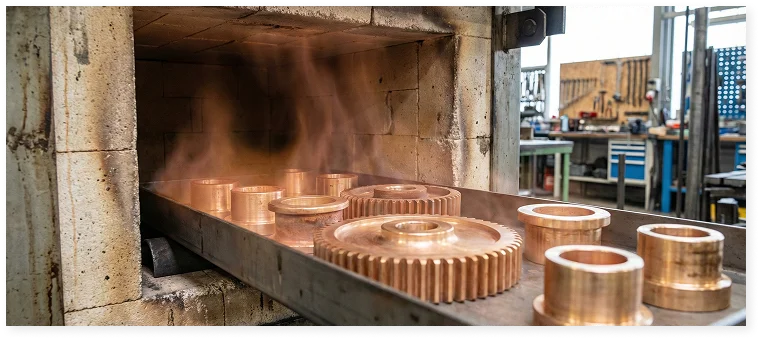
Heat treatment in brass is primarily used to control ductility and residual stress rather than “hardening.” Stress relief reduces crack risk after cold work and stabilizes geometry before finishing.
- Stress relief: reduces residual stresses from forming and machining.
- Anneal: restores ductility to enable additional forming.
Joining Methods: Brazing, Soldering, and Welding
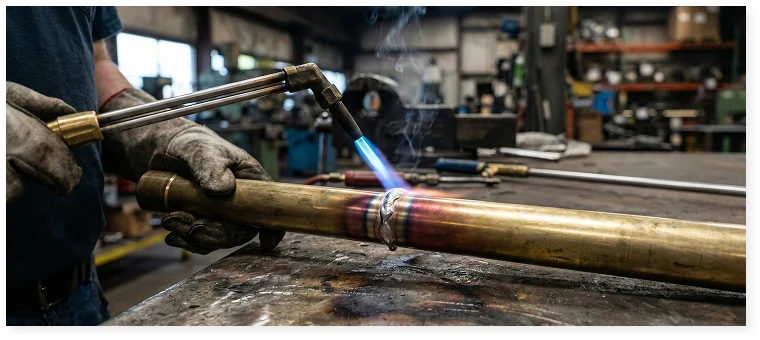
- Joining method selection controls leak integrity and long-term durability in assemblies. Brazing is common for brass because it provides strong joints without melting the base metal, while soldering is used for lower-temperature applications. Welding is possible but requires controls for zinc behavior and fume management.
- Brazing: fluid systems, HVAC, fuel lines, brazed manifolds.
- Soldering: electronics and low-pressure joints (lead-free where required).
- Welding: specialized applications with controlled parameters.
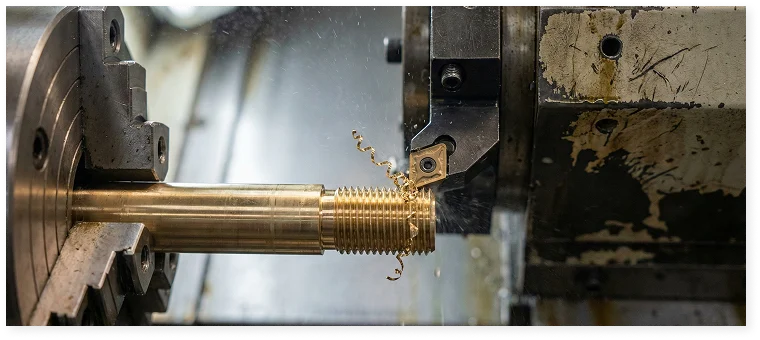
Precision Threading Strategies
Thread strategy influences strength, fatigue performance, and pressure integrity. Rolling forms threads by displacing material, while cutting removes material; the best choice depends on geometry, ductility, and the pressure boundary role of the thread.
- Thread rolling: better surface integrity and fatigue behavior when feasible.
- Thread cutting: needed for internal/blind features and low-volume flexibility.
DFM Fundamentals —
Design for Manufacturability
(DFM) in Brass
DFM rules are the cross-process “glue” that prevents scrap and rework. This section covers geometry constraints, tolerance communication, wall thickness strategy, and cost-reduction design patterns that apply across brass processes.
Geometric Guidelines —
Geometric Design Guidelines
(casting draft, forging radii, machining undercuts)
Geometry drives manufacturability because each brass process has different forbidden features. Draft supports mold release, radii support metal flow in forging, and tool access rules dictate machining feasibility.
Casting-Focused Rules
- Draft: add draft on vertical walls to enable clean release.
- Fillets: avoid sharp internal corners to reduce hot spots and tearing.
- Allowance: plan machining for critical datums
Machining-Focused Rules
- Avoid tool-inaccessible pockets or undercuts when possible.
- Minimize part re-orientation (reduce setups).
- Group features that share tools and datum references.
Dimensional Control —
Tolerance Standards and GD&T
(ISO 2768-f vs. m; brass machinability)
Tolerances should be communicated in a recognized system so suppliers and inspectors interpret them consistently. General tolerances cover noncritical dimensions while GD&T controls functional relationships like position and concentricity.
General Tolerances
reserve tight numbers for functional features; let noncritical dimensions float.
Datum Strategy
datums should reflect how the part locates and seals in assembly.
Inspection Match
align tolerance tightness with metrology capability.
Wall Thickness Guidelines —
Wall Thickness and Section Variations
(thin-wall distortion prevention)
Wall thickness consistency improves stability. Abrupt transitions amplify distortion in casting and strain localization in forming. Thin-wall pressure boundaries also reduce corrosion margin; design should add thickness where selective leaching risk exists.
- Use gradual thickness transitions to reduce hot spots and warpage.
- Prefer uniform sections for forming repeatability.
- Design sealing faces with sufficient stiffness to resist distortion during torque and pressure.
Design for Manufacturability —
Cost-Reduction Design Strategies
(setups, standard stock, machining allowances)
Brass part cost is dominated by material utilization, cycle time, setup count, and inspection burden. Designs that minimize setups and standardize stock sizes reduce cost without changing performance.

Minimize setups
keep critical features reachable in one orientation.

Standardize stock
avoid custom diameters unless necessary.

Separate cosmetic from functional
specify finishes only where they matter.
Quality & Metrology —
Quality Assurance and Metrology
QA verifies that dimensions, material identity, and performance match requirements. The most reliable brass QA plans bind inspection strategy to datums, thread standards, surface roughness, and chemistry verification.

Quality Control Framework
A brass QA framework combines dimensional inspection, composition verification, and application-specific testing. This prevents the most common escapes: incorrect alloy, out-of-spec threads, sealing surface mismatch, and unverified compliance.
Metrology Protocols —
Dimensional Inspection Protocols
(CMM, thread gauging, surface roughness)
Dimensional inspection proves fit and function by validating the tolerance chain that controls alignment, sealing, and assembly torque. Best practice is to define datums and inspection approach early because metrology feasibility constrains design choices.
CMM
for complex geometry and repeatable measurement programs.
Thread Gauging
GO/NO-GO for production, plus profile checks where needed.
Surface Roughness
Ra/Rz verification for sealing and sliding interfaces.
Material Verification —
Material Verification
(OES spectroscopy, XRF for RoHS)
Material verification prevents compliance and performance failures by confirming alloy composition rather than trusting labels. OES is typically used for precise chemistry confirmation; XRF is often used for quick screening of restricted substances.
OES
used for certification-grade chemistry verification.
XRF
rapid screening for restricted elements and incoming inspection.
Plated Parts
verify both bulk alloy and coating layers when requirements apply per layer.
Performance Testing —
Pressure and Performance Testing
(hydrostatic testing for valve components)
Pressure testing validates leak integrity and structural margin for brass components used in fluid control. When a part contains threads, brazed joints, or thin-wall pressure boundaries, pressure tests become a design requirement, not merely a final check.
Hydrostatic testing
confirms leak integrity under controlled load.
Pneumatic testing
higher leak sensitivity for gas-tight applications.
Markets We Serve —
Industry Applications and Vertical Markets
Brass selection changes by vertical because requirements shift: potable-water compliance, conductivity, marine corrosion behavior, aesthetic finish stability, or pressure integrity. Use these vertical sections as navigation nodes to use-case content.
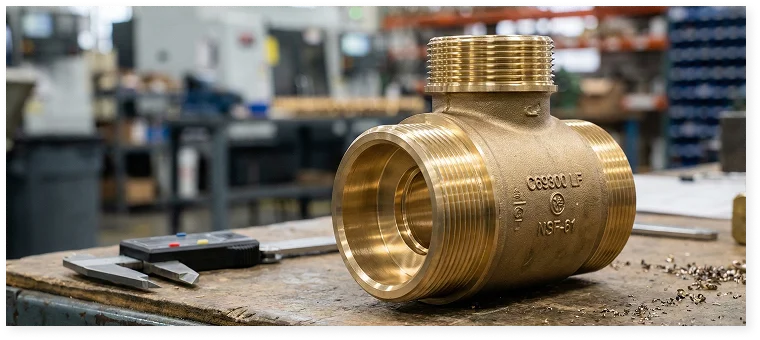
Plumbing and Potable Water Systems
Potable-water brass succeeds only when alloy selection and verification align with lead limits and corrosion resistance requirements.
Critical Considerations
- NSF/ANSI 61 certification pathways
- Lead-free alloys (e.g., C693 families) where required
- DZR strategy for aggressive water chemistry
Electronics and Electrical Engineering
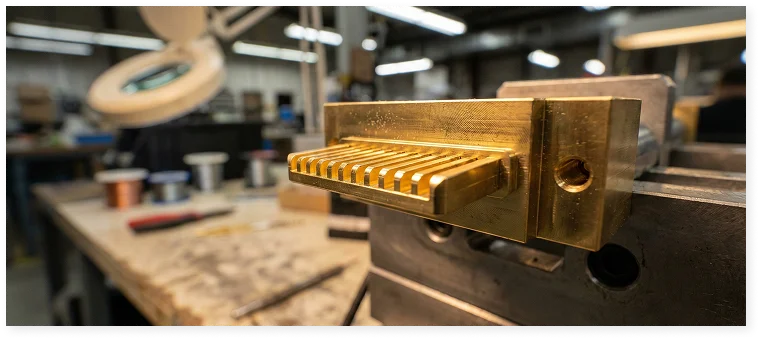
Electrical applications use brass when designers need manufacturability plus adequate conductivity and durable contact surfaces.
Critical Considerations
- Plated contacts for wear and conductivity consistency
- RoHS-compliant material verification and documentation
- Micro-precision machining for connectors and terminals
Marine and Offshore Environments
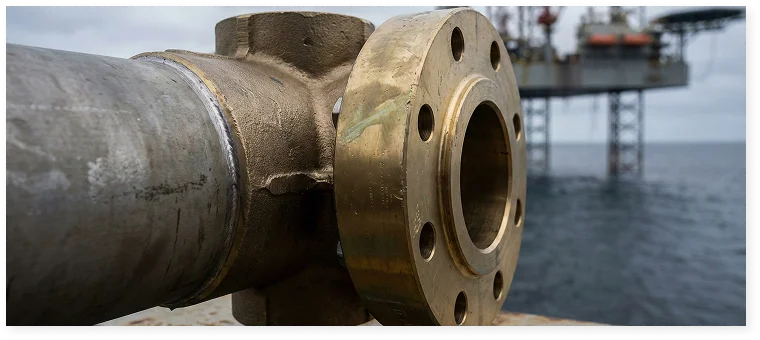
Seawater corrosion presents extreme challenges requiring specialized alloys and designs.
Critical Considerations
- C46400 naval brass for seawater exposure
- Cathodic protection for mixed-metal systems
- Biofouling resistance
Architectural and Historic Restoration
Architectural brass is driven by finish stability, matching, and fabricability across long profiles and decorative features.
Critical Considerations
- Aesthetic finishes (polish, patina, plated systems)
- Hardware matching for restoration projects
- Profile extrusion + localized machining strategy
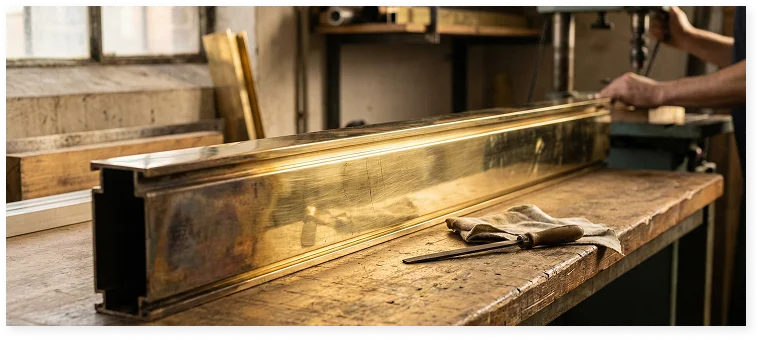
Thermal Management
Thermal applications use brass when corrosion resistance and manufacturability outweigh the need for maximum conductivity.
Critical Considerations
- Heat exchanger parts and cooling system fittings
- Surface finish and cleanliness for heat transfer efficiency
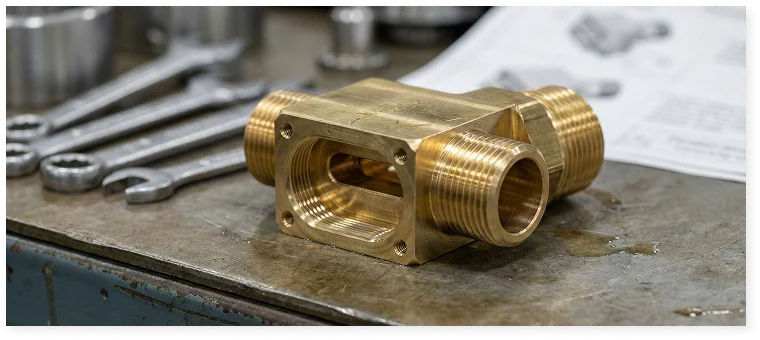
Defense and Munitions
Defense brass commonly relies on deep drawing and controlled ductility for cartridge and formed components.
Critical Considerations
- Deep drawing strategy (multi-draw with controlled work hardening)
- Stress management and anneal schedules
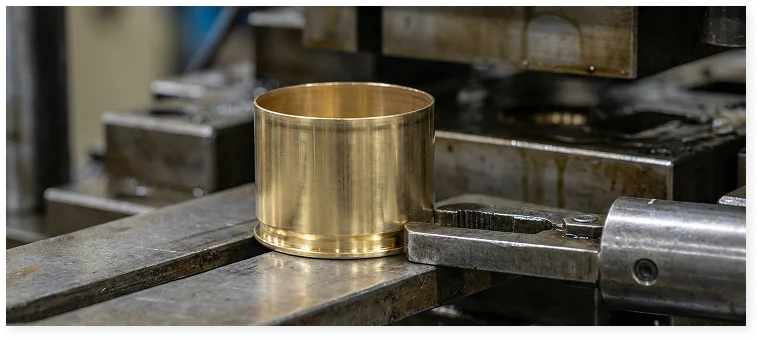
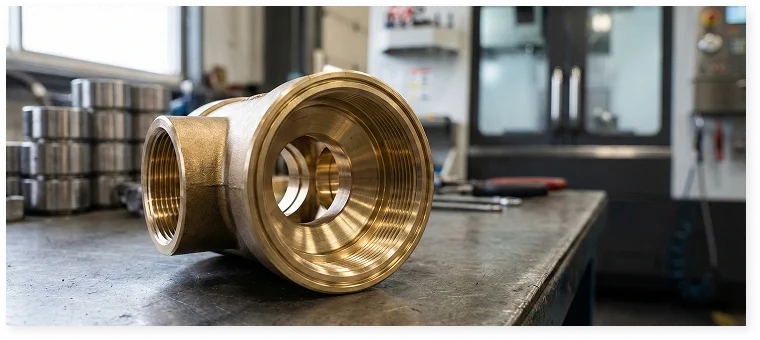
Industrial Fluid Control
Fluid control parts depend on sealing surfaces, thread integrity, and verified pressure performance.
Critical Considerations
- Machining + inspection for tight sealing datums
- Brazed assemblies for manifolds and subassemblies
- Hydrostatic/leak testing where pressure boundary exists
Sourcing & Cost Control —
Corrosion Mechanisms and Material Compatibility
“Corrosion resistance” is not one thing in brass; it’s a set of specific mechanisms with different mitigations. This section organizes corrosion risks so engineers can choose alloys, finishes, and assembly rules that prevent failure.
Corrosion Resistance in Brass
Brass corrosion performance depends on alloy chemistry and environment. Protective films help in many atmospheres, but water chemistry and mixed-metal coupling introduce different degradation patterns.
Dezincification and Selective Leaching
Dezincification removes zinc selectively and leaves a porous copper-rich residue, reducing strength and pressure integrity. DZR strategies use alloy selection and validation tests to control depth and progression.
Critical Considerations:
- Use dezincification-resistant alloys where chloride or aggressive water chemistry exists
- Design thickness margins for long service life
- Verify resistance by appropriate standards/testing pathways
Galvanic Corrosion in Mixed-Metal Systems
Galvanic corrosion occurs when brass is electrically coupled to a dissimilar metal in an electrolyte. Risk rises when a small brass area is paired against a large, more noble cathode area.
Critical Considerations:
- Use dielectric isolation where possible
- Control area ratios and electrolyte pathways
- Use coatings strategically to break electrical continuity
Failure Mode Analysis
Failure mode analysis ties physical signatures to root causes (dezincification vs SCC vs galvanic attack) and feeds design and process changes upstream where outcomes can actually be changed.
Critical Considerations:
- Document the environment (water chemistry, temperature, stress state)
- Connect crack morphology to SCC vs mechanical overload
- Verify alloy chemistry and compare to spec
Sourcing & Supply Chain —
Supply Chain Strategy
and Economics
Brass manufacturing economics are dominated by material cost (copper content), yield, cycle time, and tooling amortization. This section covers sourcing strategy, cost controls, and scrap recycling as an operating advantage.
Domestic Manufacturing Value
Domestic manufacturing can improve responsiveness and verification control when programs require tight tolerance, compliance documentation, and fast iteration between design and production.
Raw Material Cost Management
Brass pricing sensitivity is driven by copper market movement. Cost management strategies separate fabrication cost from metal-indexed price exposure and reduce variance through purchasing and inventory policies.
- LME-indexed pricing structures
- Long-term supply agreements
- Inventory strategies aligned to program cadence
Production Efficiency —
Manufacturing Economics
(cycle time, tooling, utilization)
Manufacturing economics are controlled by measurable drivers: material utilization, cycle time, setup count, inspection burden, and tooling amortization. Programs that standardize stock and reduce setups lower cost without sacrificing function.
Cost drivers
- Material utilization (chips/turnings and scrap rate)
- Cycle time (feeds/speeds, tool life, machine utilization)
- Setup count (fixtures, re-orientation)
- Tooling amortization (dies, molds, checking aids)
Cost-control tactics
- Design for fewer operations
- Use general tolerances for noncritical dims
- Batch strategically to reduce changeovers
- Specify finish only where needed
Scrap Recycling and Circular Economy
Brass is well-suited to circular material loops because chips and turnings retain high copper value. Segregating scrap by alloy family prevents contamination and increases recovery value.
- Segregate chips/turnings by alloy family
- Document recycling streams for traceability and sustainability reporting
Prototyping & Scaling —
Prototyping through Production
Brass programs succeed when prototyping proves manufacturability and testing early, then scaling introduces tooling and control plans without losing dimensional and material consistency.
Rapid Prototyping Services
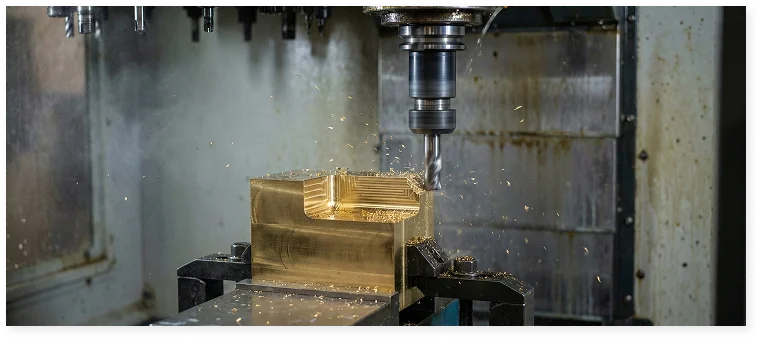
Rapid prototyping commonly uses CNC machining because it delivers production-representative alloy behavior and surface response without waiting on hard tooling.
- CNC prototypes from solid bar/plate
- Pattern routes that feed investment casting when geometry demands it
Scaling to Volume Production
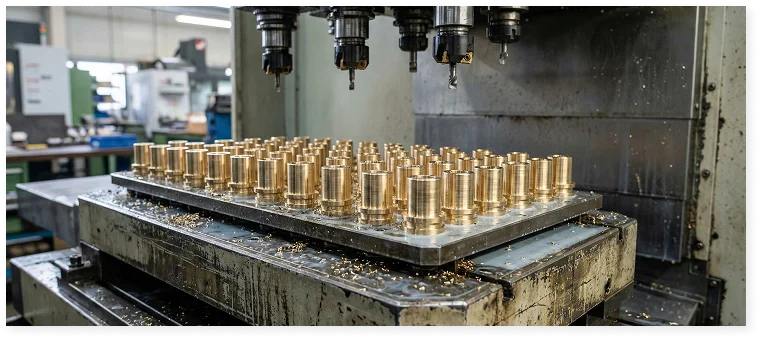
Scaling to volume changes the cost structure: the program moves from flexible setups to repeatable tooling, fixtures, and validated processes. Quality planning must scale with throughput.
- Fixture strategy and multi-spindle / automation decisions
- Control plan development and first-article approval
Tooling Economics —
Tooling Considerations for Volume
(die life, fixture amortization)
Tooling decisions dominate volume economics. Die design, wear monitoring, and checking aids determine amortized cost and dimensional stability. Programs should formalize tooling assumptions and monitoring cadence.
- Stamping die strategy: maintenance and sharpening intervals
- Forging dies: wear-driven drift and process windows
- Fixtures and checking aids: repeatability and measurement alignment
Sustainability Standards —
Sustainability and Regulatory Compliance
Compliance determines market access: potable water regulations, RoHS/REACH requirements, and environmental expectations influence alloy choice, verification method, and documentation requirements.

Lead-Free Compliance (RoHS, REACH)
Lead-free compliance requires both selecting appropriate alloy families and verifying composition and restricted substances where applicable. Coatings can introduce additional compliance considerations as separate layers.
- RoHS restrictions for electronics supply chains
- REACH communication obligations where SVHC thresholds apply
Potable Water Certifications
Potable-water components require certification pathways that address both composition and leaching performance. Documentation is part of the deliverable, not optional paperwork.
- NSF/ANSI certification pathway for potable-water contact
- Lead-free alloy selection and verification plan

Environmental Manufacturing Practices
Environmental practices are most defensible when they are operationally measurable: scrap recovery, recycled content, coolant reuse, energy efficiency, and documented waste minimization.
- Closed-loop chip recycling programs
- Coolant management and waste reduction
- Energy-efficient equipment upgrades
Sourcing & Supply Chain —
Working with Brass Manufacturers
Partner selection determines whether the program ships parts that meet dimensional, material, and compliance requirements at production rate. This section defines what to evaluate and how to structure quality agreements.
Supplier Selection —
Selecting a Manufacturing Partner
Selecting a brass manufacturer is a capability audit across process, metrology, and documentation. The best fit supplier demonstrates repeatable process control, verified material pathways, and clear communication on tolerances, finishes, and testing.
- Equipment fit: CNC/Swiss/forging/casting/stamping as required
- In-house QA: CMM, thread gauging, roughness measurement
- Material verification: OES/XRF capability or validated external lab
- Documentation: material certs, inspection reports, traceability
Design Support Capabilities
Design support reduces cost and failure risk because DFM adjustments made before programming or tooling eliminate downstream rework. Strong manufacturers formalize this as part of quoting and prototyping.
- Design review and manufacturability feedback
- Material selection guidance tied to environment and compliance
- Process recommendation with cost/tolerance tradeoffs
Quality Agreements —
Quality Agreements
and PPAP
Quality agreements and PPAP-style packages reduce risk by forcing alignment on the design record, control plan, inspection approach, and material verification before volume shipments begin.
Common PPAP elements
(For Brass Programs)
- Design records and drawing revision control
- Process flow + PFMEA + control plan
- Dimensional results tied to datums (CMM reports)
- Material certs + verification method (OES/XRF)
- Performance tests where required (leak/pressure)
- Part submission warrant / approval record

At Align Manufacturing, we pride ourselves on our commitment to producing quality metal parts. Our experienced team utilizes equipment and processes to ensure each component meets the highest standards of precision and reliability.
We continuously strive to innovate and improve our methods, ensuring that our clients receive parts that not only meet but exceed their expectations in performance and durability. With a focus on excellence and customer satisfaction, Align MFG remains a trusted partner for all your metal needs.
contact us —
ready
to discuss?

WE'RE A DEDICATED TEAM OF LOCAL PROFESSIONALS PASSIONATELY COMMITTED TO FUELING YOUR PROJECT'S SUCCESS. Our team is dedicated to maintaining a keen eye for detail in every aspect of the process, from design to delivery. Simultaneously, we prioritize clear, consistent communication with you to ensure that your vision and requirements are fully understood and met.