
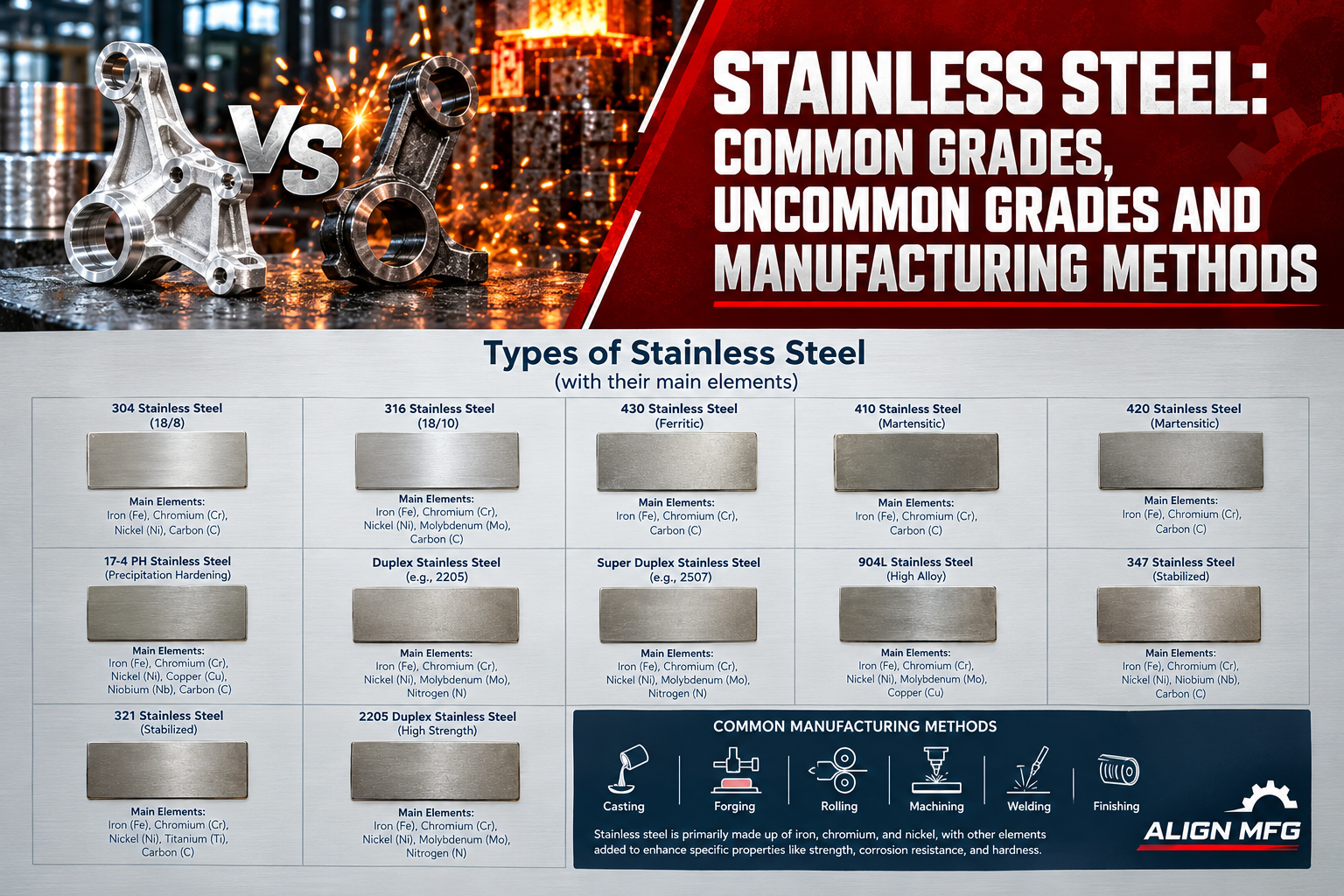
Stainless Steel: Common Grades, Uncommon Grades and Manufacturing Methods
What makes steel “stainless”
Steel becomes stainless when it contains at least 10.5% chromium. The chromium reacts with oxygen to form a passive layer on the surface only a few nanometres thick. If that layer is scratched, it re-forms on its own in the presence of air. That self-healing layer is why stainless resists rust without paint or plating.
Other elements tune the performance. Nickel improves toughness and formability. Molybdenum raises resistance to chlorides and seawater. Nitrogen adds strength. Carbon increases hardness but can reduce corrosion resistance.
Those recipes fall into five families:
| Family | Structure | Magnetic? | Hardenable by heat treatment? | Typical grades |
|---|---|---|---|---|
| Austenitic | Nickel-chromium | No (slightly after cold work) | No, only by cold work | 304, 316, 321 |
| Ferritic | Chromium only, low carbon | Yes | No | 409, 430 |
| Martensitic | Chromium with higher carbon | Yes | Yes | 410, 420, 440C |
| Duplex | Half austenite, half ferrite | Yes | No | 2205, 2507 |
| Precipitation hardening (PH) | Chromium-nickel with copper, niobium or aluminium | Yes | Yes, by ageing | 17-4 PH, 15-5 PH |
The common grades
Seven grades cover the large majority of stainless parts we quote.
| Grade | Family | Key traits | Typical uses |
|---|---|---|---|
| 304 (1.4301) | Austenitic | The all-rounder: 18% chromium, 8% nickel, easy to form and weld | Food equipment, enclosures, brackets, fasteners |
| 316 / 316L (1.4401 / 1.4404) | Austenitic | Adds 2 to 3% molybdenum for chloride resistance; “L” = low carbon for welding | Marine hardware, chemical plants, pumps, valves |
| 410 (1.4006) | Martensitic | Heat-treatable to high hardness, moderate corrosion resistance | Shafts, spacers, valve trim, cutlery |
| 420 (1.4021) | Martensitic | More carbon than 410, harder and more wear-resistant | Surgical tools, pump shafts, moulds |
| 430 (1.4016) | Ferritic | Low-cost, no nickel, good indoors | Appliance trim, sinks, decorative panels |
| 17-4 PH (1.4542) | Precipitation hardening | High strength with 304-like corrosion resistance | Aerospace fittings, oil and gas components, pump parts |
| 2205 (1.4462) | Duplex | About twice the yield strength of 316, excellent chloride resistance | Offshore, desalination, pressure vessels, structural parts |
The choice usually comes down to three questions: how corrosive is the environment, how strong or hard must the part be, and does it need welding?
The uncommon grades, and when you need them
Specialist grades cost more and are harder to source, but they solve problems the common grades cannot.
| Grade | Family | Why you would choose it |
|---|---|---|
| 303 | Austenitic | Added sulphur makes it the easiest stainless to machine. Trade-off: weaker corrosion resistance and poor weldability. |
| 416 | Martensitic | The free-machining version of 410 for high-volume turned parts. Not suitable for cold forging. |
| 440C | Martensitic | Highest hardness of any common stainless (around 58 HRC). Used for bearings, valve seats and knife blades. |
| 15-5 PH | Precipitation hardening | A cleaner, tougher cousin of 17-4 PH, preferred in aerospace for its properties across the grain. |
| 2507 (super duplex) | Duplex | Even higher strength and pitting resistance than 2205. Built for seawater, subsea equipment and aggressive chemicals. |
| 904L | Super austenitic | High nickel and copper for sulphuric and phosphoric acid service. |
| 254 SMO (6Mo) | Super austenitic | About 6% molybdenum for chloride-heavy environments such as bleach plants and seawater cooling systems. |
| Nitronic 50 / 60 | Nitrogen-strengthened austenitic | Nitronic 50 combines high strength with corrosion resistance. Nitronic 60 resists galling, so it suits sliding and threaded parts. |
| CF8 / CF8M | Cast austenitic | The cast equivalents of 304 and 316. Important for valve and pump bodies made by casting. |
A practical note: cast and wrought versions of the “same” grade are covered by different standards and have different minimum properties. When a drawing calls out 316, confirm whether the part will be cast (CF8M) or machined and forged from bar (316).
How stainless parts are made
The right process depends on the part’s shape, size, volume and the properties it needs. Most real parts combine two or more of these.
| Process | Best for | Strengths | Watch-outs |
|---|---|---|---|
| Investment casting | Complex shapes, 10 g to 50 kg | Near-net shape, fine detail, little machining | Tooling cost; porosity must be controlled; cast grades differ from wrought |
| Sand casting | Large, heavier parts such as pump and valve bodies | Low tooling cost, very large sizes possible | Rougher surface, looser tolerances, more machining |
| Hot forging | Load-bearing parts: flanges, fittings, levers | Excellent strength and fatigue life from the grain flow | Die cost; draft angles; needs machining to finish |
| Cold forging / cold heading | High-volume small parts: fasteners, spacers, pins | Fast, very little waste, work-hardened strength | Stainless hardens quickly and needs special lubricants and annealed wire |
| CNC machining | Precision features, prototypes, low to medium volume | Tight tolerances, no tooling | Stainless is slow to cut and wears tools; material waste from bar |
| Laser cutting, stamping and bending | Brackets, plates, enclosures | Low cost, fast turnaround | Minimum bend radii; duplex needs larger radii than 304 |
| Metal injection moulding (MIM) | Tiny, intricate parts under about 100 g at high volume | Complex geometry, net shape | High tooling cost; size limits |
| Additive manufacturing (3D printing) | Prototypes, complex internal channels | No tooling, design freedom | High cost per part; usually needs HIP and machining |
Secondary processes complete the part:
- Heat treatment (solution annealing, hardening, ageing) sets strength and hardness.
- Hot isostatic pressing (HIP) closes internal porosity in castings for critical parts.
- Pickling and passivation remove surface iron and restore the protective chromium layer after machining or welding.
- Electropolishing gives a smooth, hygienic finish for food and pharmaceutical equipment.
- Coating (paint, powder or PTFE) adds colour or extra protection where required.
Why stainless steel is worth it
Stainless costs more per kilogram than carbon steel, but it often costs less over the life of the part.
- Corrosion resistance without coatings. The passive layer protects the whole part, including cut edges and scratches, where paint and plating fail first.
- Strength across a wide temperature range. Austenitic grades stay tough at cryogenic temperatures, and many grades hold their strength well above 500°C.
- Hygiene. A smooth, non-porous surface is easy to clean, which is why stainless is standard in food, beverage and medical equipment.
- Low maintenance. No repainting, no replating and fewer replacements mean lower lifecycle cost, especially in outdoor, marine and washdown environments.
- Strength-to-weight options. Duplex and PH grades let you design thinner, lighter parts for the same load.
- Recyclability. Stainless is fully recyclable, and new stainless typically contains a high proportion of recycled scrap.
It is not perfect. Stainless can suffer pitting and crevice corrosion in chlorides if the grade is too low. It can gall when stainless threads run against stainless. It is harder to machine than carbon steel, and nickel and molybdenum prices move with the market. Choosing the right grade for the environment prevents almost all of these problems.
Choosing the right grade and process
Start with the environment, then the load, then the volume.
- Environment: indoors and dry points to 304 or 430. Outdoors, washdown or coastal points to 316. Seawater or chemicals point to duplex 2205, super duplex 2507 or a super austenitic grade.
- Load and wear: high hardness points to 410, 420 or 440C. High strength with good corrosion resistance points to 17-4 PH or duplex.
- Volume and shape: complex shapes suit casting. Load-bearing parts suit forging. High-volume small parts suit cold heading or MIM. Precision features and low volumes suit CNC machining.
- Documentation: ask for mill test certificates (EN 10204 3.1) showing chemistry and where the steel was melted, especially for regulated or export-controlled work.
At Align Manufacturing, we source precision stainless components for customers in oil and gas, trucking and trailer, construction, railway, food and beverage, and industrial machinery. The same question comes up on almost every project: which stainless grade, and which manufacturing process? This guide covers the grades you see every day, the specialist grades that solve harder problems, how stainless parts are actually made, and why stainless is so often worth the higher price per kilogram. Get in touch https://alignmfg.co/contact/