
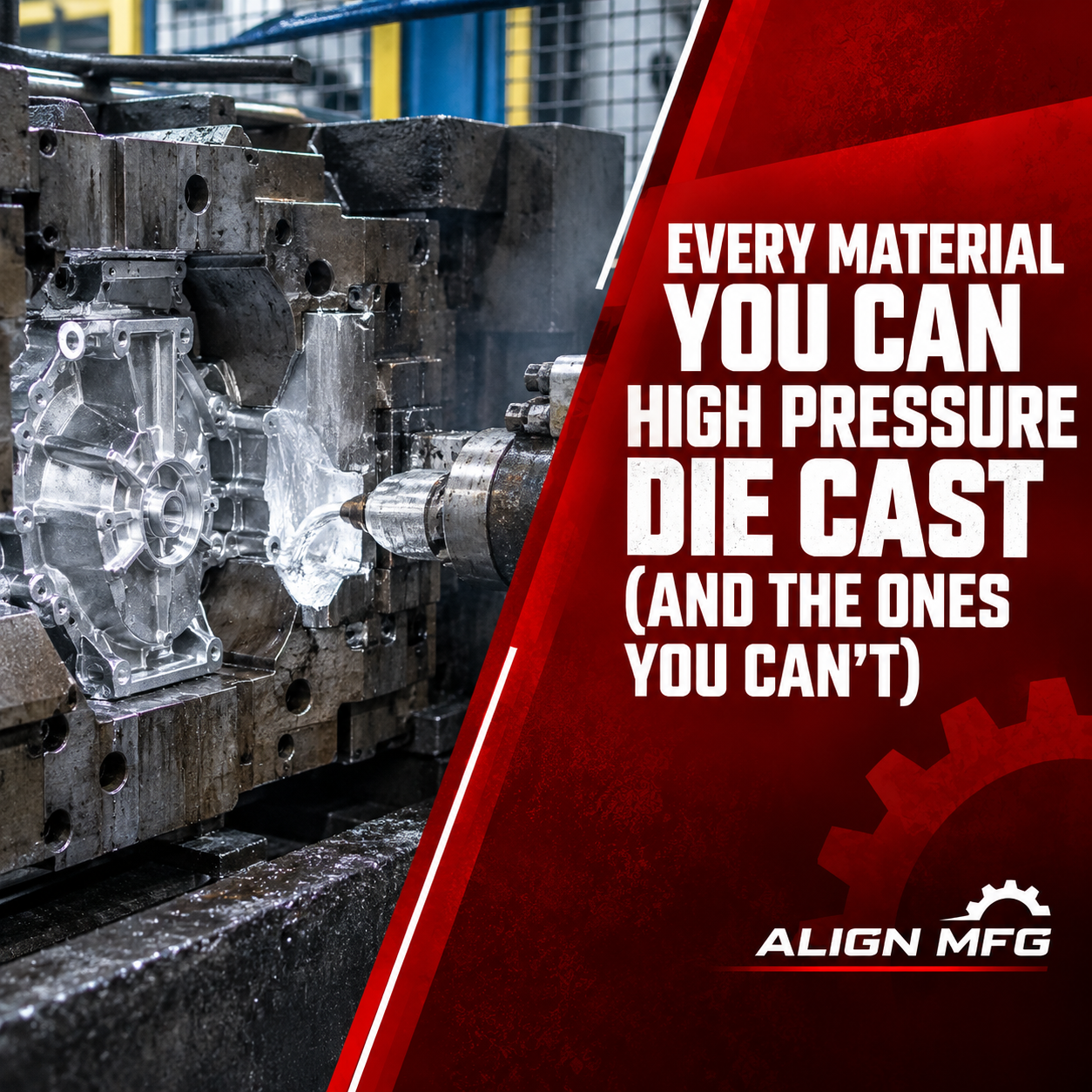
Every Material You Can High Pressure Die Cast (and the Ones You Can’t)
High pressure die casting (HPDC) forces molten metal into a hardened steel die at pressures from 1,500 to 25,000 psi and holds it there until it solidifies. The process is fast, repeatable, and produces thin walls and tight tolerances that sand and investment casting cannot touch. But it only works with a narrow family of metals. The die is steel, and anything that melts hot enough to attack steel, or that oxidises violently in air, is either impossible or uneconomic. Here is the full list of what can be die cast, what each alloy is good for, and where the limits sit.
How the process constrains the material
There are two machine types, and the material picks the machine.
Hot chamber machines keep the injection system submerged in the molten metal. They cycle fast (up to 900 shots an hour on small parts) but the gooseneck and plunger sit in the melt, so the alloy has to melt low enough not to dissolve them. That means zinc, magnesium, lead and tin.
Cold chamber machines ladle each shot into a separate sleeve. Slower, but the melt never touches the injection mechanism, so higher-melting alloys work. That means aluminium, copper alloys, and magnesium when the foundry prefers it.
Every material below falls into one camp or the other.
1. Aluminium alloys (cold chamber)
The workhorse. Roughly 80 percent of die castings by weight are aluminium. Low density, good corrosion resistance, decent strength, excellent thermal and electrical conductivity, and a die life of 100,000 to 150,000 shots.
- A380 / ADC12 / EN AC-46000. The default alloy worldwide. Good castability, good mechanical properties, machines well. If a drawing says “aluminium die cast” with no grade, this is what you get. Gearbox housings, brackets, pump bodies, heat sinks.
- A383 / ADC12Z. A380 with more silicon for better die fill on intricate, thin-wall parts. Slightly lower strength.
- A360 / ADC3. Lower copper, higher silicon. Better corrosion resistance and pressure tightness than A380. Marine hardware, hydraulic components.
- A413 / ADC1. Near-eutectic silicon. The best fluidity of the group, used for thin walls and pressure-tight castings. Lower strength.
- A356 and A357. Normally permanent-mould alloys, but die castable with vacuum. Heat treatable, higher ductility.
- Structural alloys: AlSi10MnMg (Silafont-36), Aural-2, Castasil-37, Mercalloy 367. Low iron, high ductility, heat treatable or self-hardening. Used for automotive shock towers, subframes, and the large single-piece “gigacasting” body structures. These need vacuum HPDC and a foundry that understands them; not every shop can run them.
- Recycled-content and secondary alloys. Most ADC12 in Asia is secondary (scrap-based). Fine for non-structural work, but if your customer specifies primary alloy or a maximum iron content, say so at RFQ stage.
Limits: aluminium is not heat treatable in conventional HPDC because entrapped gas blisters at solution temperatures. Fatigue strength is modest. Welding die castings is unreliable for the same gas reason. If the part needs T6 properties or welding, vacuum-assisted HPDC or a different process.
2. Zinc alloys (hot chamber)
Zinc melts at around 385°C, which means fast cycles, long die life (a million shots is common), and the finest detail and thinnest walls of any die cast metal. Zinc castings can hold ±0.025 mm on small features and are often used as-cast with zero machining.
- Zamak 3 (ZnAl4). The standard. Best balance of strength, ductility, and dimensional stability. Most zinc castings in the world are Zamak 3.
- Zamak 5 (ZnAl4Cu1). Copper addition for higher strength and hardness at some cost in ductility and creep. Hardware, gears, automotive trim.
- Zamak 2 (ZnAl4Cu3). Highest strength and hardness of the Zamaks. Used for tooling and wear applications, but ages and loses ductility over time.
- Zamak 7. A high-purity Zamak 3 with reduced magnesium for better fluidity and surface finish. Decorative and plated parts.
- ZA-8. 8 percent aluminium. Hot chamber castable, higher strength than Zamak 5, good bearing properties.
- ZA-12 and ZA-27. Higher aluminium content, higher strength, but the melting point rises enough that they are usually cold chamber alloys. ZA-27 approaches cast iron strength at a third the weight but is harder to cast consistently.
Zinc is the answer when the part is small, complex, needs plating, or needs a die that lasts forever. It is heavy (about 2.5 times aluminium), loses strength above 90°C, and creeps under sustained load, so it is wrong for anything structural that gets warm.
3. Magnesium alloys (hot or cold chamber)
The lightest structural metal you can die cast, about two thirds the density of aluminium. Excellent castability, exceptional damping, and a very good strength-to-weight ratio. Cycle times beat aluminium because magnesium has lower heat content per shot, and die life is longer because magnesium does not solder to steel the way aluminium does.
- AZ91D. The general-purpose alloy. Good strength, castability, and corrosion resistance (for magnesium). Laptop and camera bodies, power tool housings, automotive brackets.
- AM60B. Higher ductility and impact strength than AZ91D at some cost in tensile strength. Steering wheels, seat frames, instrument panels, anything that has to survive a crash.
- AM50A. More ductile again. Same applications where energy absorption matters most.
- AS41B and AE44. Creep-resistant grades for parts that see sustained load at 150 to 200°C, such as transmission housings and engine brackets.
The catch is corrosion. Magnesium is the most anodic structural metal, so galvanic contact with steel fasteners in a wet environment eats the casting. Every magnesium part needs a conversion coating or paint, and the fastener strategy has to be designed in. Melt handling also requires cover gas (SF6 or SO2 alternatives), which not every foundry is set up for.
4. Copper alloys: brass and bronze (cold chamber)
Yes, brass can be die cast, but it is a specialist process. Melting points are 900°C and above, which means die life drops to 5,000 to 20,000 shots and the dies are built from premium hot-work steels or tungsten alloys. Cycle times are long because the die has to be cooled aggressively.
- C85800 (yellow brass). The most common die cast brass. Plumbing fittings, valve bodies, decorative hardware.
- C87800 (silicon brass). Better castability and strength, lower lead. The go-to for lead-free potable water fittings.
- C86500 (manganese bronze). High strength for marine hardware.
- C99700 and C99750. Die cast “white bronze” alloys used as a nickel-free substitute for plated finishes.
Die cast brass makes sense when the part is small, the volume is high, and machining from bar or sand casting cannot hit the price. Below a few tens of thousands of pieces a year, sand or investment casting almost always wins.
5. Lead and tin alloys (hot chamber)
Historically die cast for bearings, radiation shielding, battery terminals, and printing type. Still done, but rarely. Lead die casting is restricted by RoHS and environmental rules in most markets, and tin alloys are mostly limited to specialised bearing shells and pewter. Include them for completeness, not because you will be quoting them.
What cannot be high pressure die cast
- Steel and iron. Melting points above 1,400°C destroy any steel die within a handful of shots. There are experimental processes using ceramic and refractory metal dies, but nothing commercial at scale. Ferrous parts are sand cast, investment cast, or forged.
- Titanium. Same die-life problem, plus titanium reacts with almost everything at melt temperature. Investment casting under vacuum only.
- Nickel and cobalt superalloys. Vacuum investment casting.
- High-strength wrought aluminium (2xxx, 6xxx, 7xxx). Not die cast in conventional form; hot shortness and hot tearing. Semi-solid (thixocasting, rheocasting) processes can handle some of them, but that is a different process family.
Choosing between them
Ask four questions in order.
- What temperature does the part see in service? Above 90°C rules out zinc. Above 150°C narrows magnesium to the creep grades and aluminium to the standard grades.
- What is the wall thickness and feature detail? Under 1 mm walls or fine cosmetic detail point to zinc. Structural sections over 3 mm point to aluminium or magnesium.
- What is the annual volume? Brass and magnesium need volume to justify their tooling and process cost. Zinc dies last so long that tooling amortises almost to nothing at high volume.
- What happens after casting? Plating favours zinc. Welding or T6 heat treatment means vacuum HPDC or a different process. Threaded inserts and galvanic exposure complicate magnesium.
Most industrial parts, the housings, brackets, manifolds, and covers that make up the bulk of what we quote, land on ADC12 or A380 aluminium. Zinc takes the small, precise, plated components. Magnesium and brass show up when weight or corrosion requirements force them. Knowing where the boundaries sit before the drawing goes out to a foundry saves a round of requoting, because a foundry will cast what you ask for and let you find out later that it was the wrong alloy.