What Is Casting? Metal Process, Methods, and Key Steps
What Is Metal Casting?
Metal casting is a manufacturing process that forms a part by pouring molten metal into a mold cavity, letting it solidify, and removing the solid shape. The mold supplies the part’s geometry; a pattern, used to create the mold, accounts for features such as shrinkage and the space needed for cores. Vesuvius plc estimated that global casting production reached 112 million tonnes in 2024, including 86 million tonnes of ferrous castings and 26 million tonnes of non-ferrous castings.
How does casting shape molten metal in a mold?
A mold holds a negative impression of the intended part, and a gating system directs molten metal into that cavity. Gravity, low pressure, or high pressure moves the metal, depending on the process. The metal then cools into the cavity’s shape, including details that would be difficult or expensive to machine from solid stock. Leister’s process guide describes the same sequence of pattern creation, mold preparation, melting and casting, cooling, and demolding.
How does metal casting differ from film and television casting?
In manufacturing, casting means shaping liquid material inside a mold; in film and television, casting means selecting performers for roles. The shared word describes two unrelated activities. This article uses “casting” to mean metal casting.
What is casting in art and jewelry making?
Artists and jewelers use casting to reproduce a designed form in metal, often through a mold made from a model or a wax pattern. In lost-wax investment casting, the wax pattern is replaced by a cavity in a ceramic shell before molten metal fills it. The method suits small, detailed forms, while production choices still depend on alloy, quantity, and acceptable finishing work.
What is casting?
In manufacturing, casting is the operation of forming a component by filling a mold with liquid metal and allowing the metal to become solid. The mold may be expendable, such as a sand mold, or reusable, such as a metal die. That distinction affects tooling cost, achievable detail, and how readily a process supports repeated production.
What is casting in art?
In art, casting translates a sculpted or modeled original into a metal object by transferring its shape to a mold and filling that mold with molten material. The artist may preserve the original pattern or use a sacrificial one, as in lost-wax work. The same physical principle applies in industry, though manufacturing also weighs repeatability, tolerances, and production rate.
Is CNC better than casting?
Neither process is universally better: CNC machining removes material from a solid workpiece, while casting forms the basic geometry by filling a mold. CNC is often a fit for precise features, prototypes, or lower quantities that don’t justify dedicated tooling; casting is often a fit for complex shapes, larger runs, or parts that would waste substantial stock if machined from solid. A common production route combines both: cast near-net shape, then machine critical surfaces.
How does casting work?
The foundry prepares a pattern and mold, melts and conditions the selected alloy, fills the cavity, and controls cooling until the metal solidifies. Workers then remove the casting, cut off gates and risers, clean the surface, and inspect features against the drawing. The exact sequence varies with the process and material, but the pattern-to-inspection path remains a useful high-level map.
How does steel casting work?
Steel casting uses molten steel and a mold designed to withstand the alloy’s high pouring temperature and manage feeding as the metal contracts during solidification. A foundry selects the mold system and alloy around the component’s geometry and performance needs; after solidification, it removes the mold material and may heat-treat or machine the casting. Solidification control matters because shrinkage, gas porosity, inclusions, and incomplete filling can compromise a casting.
What is casting in jewelry making?
Jewelry casting turns a small pattern into a metal piece, often using the investment process to capture fine surface detail. The wax pattern is enclosed in investment material and removed to leave a cavity; molten metal fills that cavity, then the solid piece is separated and finished. Fine detail doesn’t eliminate finishing: sprues, surfaces, and openings may still need cleanup.
Which casting method is best?
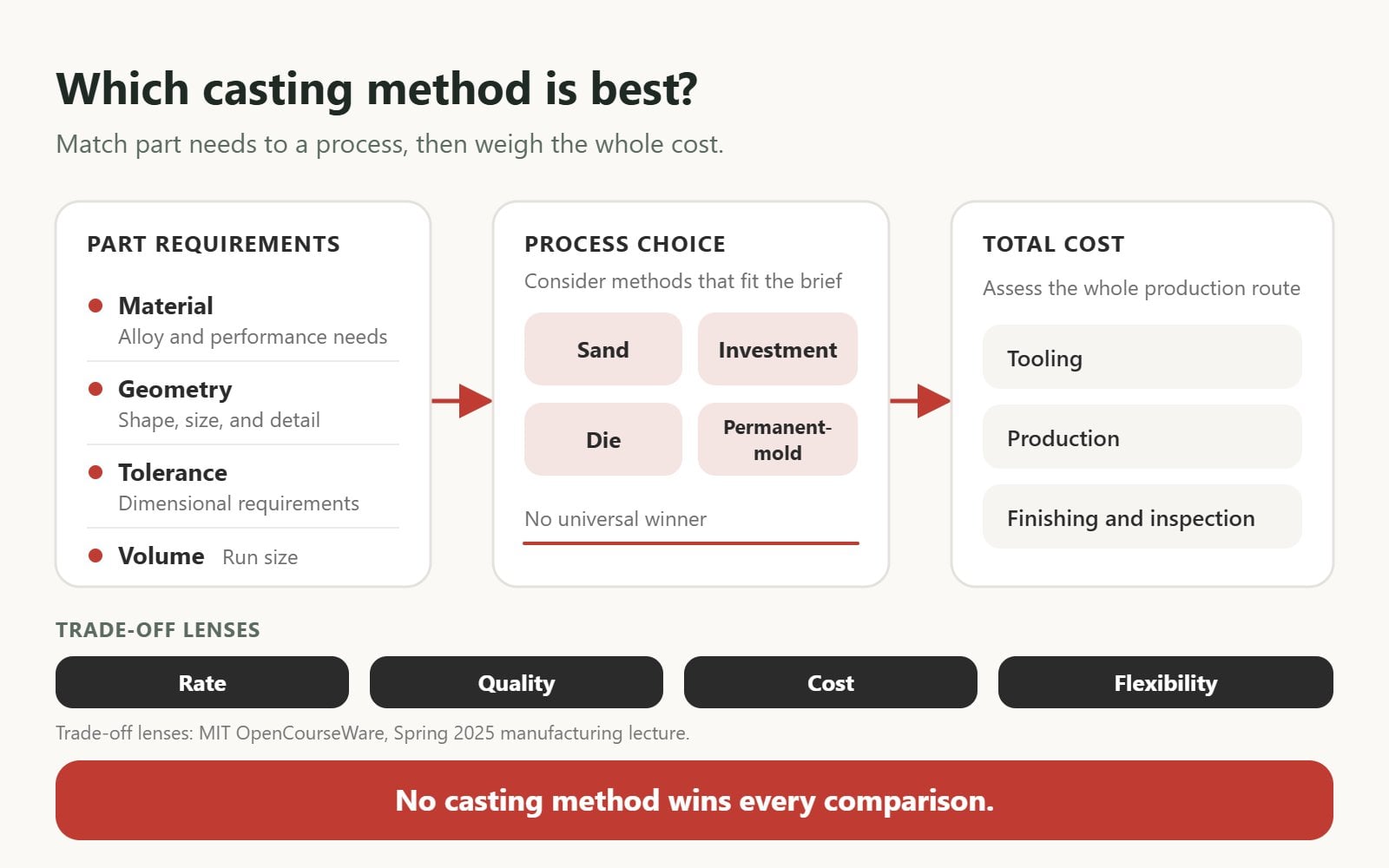
The best method is the one that meets the part’s material, geometry, tolerance, and volume requirements at an acceptable total cost. Sand casting offers adaptable tooling and can accommodate large parts; investment casting targets intricate geometry and detail; die casting supports repeatable, high-volume production of suitable alloys. No process wins every comparison.
What are the four types of metal casting?
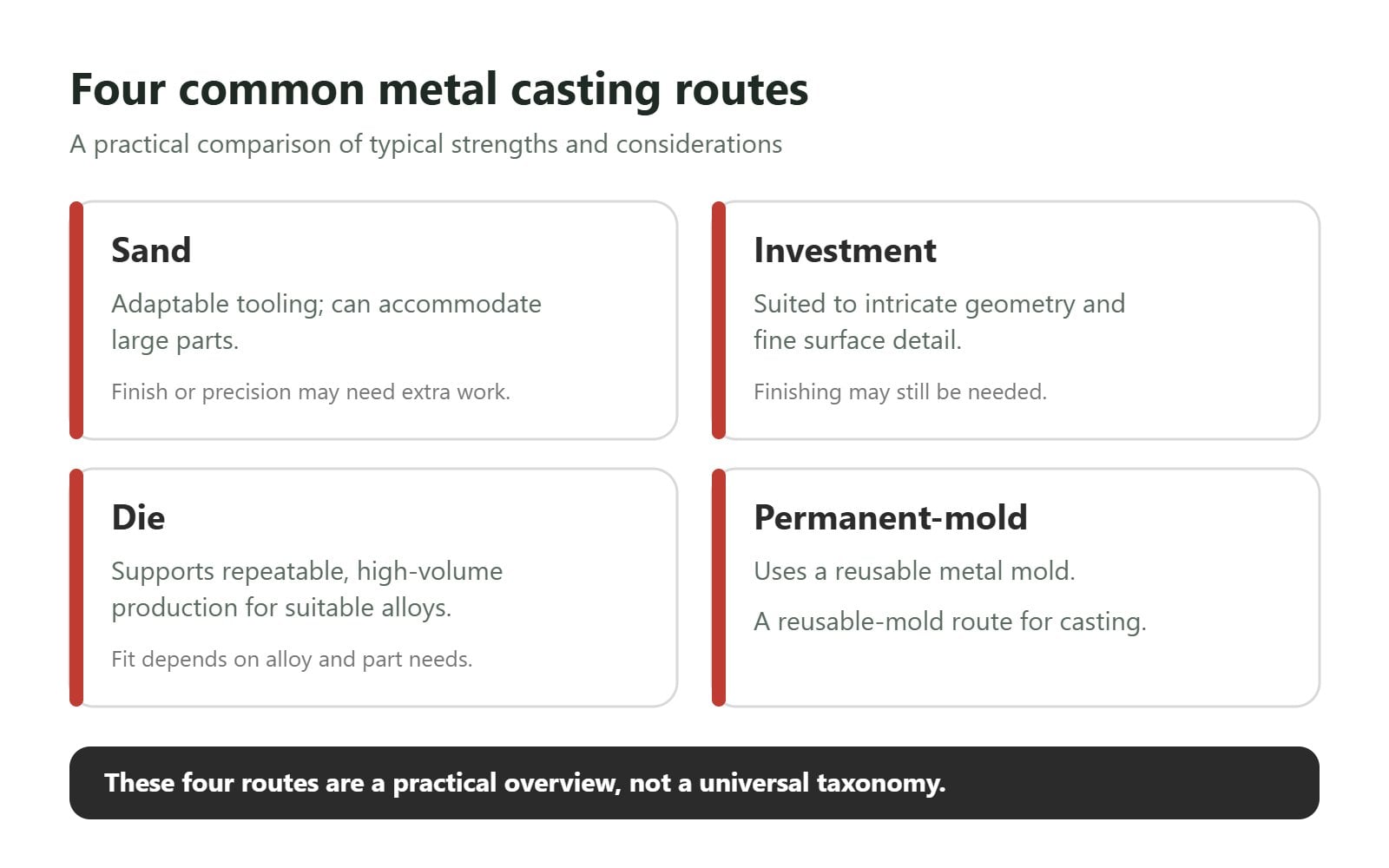
A practical four-process overview is sand casting, investment casting, die casting, and permanent-mold casting. These labels describe common manufacturing routes, not a universal scientific taxonomy: foundry references also distinguish processes by mold material, filling pressure, alloy, or production setup. ASM International’s 2025 aluminum-casting chapter, for example, surveys seven routes, including sand, permanent-mold, die, counter-pressure, and squeeze casting.
Which one of the following casting processes is the most widely used?
There isn’t a single defensible answer across every metal, product, and market. Sand casting is the broad traditional choice because it accommodates varied shapes and sizes, while die casting is a major option for repeat production of suitable non-ferrous parts. The right answer depends on what is being counted—global tonnage, number of parts, or a particular material and industry.
How Does the Metal Casting Process Work?
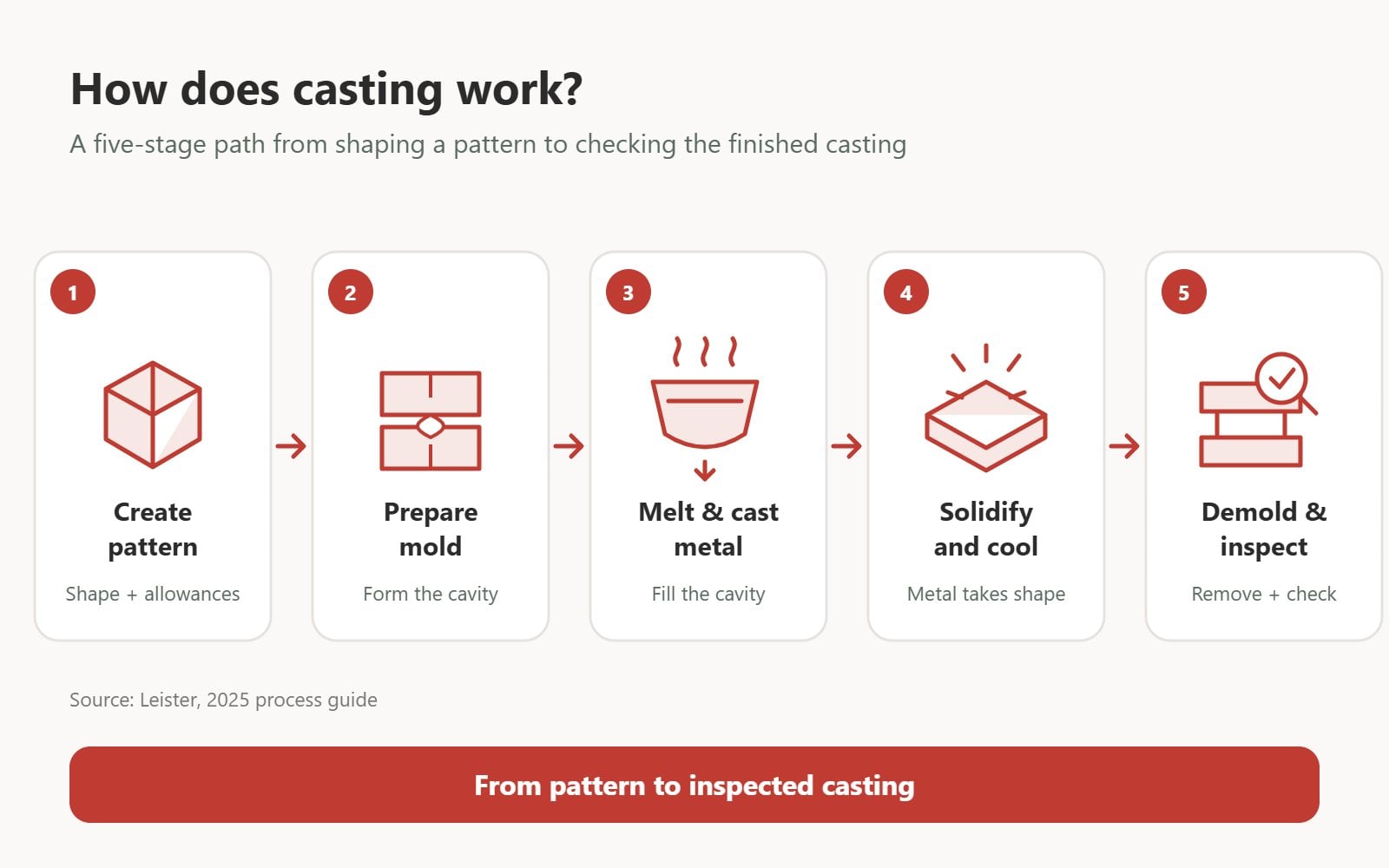
A casting moves from a defined shape to a finished, inspected component through coordinated pattern, mold, melt, pour, cooling, and removal operations. Leister’s 2025 process guide identifies five main stages: creating a sample or pattern, preparing the mold, melting and casting the metal, solidifying and cooling, and demolding and inspection.
How do patternmaking and mold preparation begin the process?
Patternmaking establishes the part’s shape and the allowances needed for the chosen alloy and process. Cores create internal passages or cavities; gates and risers provide routes for filling and feeding the part. The mold is then assembled and prepared to resist the heat and flow of the metal. For a sand mold, the preparing the mold stage establishes the cavity that the metal will reproduce.
How are molten metal pouring and solidification controlled?
Foundries manage alloy composition, melt condition, temperature, and pouring behavior so metal reaches the cavity before it freezes, without creating unacceptable turbulence or trapped gas. During cooling and solidification, the metal contracts and releases heat; mold design and feeding features help manage that transition. The exact controls depend on the alloy and process, so a steel pour and an aluminum die-casting cycle don’t use identical settings.
What happens during casting removal, cleaning, and finishing?
Once the metal has solidified sufficiently, the foundry removes the mold or opens the reusable die, separates the casting from runners and risers, and removes adhering material. Workers may then grind, blast, heat-treat, or machine the part as required by the drawing. cleaning the finished casting reveals the surface for inspection, but finishing requirements should be agreed before production because they add operations and cost.
How does steel casting work?
Steel casting follows the same broad steps, but the foundry must choose materials and mold design for steel’s casting conditions and the part’s solidification behavior. Feeding design is particularly relevant to sections that cool at different rates: if liquid metal can’t reach a contracting region, shrinkage cavities may form. Foundries specify inspection and any heat treatment or machining from the part’s service requirements, rather than treating “steel casting” as one fixed recipe.
Which Metal Casting Methods Are Used in Manufacturing?
Manufacturers select among expendable-mold and reusable-mold processes, with the best fit determined by geometry, alloy, dimensional requirements, and production volume. ASM International’s 2025 overview of aluminum casting surveys seven routes: green-sand, chemically bonded sand, gravity permanent and semipermanent mold, low-pressure permanent and semipermanent mold, counter-pressure, die casting, and squeeze casting.
Sand casting: Why is it the most traditional method?
Sand casting is traditional because a pattern can form a cavity in prepared sand, which is then broken away to release the part. The method accommodates many shapes and can be adapted to a broad range of production needs, though surface finish and dimensional precision may require additional work. For the core sequence, see the sand casting process.
Investment casting: When is fine detail important?
Investment casting suits parts where fine geometry or surface detail matters and the pattern can be sacrificed to create a ceramic mold. It supports complex forms, but the multi-step pattern and mold preparation can make it a poor fit when the component is simple and tooling economy dominates. The investment casting method is one option when detail justifies that process route.
Die casting: When does high-volume production make sense?
Die casting makes sense when a reusable metal die and production equipment can be amortized across repeated parts. The process forces molten metal into the die, supporting relatively fast, repeatable production and dimensional detail for compatible alloys. Its tooling investment can work against short runs or frequent design changes. When comparing gravity and pressure casting, compare volume and tooling alongside part geometry.
What are the four types of metal casting, and which is most widely used?
Sand, investment, die, and permanent-mold casting provide a concise comparison set, but not an exhaustive classification. Sand casting is the familiar traditional route; die casting is associated with repeat production using reusable dies. The label “most widely used” needs a defined measure and market—without one, ranking a single process across all casting is misleading.
What is the most traditional casting method?
Sand casting is the most traditional method among the common industrial routes discussed here: the pattern shapes a sand cavity, molten metal fills it, and the mold is broken away after solidification. Its long-standing use doesn’t mean it suits every part; tighter tolerances, finer detail, or very high production rates may favor another process.
How Do You Choose a Casting Method for a Part?
Choose the method by matching the part’s requirements to the process’s capabilities, then compare tooling and production economics. MIT OpenCourseWare’s Spring 2025 manufacturing lecture groups casting trade-offs around rate, quality, cost, and flexibility—a useful framework because no one process optimizes all four.
How do cost, part size, complexity, and production volume affect the choice?
Part size and shape constrain which mold and equipment can produce the component; complexity determines whether cores, multiple mold features, or specialized tooling are needed. Production volume changes the cost calculation: reusable tooling costs more to establish but can support repeated cycles, while expendable molds can avoid the same die investment. A sound comparison includes both initial tooling and expected finishing work, not just the quoted price per casting.
How do tooling needs and material requirements compare?
Sand molds are expendable, while permanent-mold and die-casting processes rely on reusable tooling; investment casting adds pattern and ceramic-shell steps. Alloy choice also narrows the field because each process must handle the material’s melting, filling, and solidification behavior. Specify the alloy, critical dimensions, surface requirements, and annual volume before asking suppliers to compare routes.
Is CNC machining better than casting?
CNC machining is a stronger fit when precision features or design iteration outweigh the benefits of near-net-shape production; casting is a stronger fit when the mold can form complex bulk geometry efficiently. MIT’s Spring 2025 lecture gives typical tolerance ranges of 0.7–2 mm for sand casting and 0.08–0.2 mm for die casting, illustrating how dimensional requirements help narrow the choices. These are lecture examples, not guaranteed tolerances for every part or foundry.
What Casting Defects, Quality Checks, and Safety Risks Should You Know?
Casting quality depends on controlling the melt, mold, filling, and cooling conditions, then verifying the finished component against its requirements. Defects can include gas porosity, shrinkage, inclusions, cold shuts, and mold-related surface or shape problems; inspection plans should target the risks that matter to the part’s function.
Which defects can occur, and how are they detected?
Gas porosity and shrinkage create voids, inclusions introduce foreign material, and a cold shut occurs when meeting streams fail to fuse properly. Visual inspection can find surface issues, while dimensional checks and suitable nondestructive or destructive tests assess other requirements. A 2024 International Journal of Metalcasting study reported an annual rejection rate of 5–7% at the specific green-sand foundry it analyzed, using production data from 2018–2021; that figure describes one facility, not the industry as a whole.
How do inspection and process controls verify casting quality?
Inspection verifies the actual part; process controls help explain whether the process can keep making conforming parts. Depending on the drawing and service, checks may cover dimensions, surface condition, material identity, or internal integrity. Records that connect inspection results with alloy batches, molds, and process settings make it easier to investigate a defect pattern rather than merely sort the affected parts.
What safety precautions matter when handling molten metal?
Molten metal operations demand controls for heat, splashes, fumes, and the severe hazard created when water contacts hot metal. OSHA documents foundry hazards and recommends task-specific protective equipment; its foundry guidance also describes the risk of steam explosions when water and molten material meet. The U.S. Bureau of Labor Statistics recorded 5.1 total recordable nonfatal injury and illness cases per 100 full-time-equivalent workers in U.S. foundries in 2024. That rate supports treating training, dry charge and tools, protective clothing, and controlled access as core operating practices.
What Should You Evaluate Before Specifying a Metal Casting?
A casting specification should translate the component’s function into measurable material, geometry, quality, and production requirements. MIT’s 2025 manufacturing lecture frames the trade-offs as rate, quality, cost, and flexibility; the design decision is to rank those attributes for the part rather than expect one process to lead on every measure.
How can design and production requirements guide your next manufacturing decision?
Start with the alloy, annual quantity, critical dimensions, internal features, surface expectations, and any inspection or certification requirements. Then ask which dimensions truly need post-cast machining and which features the mold can form directly. A clear comparison of sand, investment, die, and permanent-mold routes can reveal whether the design should change before tooling begins; for a useful next step, compare gravity-fed and pressure-assisted filling against the part’s specific geometry and production target.