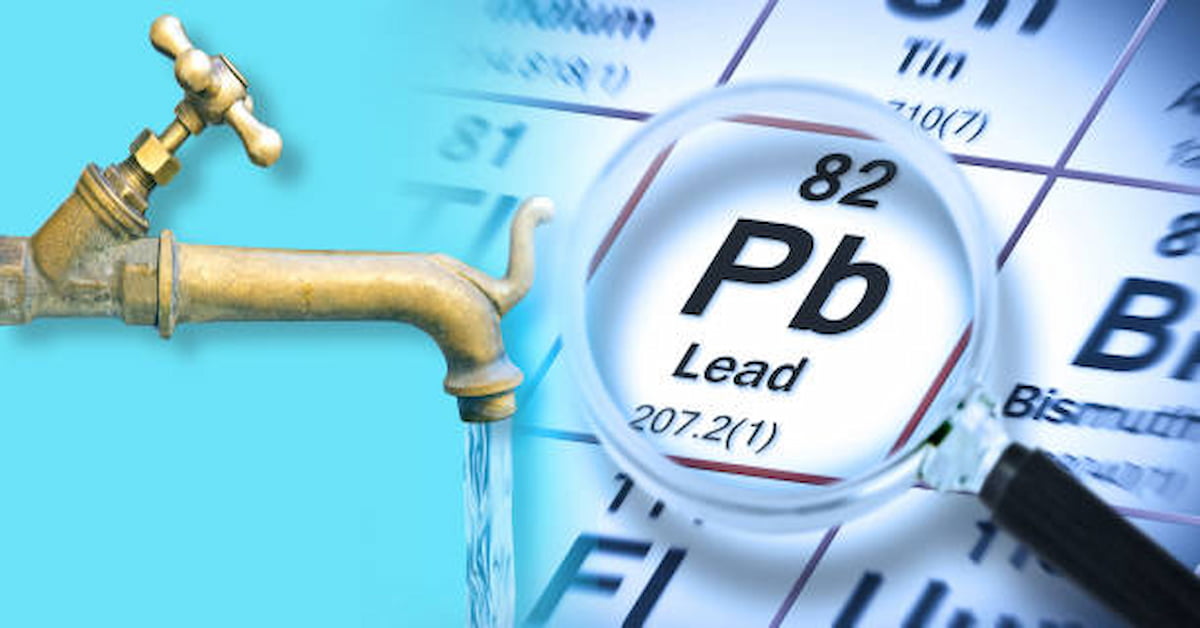
NSF/ANSI/CAN 61 Certified Brass: Lead-Content Standards for Drinking Water in 2026
Brass fittings, faucets, valves, and backflow preventers intended for drinking-water systems require more than a general “lead-free” claim. Buyers must verify that the finished product meets the applicable health-effects and lead-content requirements, not merely that the supplier used a recognised brass alloy.
This guide explains what NSF/ANSI/CAN 61 tests, how it differs from NSF/ANSI/CAN 372, how to review certification documents, and what procurement and engineering teams should check when sourcing potable-water brass components.
What Does NSF/ANSI/CAN 61 Test?
NSF/ANSI/CAN 61 establishes minimum health-effects requirements for materials, components, products, and systems that come into contact with drinking water. It covers products such as pipes, fittings, valves, faucets, coatings, joining materials, tanks, pumps, and mechanical plumbing devices.
The standard focuses on substances that may migrate from a product into drinking water. It generally involves three areas.
Extraction testing evaluates potential leaching
The product or material is exposed to controlled test water under conditions appropriate to its intended use. The water is then analysed to determine whether substances released from the product exceed the applicable health-effects criteria.
Testing conditions may vary according to:
- Product type
- Wetted surface area
- Water temperature
- Material formulation
- Intended application
Certification should therefore be reviewed for the specific product and conditions of use rather than treated as blanket approval for everything manufactured by the supplier.
Formulation review covers all wetted materials
The certification process evaluates the materials used on surfaces that contact drinking water. For a brass component, this may include:
- The brass body
- Internal waterways
- Stems and cartridges
- Plating and coatings
- Brazing or soldering materials
- Seals, gaskets, and elastomers
- Thread compounds and lubricants
A change to one of these materials may affect the product’s certification.
Ongoing surveillance maintains certification
Certification normally includes continued monitoring of the manufacturing facility and production controls. Buyers should confirm that the product remains actively listed in the certification body’s official database rather than relying only on an old certificate supplied by the manufacturer.
What Is the Difference Between NSF 61 and NSF 372?
NSF/ANSI/CAN 61 and NSF/ANSI/CAN 372 address different aspects of potable-water compliance.
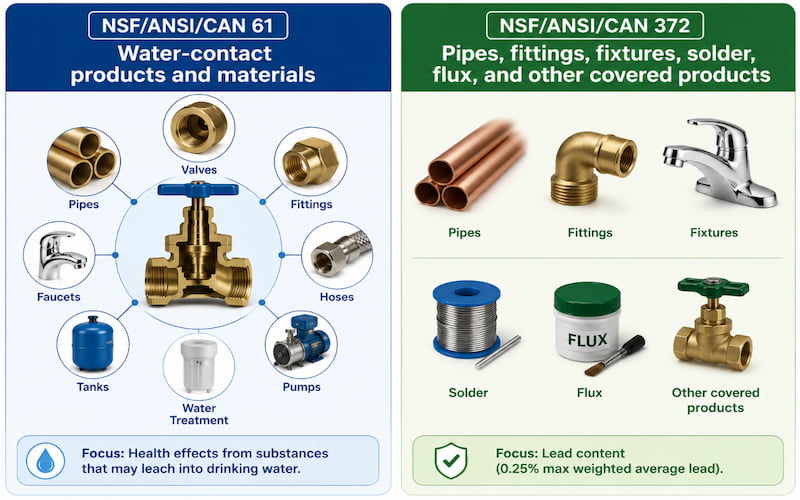
| Attribute | NSF/ANSI/CAN 61 | NSF/ANSI/CAN 372 |
| Primary purpose | Evaluates health effects from substances imparted to drinking water | Determines and verifies lead content |
| Main focus | Extraction and material-safety testing | Weighted-average lead calculation |
| Coverage | Water-contact products and materials | Pipes, fittings, fixtures, solder, flux, and other covered products |
| Lead requirement | Lead is assessed where applicable through health-effects criteria | Maximum 0.25% weighted-average lead for most covered wetted surfaces |
| Solder and flux | Evaluated under applicable product requirements | Maximum 0.2% lead |
NSF explains that NSF/ANSI/CAN 372 addresses lead content only. Most products also require an extraction or leaching standard, commonly NSF/ANSI/CAN 61.
A product should not be assumed to meet both requirements simply because it displays an NSF mark. The exact certification identifier and official product listing must be checked.
What Does “Lead-Free” Mean for Brass Components?
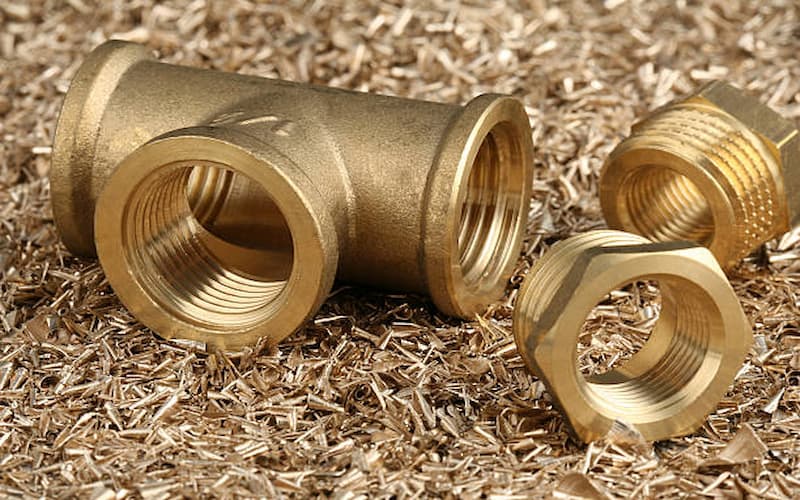
Under the U.S. Safe Drinking Water Act, “lead-free” generally means:
- No more than 0.25% weighted-average lead across the wetted surfaces of covered pipes, fittings, fixtures, and plumbing components
- No more than 0.2% lead in solder and flux
The calculation considers both the lead content and the proportional wetted surface area of each part in the assembly. It is not based only on the lead percentage of the main brass body.
Does lead-free mean zero lead?
No. “Lead-free” is a legal definition based on maximum permitted lead content. A material may contain a small amount of lead and still qualify when the complete product meets the weighted-average requirement.
Can a non-potable brass product contain more lead?
Products used exclusively for non-potable services, such as certain industrial processing, irrigation, or outdoor watering applications, may fall under exemptions. Their intended use must be clear, and they should not be marketed for potable-water applications.
How Should Buyers Review Brass Certification?
A compliance pack should prove that the exact finished product being purchased is covered. A certificate naming only the company, raw material, or alloy family may not be sufficient.
Confirm the exact product
Check whether the official listing identifies the relevant:
- Part number
- Model or series
- Product size
- Trade designation
- Water-contact temperature
- Manufacturing facility
Certification of a brass material does not necessarily transfer to every finished component produced from it. Machining, plating, joining, sealing, and assembly can introduce additional wetted materials.
Verify the standard and certification mark
The documentation should state whether the product is certified to:
- NSF/ANSI/CAN 61
- NSF/ANSI/CAN 372
- Both standards, where required
EPA guidance explains that a certification body’s mark should be reviewed together with its accompanying identifier text. A logo alone may not show which requirement the product satisfies.
Check limitations and footnotes
Official listings may include restrictions involving:
- Product dimensions
- Water temperature
- Surface-area-to-volume ratio
- Specific materials
- Coating thickness
- Product configuration
- Intended use
These limitations form part of the certification and should not be overlooked.
How Should Brass Alloys Be Selected for Potable Water?
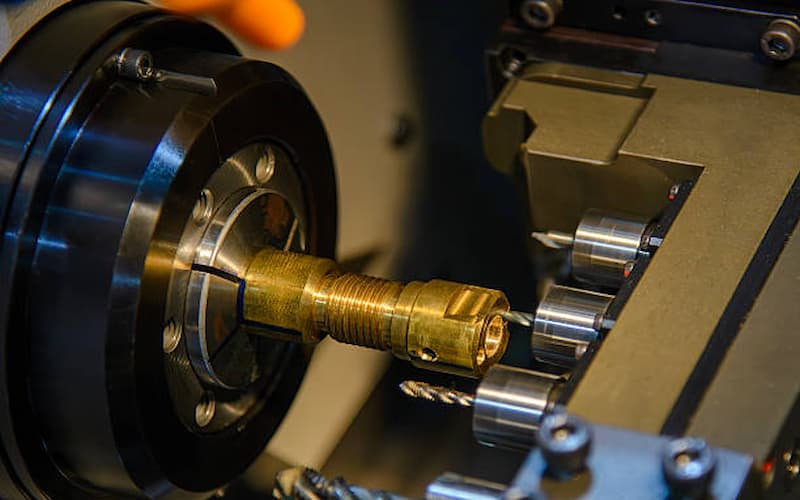
The alloy must meet the product’s regulatory, mechanical, manufacturing, and corrosion requirements. Lead content is only one part of material selection.
Important factors include:
- Lead-content compliance
- Castability or forgeability
- Machinability
- Strength and pressure rating
- Corrosion resistance
- Dezincification resistance
- Thread and sealing performance
- Plating compatibility
- Material availability
- Traceability
Leaded brass may remain suitable for non-potable use
Traditional leaded brass can provide excellent machinability and may still be appropriate for industrial valves, gas fittings, decorative hardware, and other non-potable products.
It should not be substituted into a potable-water assembly unless the finished product meets the relevant lead-content and health-effects requirements.
Lead-free brass requires manufacturing validation
Lead-free brass may use bismuth, silicon, or other alloying systems. Switching from conventional free-machining brass can affect:
- Tool wear
- Chip formation
- Cutting speeds
- Thread quality
- Casting fluidity
- Shrinkage behaviour
- Surface finish
- Pressure integrity
Production trials should therefore be completed using the actual component design and manufacturing equipment.
DZR and lead-free are not the same
Dezincification-resistant brass is designed to reduce the selective loss of zinc under certain water conditions. This is a separate property from lead-content compliance.
A product may satisfy the lead-free definition without providing the required level of dezincification resistance. Both requirements should be specified when relevant.
What Should Buyers Know About Annex N-2?
Annex N-2 of NSF/ANSI/CAN 61 includes material specifications that have undergone extraction testing and are considered acceptable materials within the conditions stated by the standard.
NSF reported that six brass rod alloys were added to Annex N-2 in the 2022 edition. However, appearing in the annex does not automatically certify every finished product made from that alloy.
When reviewing an alloy or supplier compliance pack, confirm:
- The alloy designation
- The applicable edition of the standard
- The certification scope
- The finished component covered
- Every wetted material in the assembly
- Any restrictions in the official listing
Buyers should avoid relying on unsupported claims about a “2025/2026 Annex N-2 update” unless they can verify the changes in the current controlled standard or through an accredited certification body.
How Can a Brass Supplier Be Qualified?
A practical qualification process should connect the product specification, certification, material traceability, and manufacturing controls.

Step 1: Define the requirement in the RFQ
The drawing, RFQ, and purchase order should identify:
- Required NSF/ANSI/CAN standards
- Intended potable-water application
- Maximum weighted-average lead content
- Approved brass alloy or alternatives
- Water-contact temperature
- DZR requirements where applicable
- Material traceability
- Restrictions on manufacturing changes
Avoid vague phrases such as “NSF compliant” or “lead-free brass” without defining the required certification.
Step 2: Request product-specific evidence
The supplier should provide:
- Current certification listing
- Exact part-number or model coverage
- Manufacturing-site details
- Material certificate
- Heat or lot traceability
- Wetted-material declaration
- Approved plating and sealing materials
- Certificate of conformity
The certification should cover the finished component rather than only the incoming brass bar, ingot, or casting.
Step 3: Audit the manufacturing process
The audit should review the controls used during:
- Incoming-material inspection
- Alloy verification
- Casting or forging
- Machining
- Plating and finishing
- Brazing or soldering
- Cleaning
- Assembly
- Final inspection
For cast brass products, the review may also cover charge materials, melt chemistry, pouring controls, porosity, pressure testing, and batch traceability. Buyers assessing casting suppliers can refer to Align Manufacturing’s overview of Sand casting in Thailand for more process context.
Step 4: Control production changes
The supplier should obtain approval before changing:
- Brass grade
- Raw-material source
- Manufacturing location
- Casting or forging process
- Machining subcontractor
- Plating system
- Seal material
- Wetted component
- Product design
The certification body may also need to evaluate the change before production continues.
Step 5: Maintain a compliance file
Keep the following records together:
- Approved drawing
- Purchase order
- Certification listing
- Material certificate
- Heat and batch records
- Inspection results
- Certificate of conformity
- Approved change records
- Receiving documentation
This creates a clear connection between the certified design and the parts received.
How Can a Certificate Be Verified?
Use the official database of the certification body shown on the product or documentation.
Confirm:
- Manufacturer name
- Manufacturing facility
- Product or model
- Applicable standard
- Current listing status
- Limitations and footnotes
- Whether the listing covers the finished product
EPA’s certification requirements for covered potable-water plumbing products became enforceable on September 1, 2023. Manufacturers and importers should therefore ensure that regulated products carry valid third-party lead-free certification before entering U.S. commerce.
When the listing cannot be found, buyers should contact the certification body instead of accepting an undated certificate or supplier screenshot.
What Engineering Trade-Offs Come With Lead-Free Brass?
Lead-free brass may require adjustments to production methods and tooling.
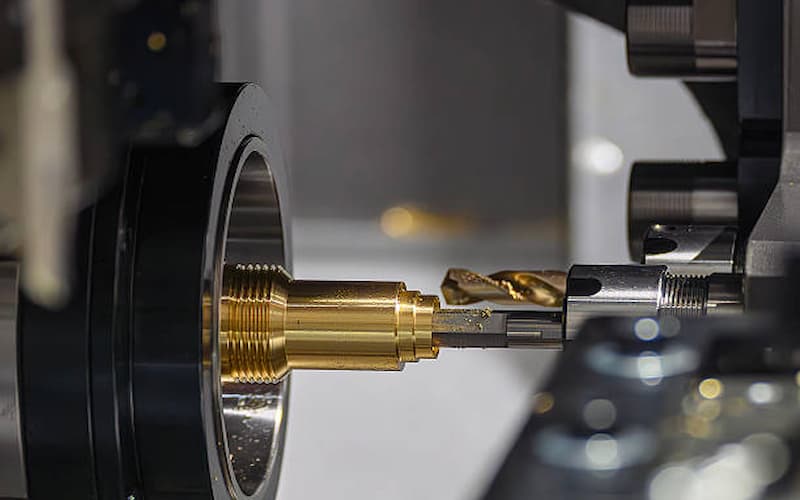
Machining parameters may need adjustment
Cutting speed, tool geometry, lubrication, chip evacuation, and threading parameters should be validated for the selected alloy. Generic assumptions about cycle time or tool life should not replace production trials.
Casting controls should match the alloy
Lead-free alloys can behave differently during melting, pouring, solidification, and feeding. Gating design, temperature control, pressure testing, and inspection planning may need to be revised.
Material selection should also match the process and component requirements. Align Manufacturing’s overview of Investment casting materials explains how material choice affects corrosion resistance, strength, and component performance.
Secondary operations remain part of compliance
A compliant brass alloy can still form part of a non-compliant finished product if unapproved materials are introduced during:
- Plating
- Coating
- Brazing
- Soldering
- Sealing
- Cleaning
- Assembly
For assemblies requiring additional joining, finishing, or dimensional control, reviewing experienced Metal Fabrication Thailand capabilities can help buyers assess the complete manufacturing process rather than the brass material alone.
What Should a Brass Compliance Checklist Include?
Use this checklist when qualifying a new supplier or reviewing an existing potable-water component:
- Finished product has an active NSF/ANSI/CAN 61 listing where required
- Product meets the applicable lead-free certification requirement
- Listing identifies the correct product or approved series
- Manufacturing facility matches the production source
- Certification limitations have been reviewed
- Wetted materials match the certified design
- Weighted-average lead content has been addressed
- Solder and flux meet the applicable limit
- Material records are traceable to the production lot
- DZR requirements are specified where necessary
- Plating, seals, and joining materials are controlled
- Supplier changes require written approval
- Certification status is checked regularly
- Shipment records are retained
Compliance is not established by a certificate stamp alone. It depends on the exact product, its wetted materials, the manufacturing site, and the current certification listing.
Conclusion
At Align Manufacturing, we manufacture precision metal components through casting, forging, CNC machining, stamping, and metal fabrication across Thailand, Vietnam, and India. For brass valves, fittings, and other water-contact products, we focus on connecting the correct material with controlled production processes, traceable quality records, and the customer’s certification requirements. We believe potable-water compliance should be addressed from the drawing and supplier-qualification stage through manufacturing, inspection, and final documentation.
FAQ
What is NSF/ANSI/CAN 61?
NSF/ANSI/CAN 61 evaluates the health effects of materials and products that come into contact with drinking water.
Is NSF 61 the same as lead-free certification?
No. NSF/ANSI/CAN 61 addresses health effects and substance migration. NSF/ANSI/CAN 372 addresses weighted-average lead content.
Does lead-free brass contain no lead?
Not necessarily. U.S. law generally defines lead-free as no more than 0.25% weighted-average lead across the wetted surfaces of covered plumbing products.
Can a raw brass alloy certificate cover a finished valve?
Not automatically. The finished product may contain additional wetted materials introduced through machining, plating, joining, sealing, or assembly and may require its own certification.
Is DZR brass automatically lead-free?
No. Dezincification resistance and lead-content compliance are separate properties.
Can leaded brass be used for non-potable components?
Yes, depending on the application and applicable regulations. The product should be clearly intended and documented for non-potable use.
Does changing factories affect certification?
It can. Certification is connected to controlled production processes and authorised manufacturing locations. The certification body should review significant location or process changes.
How should buyers verify certification?
Check the certification body’s official product directory and confirm the manufacturer, facility, product designation, standard, current status, and any listing limitations.