

Internal Auditing and Corrective Action (CAPA) for Machine Shops
Introduction: Building a Quality-First Culture
In the precision-driven world of CNC machining and manufacturing, quality isn’t an inspection step, it’s a continuous process woven throughout operations. Internal auditing and Corrective and Preventive Action (CAPA) form the backbone of proactive quality management, enabling machine shops to identify issues before they reach customers, systematically address root causes, and prevent recurrence.
This comprehensive guide provides machine shop managers, quality engineers, and operators with actionable frameworks for implementing effective internal audit programs and CAPA systems that drive continuous improvement while meeting ISO 9001, IATF 16949, and AS9100 requirements.
Understanding Internal Auditing in Manufacturing
What is an Internal Audit?
An internal audit is a systematic, independent examination of a manufacturing organization’s quality management system (QMS) to determine whether quality activities and related results comply with planned arrangements. Unlike external audits conducted by customers or certification bodies, internal audits are self-directed evaluations designed to drive improvement.
Types of Internal Audits for Machine Shops
| Audit Type | Frequency | Focus Area | Personnel Required |
| System Audits | Annual | Entire QMS against ISO/AS standards | Certified internal auditor |
| Process Audits | Quarterly | Specific manufacturing processes | Process engineer + QA |
| Product Audits | Monthly | Finished parts against specifications | Quality inspector |
| Layered Process Audits (LPA) | Daily/Weekly | Critical control points | Production supervisor |
| Supplier Audits | Annually | Subcontractor capabilities | Purchasing + QA |
| 5S Audits | Weekly | Workplace organization | Production team |
Internal Audit Program Structure
Annual Audit Schedule Example
| Month | Audit Focus | Standard Clause | Auditor |
| January | Management processes | ISO 9001: 4-5 | Quality Manager |
| February | Resource management | ISO 9001: 7 | HR + Operations |
| March | Product realization – Planning | ISO 9001: 8.1 | Engineering |
| April | Purchasing and supplier control | ISO 9001: 8.4 | Purchasing |
| May | Production and service provision | ISO 9001: 8.5 | Production Mgr |
| June | Monitoring and measurement | ISO 9001: 9 | QA Manager |
| July | Corrective action processes | ISO 9001: 10.2 | Quality Manager |
| August | Document and record control | ISO 9001: 7.5 | Document Control |
| September | Calibration and inspection | ISO 9001: 7.1.5 | Metrology Lead |
| October | Customer-related processes | ISO 9001: 8.2 | Sales + QA |
| November | Internal audit process | ISO 9001: 9.2 | Management Rep |
| December | Management review preparation | ISO 9001: 9.3 | Top Management |

Planning Effective Internal Audits
Pre-Audit Preparation
1. Define Audit Scope and Criteria
- Identify processes to be audited
- Reference applicable standards (ISO 9001, IATF 16949, AS9100)
- Review previous audit findings
- Consider customer-specific requirements
2. Select and Prepare the Audit Team
- Auditors must be independent of audited activities
- Minimum requirement: One lead auditor with formal training
- Larger audits: Audit team with defined roles
- Southeast Asia consideration: Ensure language proficiency
3. Develop Audit Checklists
Sample Process Audit Checklist: CNC Turning Operation
| Checkpoint | Evidence Required | Finding | Notes |
| Work instruction available at station? | Posted/current revision | ☐ C ☐ NC ☐ O | |
| Operator trained and certified? | Training records, skill matrix | ☐ C ☐ NC ☐ O | |
| First piece inspection completed? | FAI report, sign-off | ☐ C ☐ NC ☐ O | |
| In-process inspection per control plan? | Inspection records | ☐ C ☐ NC ☐ O | |
| Statistical process control active? | SPC charts, capability data | ☐ C ☐ NC ☐ O | |
| Tooling identified and within life? | Tool life tracking | ☐ C ☐ NC ☐ O | |
| Machine calibration current? | Calibration stickers, certs | ☐ C ☐ NC ☐ O | |
| Preventive maintenance on schedule? | PM records, work orders | ☐ C ☐ NC ☐ O | |
| Nonconforming material identified? | Red tags, quarantine area | ☐ C ☐ NC ☐ O | |
| Corrective actions from previous audits closed? | CAR tracking | ☐ C ☐ NC ☐ O |
C = Conforming, NC = Non-Conforming, O = Observation
Conducting the Audit
Opening Meeting (15-30 minutes)
- Introduce audit team
- Confirm scope and schedule
- Explain audit methodology
- Address confidentiality
On-Site Audit Activities
- Interview Personnel: Ask open-ended questions
- “Walk me through how you set up this job”
- “How do you know when a tool needs changing?”
- “What do you do if you find a defect?”
- Observe Operations: Watch actual work being performed
- Compare to documented procedures
- Note deviations and best practices
- Photograph (with permission) for evidence
- Review Records: Examine objective evidence
- Inspection records, SPC charts
- Training records, certifications
- Maintenance logs, calibration certificates
- Previous audit findings and closures
Closing Meeting (30-45 minutes)
- Present findings (non-conformities and observations)
- Allow auditee to respond and clarify
- Discuss timeline for corrective actions
- Issue draft report within 3-5 business days
Writing Non-Conformity Reports
Non-Conformity Structure (CAR Format)
1. Statement of Non-Conformity Clear, factual description of what was found:
“The CNC milling work instruction WI-045 Rev C specifies measurement of hole diameter at position A after operation OP-20. Review of inspection records for Job #23456 (run date 15 March 2026) showed no diameter measurement recorded, and the operator confirmed this dimension is not routinely checked.”
2. Reference to Standard/Requirement
“This constitutes a non-conformity with ISO 9001:2015 Clause 8.5.1 (c) – ‘the implementation of monitoring and measurement activities at appropriate stages to verify that criteria for control of processes…have been met.'”
3. Classification
- Major: Systemic failure, multiple minor NCs on same clause, potential customer impact
- Minor: Isolated incident, limited impact, easily correctable
4. Evidence References
- Document numbers, revision levels
- Photographs (if applicable)
- Interview notes
- Record samples with dates
The CAPA Process: From Finding to Fix
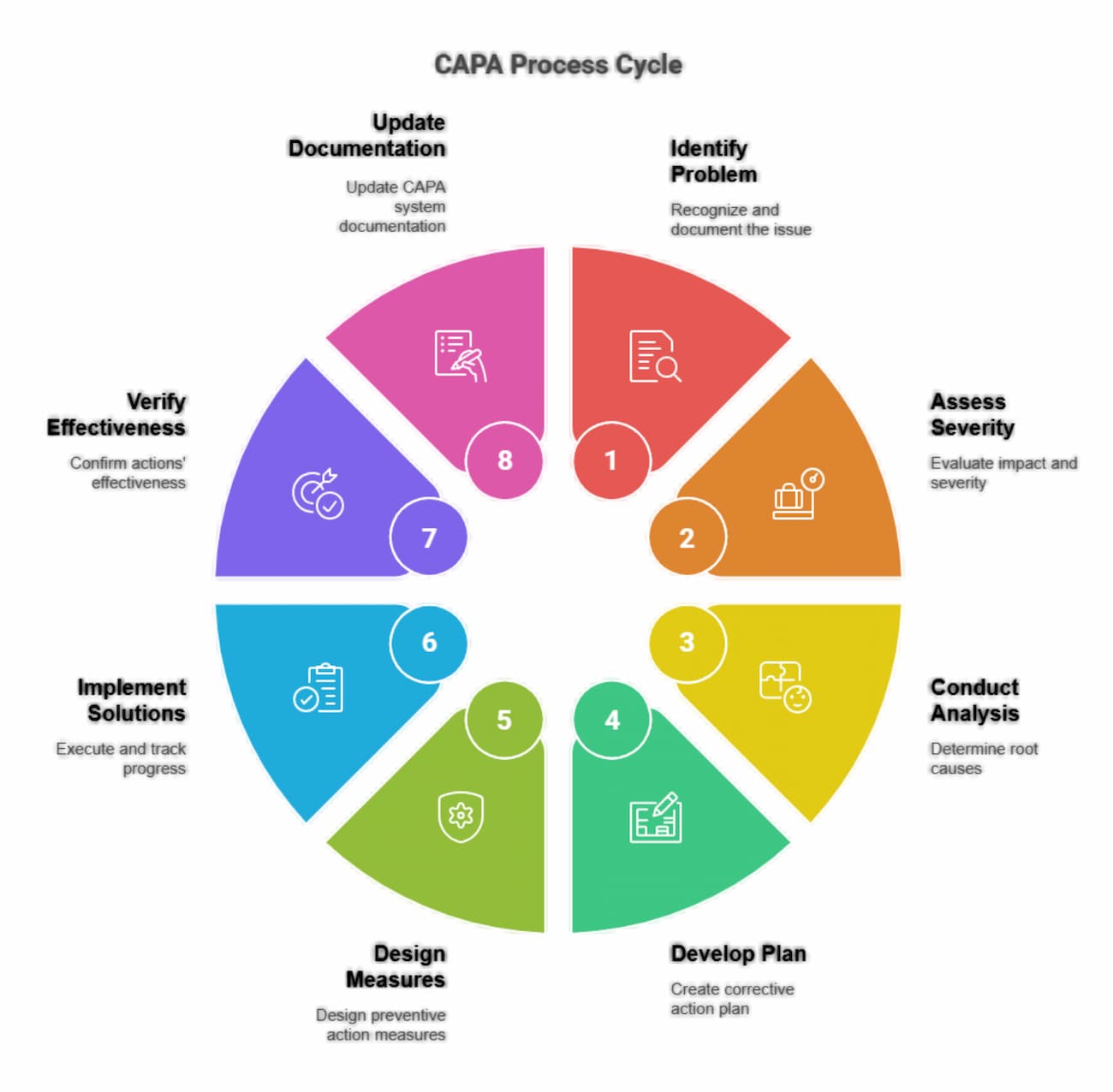
CAPA vs. Correction
| Aspect | Correction | Corrective Action | Preventive Action |
| Timing | Immediate | Short-term | Long-term |
| Focus | Symptom | Root cause | Potential issues |
| Goal | Fix the problem | Prevent recurrence | Prevent occurrence |
| Example | Rework nonconforming part | Fix broken fixture | Update PM schedule |
The 8D Problem-Solving Method
Originally developed by Ford Motor Company, 8D is widely used in manufacturing:
D0: Plan
- Define the problem symptom
- Establish emergency response action if needed
- Form the team
D1: Establish the Team
- 4-6 members with process knowledge
- Include operator, engineer, quality representative
- Assign roles: Champion, Team Leader, Recorder, Members
D2: Describe the Problem Use the 5W2H framework:
- What is the problem? (defect type, characteristic)
- Where was it found? (location, machine, shift)
- When did it occur? (date, time, sequence)
- Who is affected? (customer, process, product)
- Why is it a problem? (impact, severity)
- How was it detected? (inspection method, frequency)
- How many were affected? (quantity, percentage)
D3: Develop Interim Containment
- Stop the bleeding: quarantine suspect material
- Sort good from bad
- Implement 100% inspection if necessary
- Document containment effectiveness
D4: Root Cause Analysis Investigate both:
- Escape Point: Why did the defect reach the customer?
- Root Cause: Why did the defect occur?
Use multiple tools:
- 5 Whys: Ask “why” five times to drill down
- Fishbone (Ishikawa): Categories – Man, Machine, Material, Method, Measurement, Environment, Management
- Fault Tree Analysis: Top-down logic analysis
- FMEA: Review for overlooked failure modes
D5: Choose Permanent Corrective Actions
- Address root causes, not symptoms
- Verify actions don’t create new problems
- Define implementation timeline
- Assign responsibility
D6: Implement and Verify
- Execute corrective actions
- Train affected personnel
- Update documents (procedures, work instructions)
- Verify effectiveness with data (30-90 days minimum)
D7: Prevent Recurrence
- Apply lessons learned to similar processes
- Update FMEAs, Control Plans
- Revise training materials
- Communicate across organization
D8: Recognize the Team
- Document and share success
- Reward team members
- Archive for future reference
Root Cause Analysis Tools
The 5 Whys Technique
Example: Dimensional variation on turned parts
| Level | Question | Answer |
| 1 | Why are parts out of tolerance? | Because the cutting tool wears inconsistently |
| 2 | Why does the tool wear inconsistently? | Because feed rates vary between operators |
| 3 | Why do feed rates vary? | Because the parameter sheet is not at the machine |
| 4 | Why isn’t the parameter sheet at the machine? | Because the document control update hasn’t been distributed |
| 5 | Why hasn’t it been distributed? | Because the document change process has no verification step |
Root Cause: Document change process lacks verification of distribution.
| Category | Cause 1 | Cause 2 | Cause 3 |
|---|---|---|---|
| Man | Training | Fatigue | New hire |
| Machine | PM due | Vibration | Spindle |
| Material | Lot var | Mixed | Moisture |
| Method | WI not current | Shortcut | Method var |
| Measurement | Cal due | Gage worn | Method var |
Pareto Analysis
Rank defects by frequency to focus efforts:
| Defect Type | Count | Cumulative % |
| Dimensional | 45 | 45% |
| Surface finish | 30 | 75% |
| Burr | 12 | 87% |
| Contamination | 8 | 95% |
| Other | 5 | 100% |
Focus CAPA efforts on dimensional and surface finish issues first (75% of problems).
CAPA Documentation and Tracking
CAPA Record Requirements
Each CAPA must contain:
- Unique identifier (e.g., CAR-2026-047)
- Date opened and originator
- Problem description (linked to audit finding or NCR)
- Immediate containment actions and dates
- Root cause analysis documentation
- Corrective actions with assigned owners and due dates
- Implementation verification evidence
- Effectiveness verification with metrics
- Closure approval by quality management
- Dates for each milestone
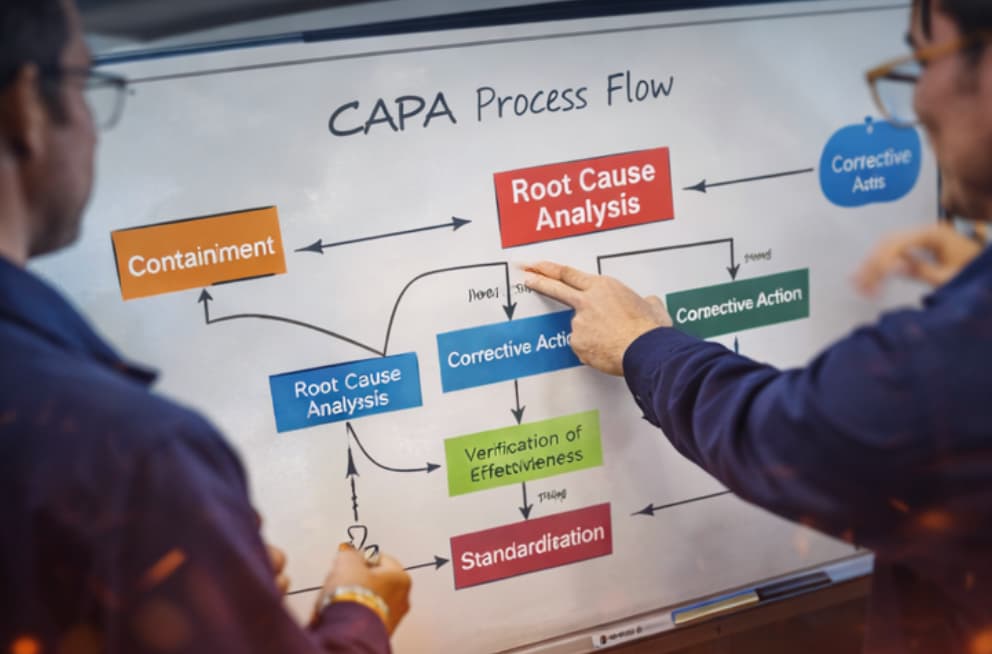
CAPA Tracking Metrics
| Metric | Target | Calculation |
| Open CARs | <10 | Count of active CARs |
| Average age | <30 days | Sum of open days / total CARs |
| On-time closure | >95% | Closed on time / total closed |
| Effectiveness rate | >90% | Effective verifications / total closed |
| Recurrence rate | <5% | Repeated issues / total closed |
Southeast Asia Implementation Considerations
Cultural Factors
Challenge: Saving Face
- Non-conformities may be perceived as personal criticism
- Root cause analysis may avoid identifying human error
Solutions:
- Frame audits as “process reviews,” not “personnel evaluations”
- Use “we” language: “How can we improve this process?”
- Recognize that honest reporting of problems is encouraged
- Separate the person from the process in all documentation
Challenge: Hierarchical Communication
- Operators may not feel empowered to report issues to auditors
- Corrective actions may need management approval before implementation
Solutions:
- Include supervisors in audit closing meetings
- Establish clear escalation paths
- Empower team-level problem solving within defined limits
- Train management on the importance of rapid response
Language and Documentation
- Provide audit checklists in local language
- Use visual aids (photos, diagrams) to supplement written reports
- Consider bilingual auditors for international customers
- Ensure all personnel understand key quality terms
Regulatory Environment
Thailand Industrial Standards
- TISI (Thai Industrial Standards Institute) requirements for certain products
- Factory Act compliance for safety-related CAPAs
ASEAN Manufacturing Standards
- Harmonizing quality approaches across regional facilities
- Mutual recognition of supplier audits within ASEAN
Audit and CAPA Checklists
Pre-Audit Checklist
☐ Audit scope defined and documented
☐ Audit criteria identified (standards, procedures)
☐ Audit team selected and available
☐ Auditee notified with adequate lead time (1-2 weeks)
☐ Previous audit reports reviewed
☐ Customer complaints and CARs reviewed
☐ Checklists prepared
☐ Opening meeting scheduled
CAPA Implementation Checklist
☐ Root cause verified (not just symptom)
☐ Actions address root cause
☐ Containment verified effective
☐ Documents updated (procedures, WIs, drawings)
☐ Training completed and recorded
☐ Implementation verified within timeframe
☐ Effectiveness metrics defined
☐ Effectiveness verified with data
☐ No negative side effects introduced
☐ Lessons learned communicated
☐ Management approval for closure
FAQ
Q1: How often should we conduct internal audits?
A: ISO 9001 requires audits at planned intervals, typically interpreted as annual coverage of all processes. Best practice for machine shops:
- Entire QMS: Audited at least annually
- Critical processes: Semi-annually or quarterly
- Problem areas: Monthly until stable
- Layered Process Audits: Weekly for high-risk operations
Q2: Can the same person audit a process they work in?
A: No, auditors must be independent of the area being audited to ensure objectivity. However, they can audit other departments or processes. Small shops may need to bring in external auditors or cross-train employees to audit each other’s areas.
Q3: What’s the difference between a correction and a corrective action?
A: A correction fixes the immediate problem (rework a defective part). A corrective action fixes the root cause to prevent recurrence (repair the fixture that caused the defect). ISO 9001 requires corrective actions for non-conformities; corrections alone are insufficient.
Q4: How do we verify the effectiveness of corrective actions?
A: Effectiveness verification requires objective evidence that the problem has been eliminated:
- Statistical data showing defect reduction (minimum 30-90 days)
- No recurrence of the specific issue in subsequent production runs
- Process capability improvements
- Customer complaint reduction
- Audit findings showing sustained compliance
Q5: What if a corrective action doesn’t work?
A: Reopen the CAR and:
- Verify the root cause analysis was correct
- Investigate why the selected action failed
- Apply additional or different corrective actions
- Consider escalation to management for resource support
- Document lessons learned
Q6: How do we prioritize multiple audit findings?
A: Use risk-based prioritization:
- Safety issues: Immediate action required
- Customer impact: High priority, short timelines
- Systemic failures: Address before isolated issues
- Repeat findings: Escalate management attention
- Observations: Address as resources permit
Q7: Can we close a CAR before the effectiveness verification period is complete?
A: No, ISO 9001 requires evidence that corrective actions are effective. Closing before verification is complete violates the standard and risks recurrence. The only exception is if the CAR is reclassified as a preventive action with different timing requirements.
Q8: What’s the role of management review in audit and CAPA?
A: Management review (ISO 9001 Clause 9.3) must include:
- Status of actions from previous audits
- Results of internal and external audits
- Performance of external providers (supplier audits)
- Effectiveness of corrective actions
- Opportunities for improvement
- Resource needs for quality activities
Conclusion
Internal auditing and CAPA are not just compliance requirements, they are essential tools for building a resilient, quality-driven manufacturing operation. When implemented effectively, they transform audits from reactive exercises into proactive systems that continuously identify risks, eliminate root causes, and strengthen process control across the shop floor.
By establishing structured audit programs, clear non-conformity reporting, and disciplined CAPA workflows, machine shops can move beyond firefighting and toward sustainable improvement. The frameworks outlined in this guide, from audit planning and execution to root cause analysis and effectiveness verification, provide a practical roadmap for maintaining compliance while driving measurable operational gains.
For manufacturers operating in competitive regions such as Southeast Asia, the ability to demonstrate strong internal controls and consistent quality performance is a key differentiator. At Align Manufacturing, we support our partners by integrating robust audit and CAPA systems with production best practices, supplier management, and advanced manufacturing capabilities such as investment casting in Thailand, ensuring both process reliability and long-term scalability.
Ultimately, the goal is not just to pass audits, but to build a system where quality is embedded into every step of production which reduces risk, improves efficiency, and delivers consistent value to customers.