
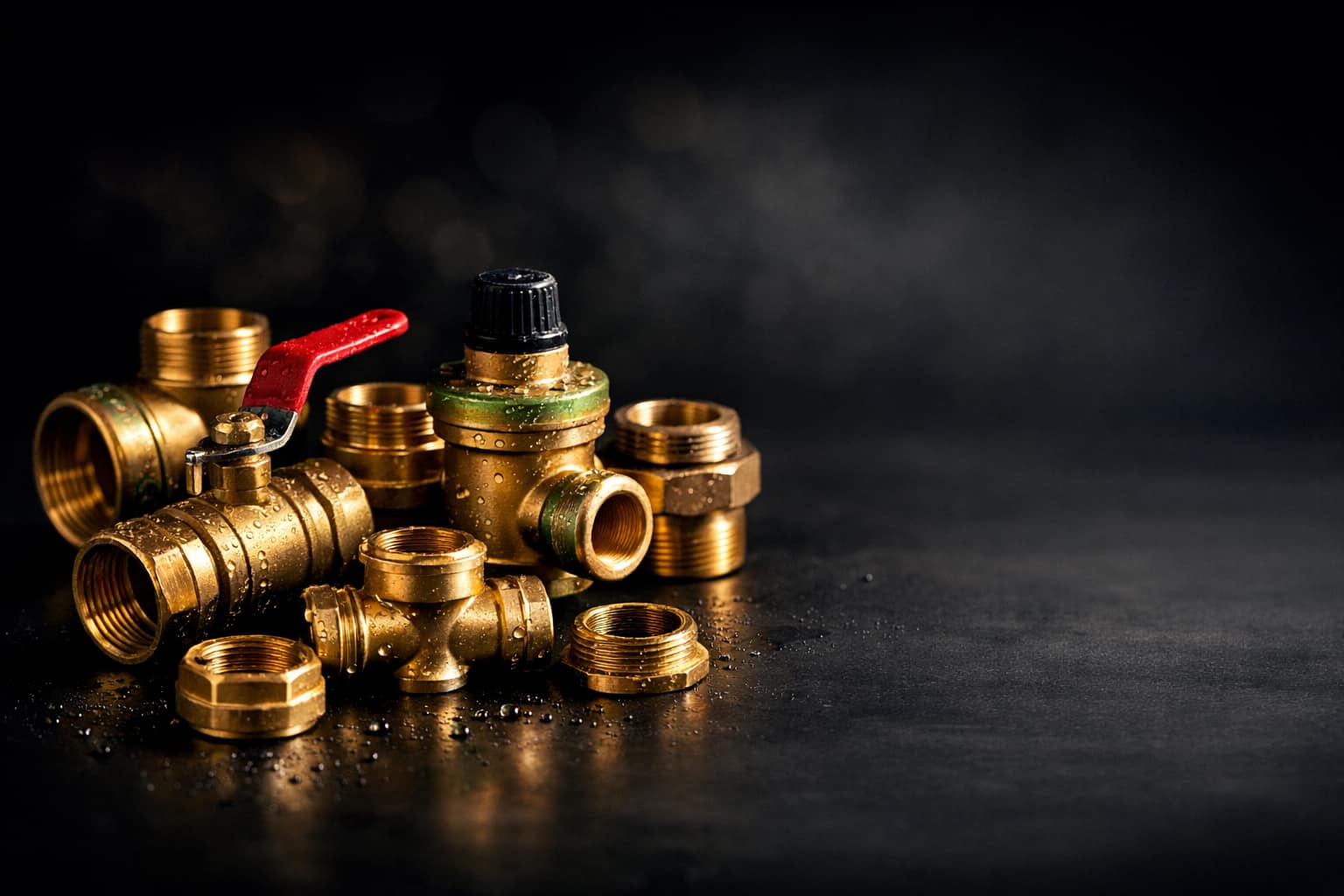
Why Brass? The Corrosion Resistance of Brass in Plumbing Systems
Introduction: The Material Choice That Lasts Generations
Walk through any historic European city and you’ll see brass plumbing fixtures that have functioned for centuries. From ancient Roman aqueducts to modern high-rise buildings, brass has proven itself as the premier material for water handling systems. But why brass? What gives this copper-zinc alloy its remarkable ability to withstand constant water exposure, pressure cycling, and aggressive water chemistries?
This technical exploration examines the metallurgical properties that make brass the material of choice for plumbing systems, diving deep into corrosion mechanisms, alloy selection, and the engineering considerations that guide modern specification.
Understanding Brass: More Than Just Copper and Zinc
Brass Alloy Families
Brass isn’t a single material, it’s a family of alloys with compositions tailored to specific applications:
| Alloy | UNS Designation | Copper % | Zinc % | Lead % | Key Properties |
| Red Brass | C23000 | 85 | 15 | 0 | Excellent corrosion resistance, formability |
| Cartridge Brass | C26000 | 70 | 30 | 0 | Good strength, excellent cold workability |
| Yellow Brass | C27000 | 65 | 35 | 0 | High strength, lower cost |
| Free-Cutting Brass | C36000 | 61.5 | 35.5 | 3 | Machinability, dezincification risk |
| Forging Brass | C37700 | 58-61 | 39-42 | 2-3 | Hot forgeability |
| Admiralty Brass | C44300 | 71 | 28 | 0 + 1% Sn | Superior seawater resistance |
| Aluminum Brass | C68700 | 77 | 20.8 | 0 + 2% Al | High seawater corrosion resistance |
| DZR Brass | C35330 | 62 | 36.8 | <0.1 + As | Dezincification resistant |
How Brass Composition Affects Corrosion Resistance
Copper Content Higher copper content (above 70%) generally improves corrosion resistance:
- Better resistance to dezincification
- Improved pitting resistance
- Superior performance in acidic waters
- Higher material cost
Zinc Content Zinc provides strength but increases susceptibility to certain corrosion mechanisms:
- Each 1% zinc increase raises tensile strength ~1,000 PSI
- Zinc above 35% significantly increases dezincification risk
- High-zinc alloys (>37%) generally not recommended for potable water
Lead Content (Legacy Alloys) Lead was historically added for machinability:
- Lead improves chip breaking during machining
- Lead does not dissolve in brass matrix, exists as discrete particles
- Modern lead-free regulations (NSF/ANSI 372) require <0.25% lead
Corrosion Mechanisms in Water Systems
1. Uniform Corrosion (General Attack)
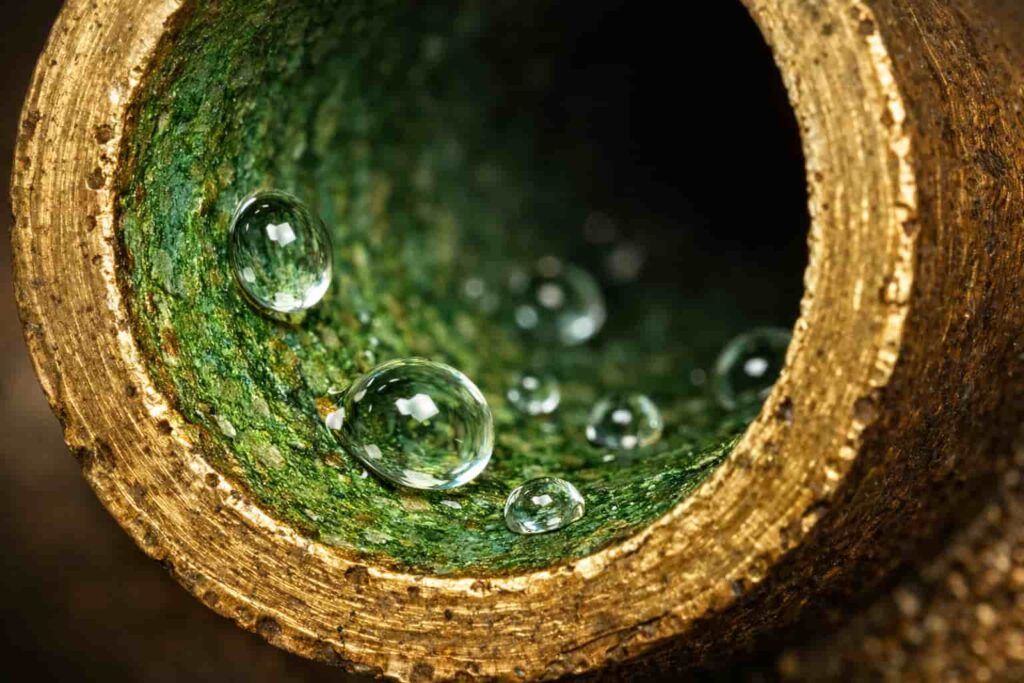
What Happens The entire surface gradually dissolves into the water, thinning the material uniformly.
Rate Factors
- Water pH (most aggressive at pH <6.5 or >8.5)
- Dissolved oxygen concentration
- Temperature (corrosion rate doubles every 18°F/10°C)
- Water velocity (erosion-corrosion at high flow)
Brass Performance Brass forms a protective patina layer (primarily copper carbonate) that dramatically slows uniform corrosion after initial exposure. In typical potable water:
- Initial corrosion rate: 0.1-0.5 mils/year
- Long-term rate (after patina formation): 0.01-0.05 mils/year
- Expected service life: 50-100+ years
2. Dezincification (Selective Leaching)
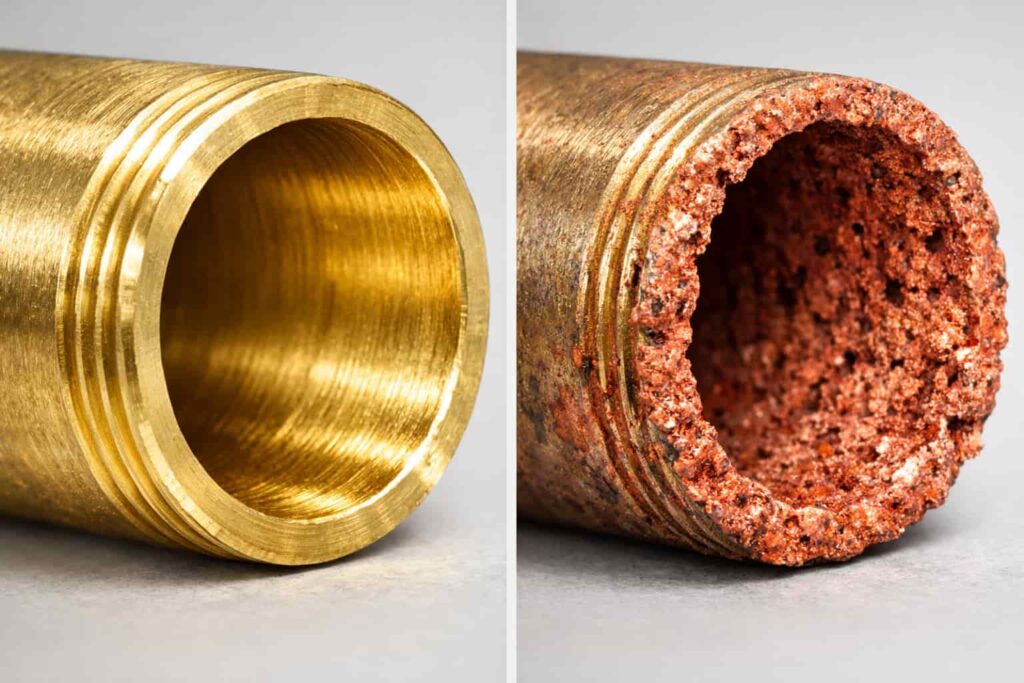
The Mechanism Dezincification is the selective removal of zinc from brass, leaving behind a porous, weak copper structure:
Original brass: Cu-Zn solid solution
↓
Dezincified layer: Porous copper (weak, spongy)
↓
Zn²⁺ ions in water
Two Types of Dezincification
| Type | Appearance | Environment | Rate |
| Plug-type | Localized pits or plugs | Stagnant or low-flow conditions, high chloride, pH >8 | Rapid, destructive |
| Layer-type | Uniform surface layer | High temperature (>140°F), acidic or alkaline pH | Slow, predictable |
Susceptibility by Alloy
- C36000 (61.5% Cu): Highly susceptible
- C37700 (58% Cu): Highly susceptible
- C26000 (70% Cu): Moderately susceptible
- C23000 (85% Cu): Low susceptibility
- DZR Brass (arsenic-inhibited): Resistant
Prevention
- Use low-zinc alloys (>70% Cu) for critical applications
- Specify DZR (dezincification-resistant) brass for aggressive waters
- Limit continuous operating temperature to <140°F (60°C)
- Ensure adequate water velocity to prevent stagnation
3. Pitting Corrosion
The Mechanism Localized attack creating small holes (pits) that can penetrate through walls:
- Initiation at surface inclusions or defects
- Local chemistry changes accelerate attack
- Can cause failure even with minimal weight loss
Factors Promoting Pitting
- Chloride ions (>250 ppm increases risk)
- Sulfate-reducing bacteria
- Carbon dioxide (forms carbonic acid)
- Oxygen concentration cells
- Surface deposits or biofilms
Brass Performance Brass is moderately resistant to pitting. C23000 and C26000 show better pitting resistance than high-zinc alloys. Proper water treatment and periodic system flushing minimize risk.
4. Stress Corrosion Cracking (SCC)
The Mechanism Combination of tensile stress and specific environments causes brittle cracking:
- Tensile stress (residual or applied)
- Ammoniacal environments (ammonia, amines, nitrates)
- Moist atmospheres with industrial pollutants
Symptoms
- Fine cracks visible under magnification
- Often initiates at threads or stress concentrators
- Can occur at stresses below yield strength
Prevention in Brass
- Stress relief annealing after forming/machining
- Avoid contact with ammonia-based cleaners
- Specify stress-relieved material for critical applications
- Design to minimize residual stresses
5. Erosion-Corrosion
The Mechanism Mechanical removal of protective films by high-velocity water, exposing fresh metal to corrosion:
Critical Velocities for Brass
| Water Condition | Maximum Recommended Velocity |
| Clean, treated water | 8-10 ft/sec (2.4-3.0 m/s) |
| Untreated freshwater | 6-8 ft/sec (1.8-2.4 m/s) |
| Seawater | 3-5 ft/sec (0.9-1.5 m/s) |
| Water with particulates | 3-4 ft/sec (0.9-1.2 m/s) |
Mitigation
- Design for lower velocities (larger diameter piping)
- Use erosion-resistant alloys (aluminum brass, 90-10 Cu-Ni)
- Avoid abrupt direction changes and restrictions
- Filter water to remove abrasive particles
Water Chemistry Effects on Brass Corrosion
pH Impact
| pH Range | Effect on Brass | Recommendation |
| <6.0 | Accelerated general corrosion, dezincification risk | Avoid or use C23000/C70600 |
| 6.0-6.5 | Moderate corrosion, manageable with proper alloy | Monitor regularly |
| 6.5-8.5 | Optimal range for most brass alloys | Standard alloys acceptable |
| 8.5-9.0 | Increased dezincification risk | Use DZR or C23000 |
| >9.0 | High dezincification risk, possible SCC | Use C23000 or alternative materials |
Chloride Concentration
Chlorides accelerate localized corrosion:
- <50 ppm: Negligible effect
- 50-250 ppm: Monitor for pitting in hot water systems
- 250-500 ppm: Use C23000 or DZR brass
- >500 ppm: Consider 90-10 Cu-Ni or stainless steel
Hardness and Scale Formation
Paradoxically, moderate water hardness benefits brass:
- Calcium carbonate scale provides barrier protection
- Very soft water (<50 ppm CaCO₃) can be more aggressive
- Very hard water (>300 ppm) may cause flow restriction from scale
Alloy Selection Guide for Plumbing Applications
Potable Water Distribution (Cold)
Recommended Alloys
- C23000 (Red Brass): Best corrosion resistance, higher cost
- C26000 (Cartridge Brass): Good balance of properties and cost
- C27000 (Yellow Brass): Acceptable for non-aggressive waters
- C35330 (DZR): Required for aggressive or unknown water chemistry
Applications
- Valve bodies and components
- Fittings and couplings
- Meter housings
- Backflow preventers
Hot Water Systems
Critical Considerations
- Temperature accelerates dezincification
- Continuous duty above 140°F (60°C) requires special alloys
Recommended Alloys
- C23000 (Red Brass): Preferred for all hot water
- C26000 (Cartridge Brass): Acceptable to 180°F intermittent
- C35330 (DZR): Required for continuous hot water or unknown chemistry
Avoid
- C36000, C37700 in continuous hot water service
- Any high-zinc alloy above 140°F continuous
Seawater and Marine Applications
Aggressive Factors
- High chloride concentration (~19,000 ppm)
- Biological fouling
- Temperature variations
- Velocity effects
Recommended Alloys
- C44300 (Admiralty Brass): Good general purpose marine brass
- C68700 (Aluminum Brass): Superior seawater resistance
- C70600 (90-10 Cu-Ni): Best for high-velocity seawater
Design Guidelines
- Limit velocity to 3-5 ft/sec for brass
- Provide for tube replacement (thin wall designs)
- Consider cathodic protection for severe service
Testing and Standards
Corrosion Test Methods
ASTM B154 – Mercurous Nitrate Test
- Detects susceptibility to stress corrosion cracking
- Specimen exposed to mercurous nitrate solution
- Cracking indicates residual stresses
ISO 6509 – Dezincification Resistance Test
- 24-hour exposure to copper chloride solution at 158°F (75°C)
- Microscopic examination for dezincification depth
- Pass/fail based on allowable penetration
ASTM G48 – Pitting and Crevice Corrosion Resistance
- Ferric chloride exposure test
- Evaluates localized corrosion susceptibility
Material Standards for Plumbing
NSF/ANSI 61 – Drinking Water System Components
- Establishes maximum contaminant levels
- Requires leaching tests for 17-day exposure
- Brass must meet lead content and extraction requirements
NSF/ANSI 372 – Lead Content
- Maximum 0.25% weighted average lead content
- Replaces previous 8% lead content standard
- Requires lead-free alloy formulations
ASTM B16/B16M – Brass Rod, Bar, Shapes
- Specifies C36000 for machining applications
- Material properties and tolerances
Southeast Asia Considerations
Regional Water Chemistry
Thailand Water Supplies
- Bangkok: Moderate hardness (100-150 ppm CaCO₃), pH 7.0-7.5
- Chiang Mai: Softer water, potential for slightly acidic conditions
- Phuket: Variable, coastal areas may have saltwater intrusion
- Industrial areas: Potential for low pH from acid rain
Recommendations
- C26000 acceptable for most applications
- DZR recommended for industrial or unknown water chemistry
- Monitor first installations in new areas for unexpected corrosion
Tropical Climate Effects
High Humidity Storage
- Brass can tarnish rapidly in humid conditions (>70% RH)
- Protective packaging (VCI paper, desiccants) recommended
- Surface oxidation cosmetic only, doesn’t affect performance
Condensation Concerns
- Cold water lines in hot, humid environments sweat
- External condensation can accelerate atmospheric corrosion
- Insulation of cold lines prevents condensation-related issues
Local Standards
Thai Industrial Standards (TIS)
- TIS 2559: Copper and copper alloy tubes for water and gas
- TIS 2560: Fittings for copper tubes
- Generally aligned with ISO and ASTM standards
Conclusion
In modern plumbing and industrial systems, the long-term performance of brass is not just a matter of tradition but of precise engineering and material science. From alloy composition to water chemistry, every factor plays a role in ensuring durability, safety, and resistance to corrosion mechanisms such as dezincification and pitting. At Align Mfg, we apply this deep technical understanding to deliver high-quality components through our expertise in thailand precision machining, ensuring that every part meets strict performance standards for demanding environments such as water systems, infrastructure, and industrial applications.
Ultimately, choosing brass is about choosing reliability over decades—not just at installation, but throughout the lifecycle of the system. With the right alloy selection, proper design considerations, and controlled manufacturing processes, brass continues to outperform many alternative materials in both residential and industrial contexts. At Align Mfg, we combine advanced machining capabilities with material expertise to help clients achieve long-lasting, corrosion-resistant solutions that are engineered for real-world conditions.
FAQ
Q1: How long will brass plumbing last?
A: Properly selected and installed brass plumbing typically lasts 50-100 years. Factors affecting longevity:
- Alloy selection (C23000 outlasts C36000 in aggressive water)
- Water chemistry (aggressive water reduces life)
- Temperature (hot water systems age faster)
- Installation quality (excessive strain causes stress corrosion) Many brass fittings from the 1920s-1950s are still in service.
Q2: Why is dezincification such a concern with brass?
A: Dezincification is insidious because:
- It occurs internally, making visual detection difficult
- The remaining porous copper looks normal but has minimal strength
- Failure can be sudden and catastrophic (pipe bursts)
- It’s accelerated by heat, chlorides, and high pH, common in water systems
- Once started, it’s impossible to stop without replacing the affected component
Q3: Can I use standard C36000 brass for potable water?
A: C36000 can be used for potable water but with caveats:
- More susceptible to dezincification than C26000 or C23000
- Requires lead-free formulation (NSF/ANSI 372 compliant)
- Not recommended for continuous hot water service
- Better choice: C26000 for general use, C23000 for critical/aggressive applications
Q4: What’s the difference between “lead-free” and “no-lead” brass?
A: Under NSF/ANSI 372:
- Lead-free: Maximum 0.25% weighted average lead content
- No-lead: Marketing term, same 0.25% requirement
- Biocide brasses (C69300, C87850) use silicon or bismuth instead of lead for machinability
- All brasses labeled for potable water in the US must meet NSF/ANSI 372
Q5: Why do some brass fittings turn green?
A: The green patina (verdigris) is copper carbonate or copper chloride:
- Forms when brass reacts with carbon dioxide and moisture
- Actually indicates active corrosion has slowed (protective layer)
- Common on outdoor fixtures or humid environments
- Generally cosmetic, doesn’t indicate imminent failure
- Can be cleaned with mild acid (vinegar) if appearance is concern
Q6: Is brass safe for drinking water?
A: Yes, brass meeting NSF/ANSI 61 is safe for drinking water:
- Leaching tests ensure minimal copper and zinc extraction
- Lead content strictly limited (<0.25%)
- Copper is an essential nutrient (RDA: 900 mcg/day for adults)
- Brass doesn’t support bacterial growth (oligodynamic effect of copper)
Q7: Can brass and galvanized steel be used together?
A: No, this creates a galvanic couple:
- Brass (cathode) + Steel (anode) = accelerated steel corrosion
- Dielectric unions or fittings required to separate dissimilar metals
- Failure to isolate leads to premature steel pipe failure
- Bronze (not brass) to steel is less problematic but still not recommended
Q8: Why choose brass over plastic (PEX, CPVC) for plumbing?
A: Brass advantages:
- Durability: 50-100 year service life vs. 25-50 for plastics
- Temperature resistance: Higher pressure ratings at temperature
- UV resistance: Can be used outdoors; plastics degrade in UV
- Fire resistance: Won’t burn or release toxic fumes
- Recyclability: 100% recyclable; plastics have limited recycling
- Proven history: Centuries of performance data
Plastic advantages:
- Lower cost
- Corrosion-proof (not corrosion-resistant)
- Flexibility
- Ease of installation
Selection depends on application priorities, budget, and expected service life.
References
[^1^]: Copper Development Association. “Corrosion Resistance of Copper and Copper Alloys in Plumbing Systems.” CDA Publication A4015-14/20.
[^2^]: American Society for Testing and Materials. “ASTM B16/B16M-21: Standard Specification for Free-Cutting Brass Rod, Bar and Shapes for Use in Screw Machines.” ASTM International, 2021.
[^3^]: National Sanitation Foundation. “NSF/ANSI 61-2023: Drinking Water System Components – Health Effects.” NSF International, 2023.
[^4^]: National Sanitation Foundation. “NSF/ANSI 372-2021: Drinking Water System Components – Lead Content.” NSF International, 2021.
[^5^]: International Organization for Standardization. “ISO 6509:2014: Corrosion of metals and alloys – Determination of dezincification resistance of brass.” ISO, 2014.
[^6^]: ASM International Handbook Committee. “ASM Handbook, Volume 13B: Corrosion: Materials.” ASM International, 2005.
[^7^]: Copper Development Association. “The Copper Tube Handbook.” CDA Publication A4050-10/19.
[^8^]: Society of Automotive Engineers. “SAE J1746: Potable Water Hose and Hose Assemblies for Marine Applications.” SAE, 2018.
[^9^]: Thai Industrial Standards Institute. “TIS 2559-2554: Copper and copper alloy tubes for water and gas.” TISI, 2011. est