
Forging Aluminum vs Steel: Strength, Weight, and Cost
Every manufacturing decision carries weight, sometimes literally. When procurement engineers and product designers face the critical choice between forged aluminum and forged steel, they’re not just selecting a material. They’re defining performance parameters, cost structures, supply chain requirements, and ultimately, product success in competitive markets.
This comprehensive analysis provides the data-driven framework manufacturing professionals need to make informed material specification decisions. Whether you’re sourcing components for aerospace systems, automotive assemblies, or marine equipment, understanding the nuanced trade-offs between aluminum and steel forgings will position your projects for optimal outcomes.
What Is Drop Forging and Why Does It Matter?
Before diving into material comparisons, it’s essential to understand why drop forging matters. Unlike casting, which can introduce porosity and inconsistent grain structures, drop forging shapes metal billets through controlled compression and deformation.
The Process Improves Strength and Durability
The drop forging process begins with a metal billet being heated to the optimal forging temperature. Once heated, a high-pressure hammer or press shapes the material into a die. This controlled compression causes the grain structure to align with the component’s shape, resulting in superior mechanical properties, enhanced durability, and a refined microstructure.
This process fundamentally improves strength, fatigue resistance, and impact absorption, regardless of whether aluminum or steel serves as the base material. The forging advantage applies to both, but each material responds differently to the process, creating distinct performance profiles.
Why Is Aluminum Lighter Than Steel in Forging Applications?
Aluminum Offers a Major Weight Advantage
Aluminum’s most celebrated characteristic in manufacturing circles is its density, which is approximately one-third that of steel. This isn’t merely a specification point; it’s a transformational advantage for applications where every gram matters.
Key density comparison:
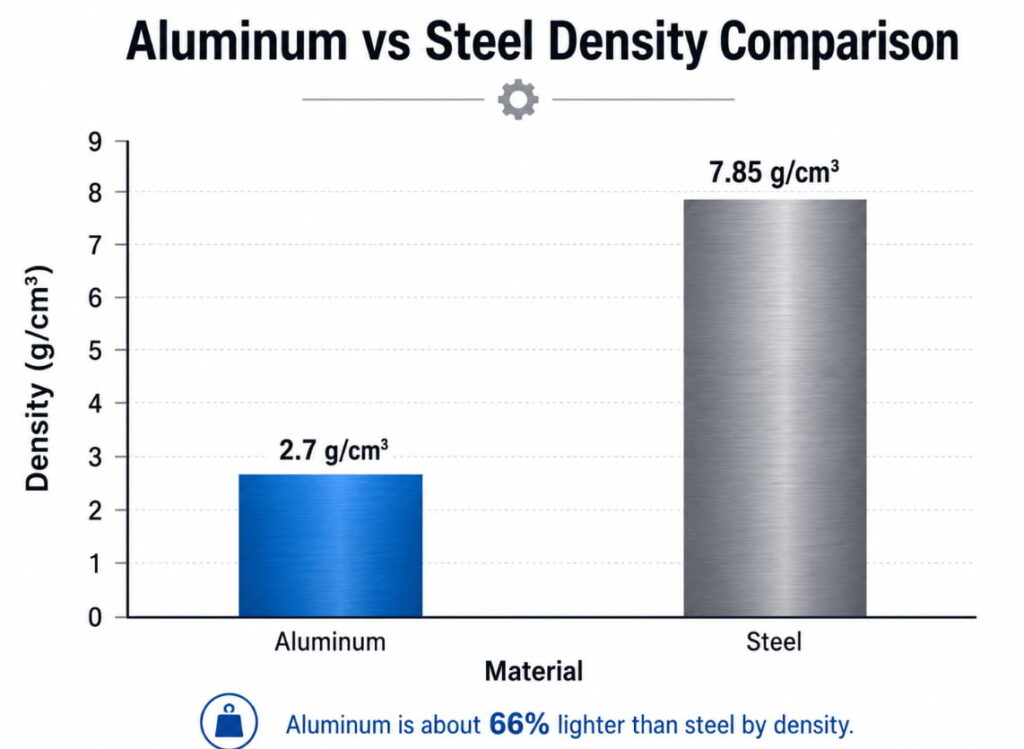
- Aluminum: 2.7 g/cm³
- Steel: 7.85 g/cm³
- Weight reduction: ~66% when switching from steel to aluminum
The Weight Difference Creates Real-World Benefits
In aerospace applications, this weight difference translates directly to fuel efficiency and payload capacity. A structural component weighing 30kg in steel becomes approximately 10kg in aluminum, resulting in a 20kg saving that compounds across thousands of parts in modern aircraft.
Transportation sector benefits include:
- Automotive: Reduced unsprung weight improves handling and fuel economy
- Aerospace: Every kilogram saved equals significant lifetime fuel savings
- Marine: Lower displacement improves vessel speed and efficiency
- Electric vehicles: Extended range through weight reduction
Aluminum Is Best When Weight Matters Most
Aluminum should be prioritised when mobility, transportation efficiency, and handling are important. It is especially useful when component weight affects overall system performance or when fuel costs represent a significant operational expense.
Is Steel Stronger Than Aluminum in Forged Components?
Steel Has Higher Absolute Strength
Steel maintains its reputation for raw strength, and deservedly so. In absolute terms, forged steel components withstand higher loads and stresses than their aluminum counterparts.
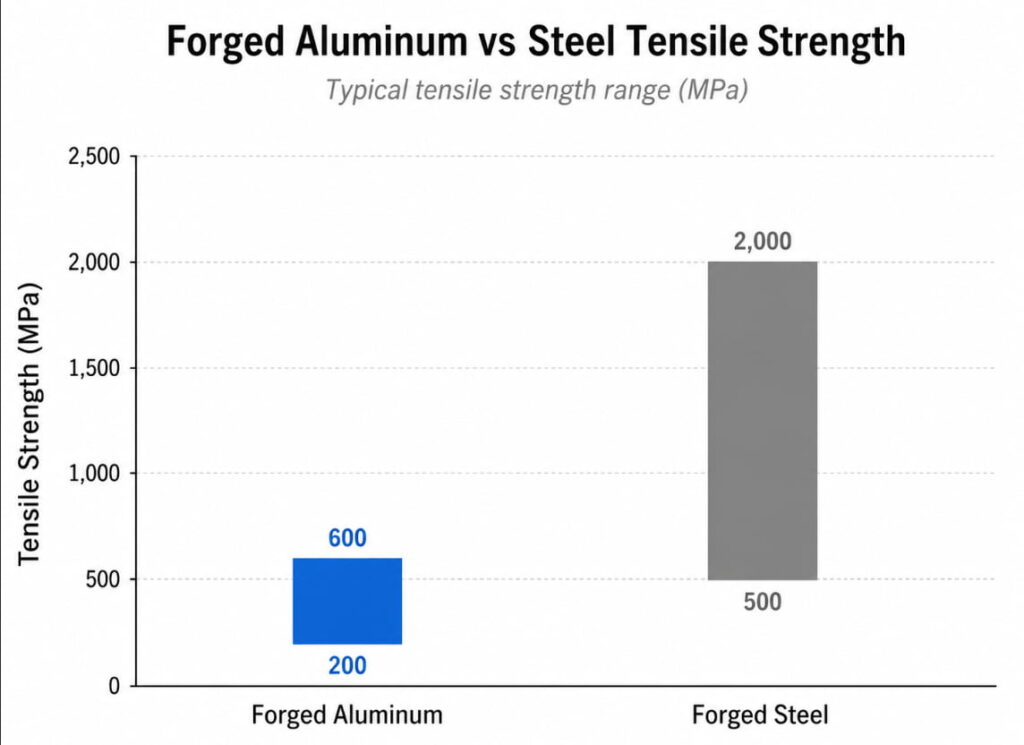
Tensile strength comparison:
- Forged steel: 500–2,000 MPa, depending on alloy and heat treatment
- Forged aluminum: 200–600 MPa, depending on alloy and temper
However, this comparison becomes more nuanced when examining strength-to-weight ratio, a critical metric for design engineers.
Aluminum Competes Through Strength-to-Weight Ratio
When normalised for weight, high-performance aluminum alloys approach and sometimes exceed steel’s performance. This is why aerospace manufacturers extensively use aluminum despite steel’s higher absolute strength.
Specific strength comparison:
- High-strength aluminum alloys: 150–220 kN·m/kg
- Medium-carbon steel: 65–130 kN·m/kg
For equivalent weight budgets, aluminium often delivers superior structural performance.
Fatigue Resistance Depends on the Application
Forged components typically face cyclic loading, making fatigue resistance crucial. Forged aluminum performs well in high-cycle fatigue applications, especially with alloys such as 7075 and 7050. It is also well-suited for vibrating environments.
Forged steel, on the other hand, offers exceptional endurance limits in many alloy grades. It delivers consistent performance under repeated stress and is usually preferred for high-load, low-cycle applications.
How Do Aluminum and Steel Compare for Corrosion Resistance?
Aluminum Has Natural Corrosion Protection
Aluminum possesses an inherent corrosion resistance that steel cannot match without additional treatments. When exposed to oxygen, aluminum forms a thin, hard oxide layer that protects the underlying metal from further oxidation.
This oxide layer is valuable because it is self-healing, permanent, and effective in most atmospheric and marine environments. Scratches naturally re-oxidize, meaning the protection does not require constant reapplication or maintenance.
This makes aluminum suitable for:
- Marine applications and coastal installations
- Outdoor architectural components
- Food processing equipment
- Chemical processing environments
Steel Requires Additional Protection
Steel requires active corrosion protection through methods such as galvanizing, powder coating, paint systems, or plating. Stainless steel is another option, but it usually involves higher material costs, reduced machinability, and different forging characteristics.
Steel components also require ongoing inspection and maintenance of protective systems. Damage to coatings creates vulnerability points where corrosion can start and spread, sometimes invisibly until significant damage has occurred.
Which Material Is More Cost-Effective: Forged Aluminum or Forged Steel?
Steel Has Lower Raw Material Costs
At first glance, aluminum appears more expensive than steel.
Approximate raw material pricing:
- Aluminum: $2.50–4.00 per kg
- Steel: $0.50–1.50 per kg
However, material cost represents only one component of total cost of ownership.
Aluminum Can Reduce Processing Costs
Aluminum often offsets its higher raw material cost through easier machining and lower processing requirements. It can be machined faster, causes less tool wear, consumes less energy during processing, and makes it easier to achieve tight tolerances.
Steel, by contrast, usually requires slower machining, higher tooling costs, greater energy consumption, and may need post-forging heat treatment.
Finished Part Cost Can Favor Aluminum
For complex components requiring significant machining after forging, aluminum’s superior machinability can offset its higher raw material cost.
Example:
- Steel forging: $100 material + $300 machining = $400 total
- Aluminum forging: $150 material + $150 machining = $300 total
In this example, the aluminum component costs 25% less despite the material itself being more expensive.
Where Are Aluminum and Steel Forgings Used Across Industries?
Aerospace Strongly Favors Aluminum
Aerospace represents the ultimate proving ground for aluminum forgings. The sector’s strict weight requirements make aluminium the dominant choice for many components.
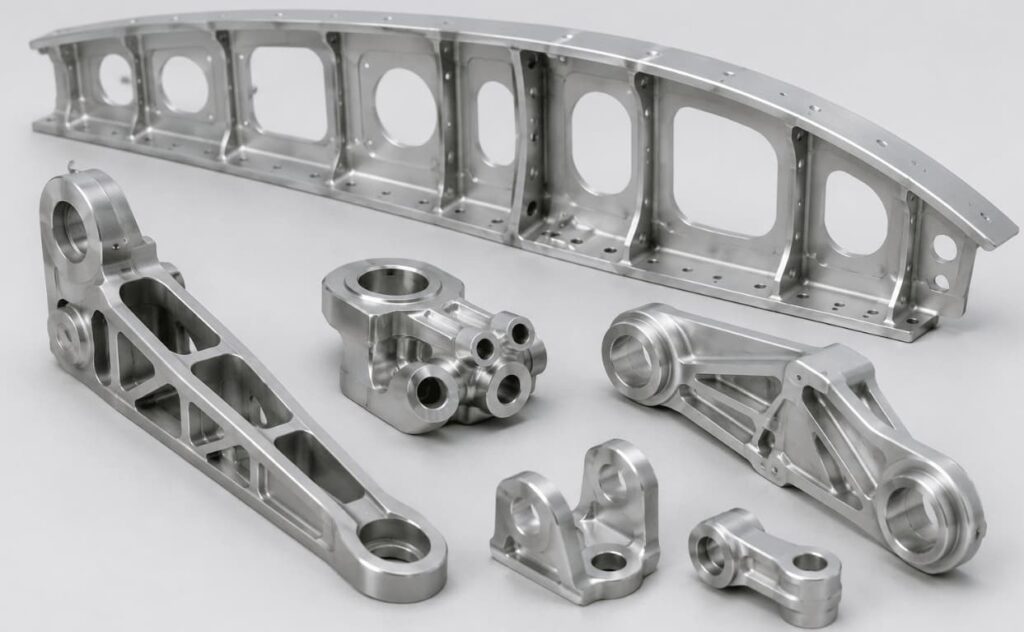
Typical aerospace applications include:
- Wing spars and ribs
- Fuselage frames
- Landing gear components
- Control surfaces
- Engine mounts
Common aerospace-grade aluminum alloys include 7075 for high strength-to-weight ratio, 7050 for toughness and stress corrosion resistance, and 2024 for fatigue resistance in wing and fuselage applications.
Automotive Manufacturing Uses Both Materials
Modern vehicles use both aluminum and steel strategically. Steel remains dominant in structural safety components, high-stress suspension parts, engine and transmission components, and cost-sensitive high-volume parts.
Aluminum is increasingly used for body panels, wheels, engine blocks, heads, and suspension components where weight reduction, thermal efficiency, and handling improvement are important.
Marine Applications Often Favor Aluminum
Marine environments heavily favor aluminum because of its corrosion resistance. It is commonly used for smaller vessel hull structures, superstructures, deck components, masts, rigging, and engine components.
Steel remains important in marine applications where heavy structural strength is needed, such as large vessel hulls, propeller shafts, anchoring systems, and high-load deck equipment.
Industrial Equipment Selection Depends on Performance Needs
Industrial applications typically prioritise strength and durability over weight. Steel is often preferred for heavy machinery components, press frames and beds, gear blanks, and high-load bearing housings.
Aluminum is becoming more common in robotics, conveyor systems, pneumatic equipment, and electronics enclosures where weight reduction, energy efficiency, portability, and heat dissipation matter.
How Should You Choose Between Aluminum and Steel Forgings?
Aluminum Is Better for Lightweight and Corrosion-Resistant Applications
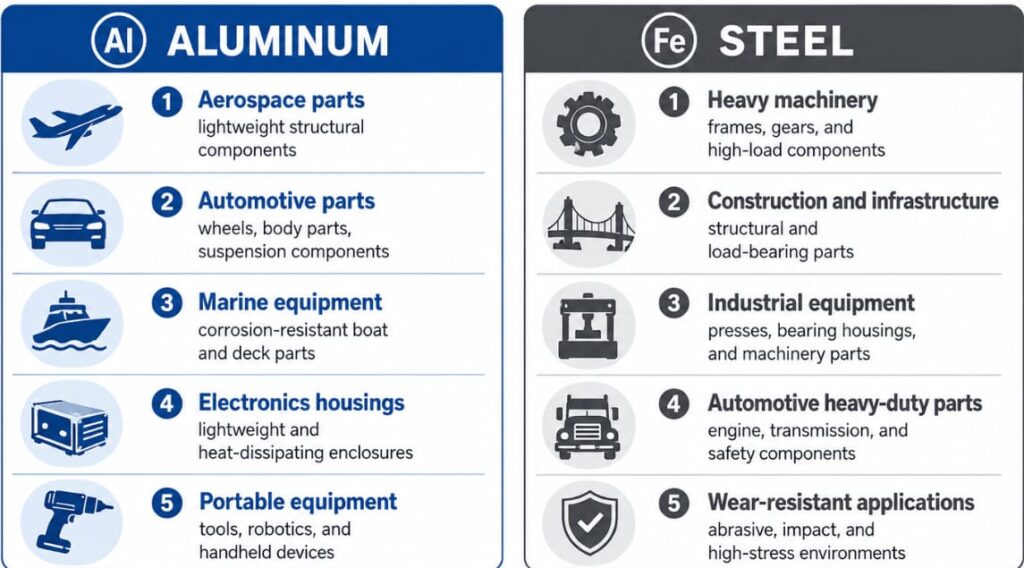
Aluminium should be prioritised when weight is critical, corrosion resistance is required, machining costs dominate, or thermal performance matters. It is especially suitable for transportation applications, aerospace components, handheld equipment, racing vehicles, marine environments, chemical exposure, and components with complex geometries.
Steel Is Better for Strength, Wear Resistance, and Cost-Sensitive Applications
Steel should be prioritised when absolute strength, wear resistance, cost sensitivity, or established supply chains matter most. It is often the better choice for heavy load-bearing components, safety-critical structures, high-impact applications, bearing surfaces, abrasive environments, and high-volume production.
What Forging Process Factors Should Engineers Consider?
Aluminum Requires Lower Forging Temperatures
Aluminum forging usually takes place at around 350–500°C. This lower temperature means less energy input, faster heating and cooling cycles, and reduced thermal stress on tooling.
Steel forging typically takes place at around 1,100–1,250°C. This requires higher energy consumption, longer heating cycles, and greater thermal stress on equipment.
Temperature Affects Die Life and Tooling Costs
The temperature difference between aluminum and steel has a major impact on tooling economics. Aluminum’s lower forging temperature generally extends die life, reduces maintenance frequency, lowers replacement costs, and allows higher production volumes per die set.
Steel forging usually creates more thermal fatigue, requires more frequent maintenance, involves higher tooling investment, and may require die replacement more often.
How Sustainable Are Aluminum and Steel Forgings?
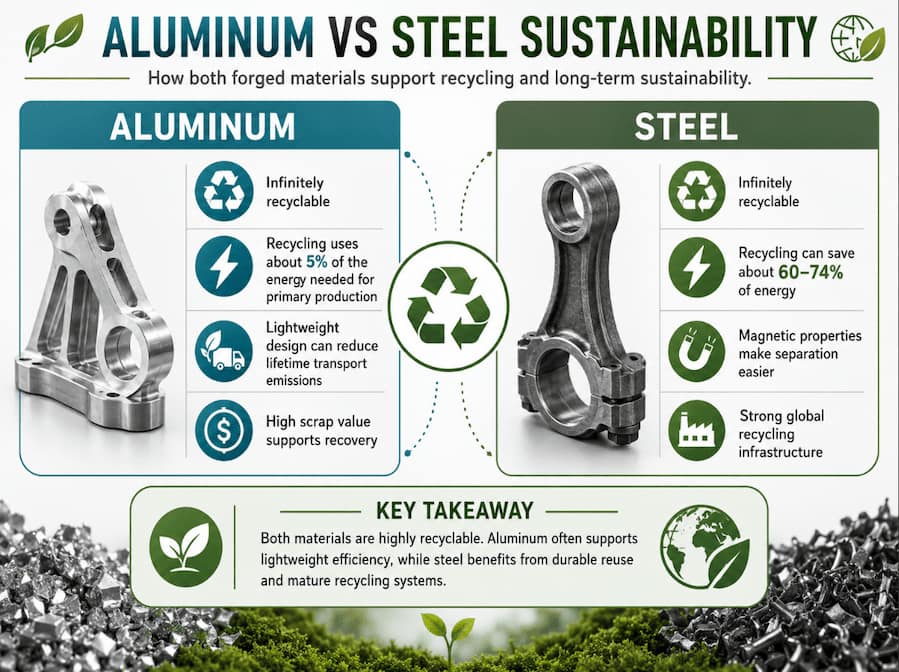
Both Materials Are Highly Recyclable
Both aluminum and steel offer excellent recyclability, but they differ in energy savings and recovery characteristics.
Aluminum is infinitely recyclable without quality loss, and recycling requires only around 5% of the energy needed for original production. It also has well-established recycling infrastructure and high scrap value, which encourages recovery.
Steel is also infinitely recyclable. Recycling steel saves around 60–74% of energy, and its magnetic properties make separation easier. It also benefits from established global recycling markets.
Lifecycle Impact Depends on the Application
Steel may have higher per-kg CO₂ emissions, while aluminum has an energy-intensive initial production process. However, in lightweight transportation applications, aluminum’s weight savings can result in lower lifetime emissions despite its higher production footprint.
How Should Aluminum and Steel Forgings Be Tested for Quality?
Both Materials Require Rigorous Testing
Both aluminum and steel forgings require careful quality verification. Common non-destructive testing methods include ultrasonic testing for internal defects, magnetic particle inspection for surface cracks, dye penetrant inspection for surface-breaking defects, and X-ray inspection for complex geometries.
Aluminum and Steel Have Different Testing Priorities
Aluminum-specific checks often focus on stress corrosion cracking susceptibility, heat treatment verification, and surface finish requirements.
Steel-specific checks often focus on hardness testing after heat treatment, microstructure verification, and temper and toughness validation.
What Are the Future Trends in Aluminum and Steel Forging?
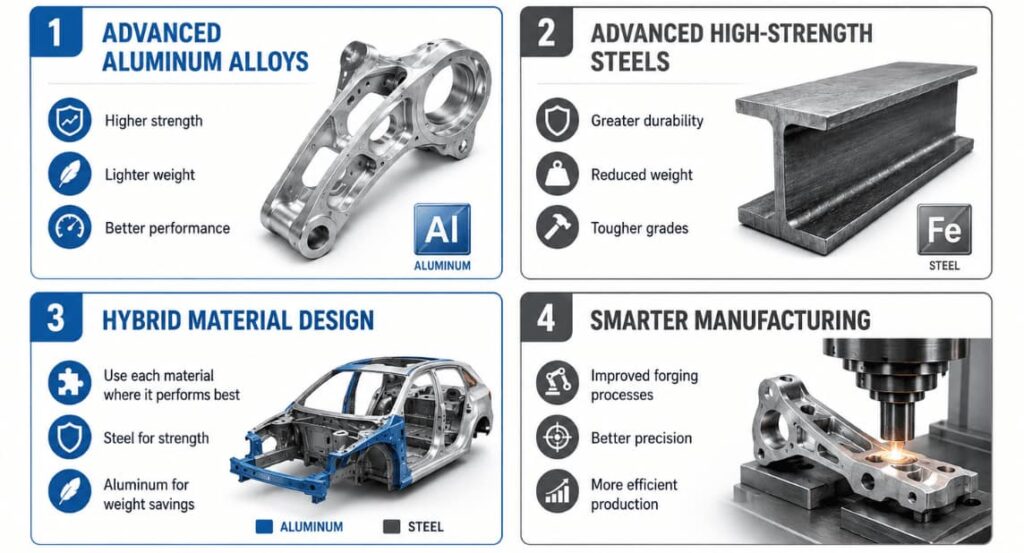
Aluminum Alloys Are Becoming Stronger
Research continues to develop aluminum alloys with improved performance. Emerging developments include scandium-aluminum alloys for exceptional strength, aluminum-lithium alloys for further weight reduction, nanostructured aluminum for enhanced properties, and improved recycling processes.
Steel Grades Are Also Advancing
Steel development focuses on achieving higher strength without major weight penalties. Advanced high-strength steels include dual-phase steels, transformation-induced plasticity steels, and twinning-induced plasticity steels.
Hybrid Material Approaches Are Growing
Innovative designs increasingly combine both materials. Multi-material structures may use steel cores with aluminum skins, strategic material placement, optimized strength-to-weight ratios, and a better balance between cost and performance.
Conclusion
The aluminum versus steel forging decision defies simple answers. Each material offers distinct advantages that align with specific application requirements, cost structures, and performance priorities.
Aluminum’s main advantages are light weight, corrosion resistance, machinability, and excellent strength-to-weight ratio. This makes it the optimal choice for transportation, aerospace, and weight-sensitive applications.
Steel’s main strengths are absolute strength, cost efficiency, wear resistance, and established supply chains. This makes it the preferred material for heavy-duty industrial, safety-critical, and high-volume applications.
Successful procurement engineers and product designers recognize that material selection represents a systems decision, not merely a material specification. By analyzing weight requirements, corrosion exposure, machining needs, volume economics, and performance priorities, manufacturers can confidently specify the optimal material for their applications. The forged component’s success depends not just on the material chosen, but on how well that material aligns with the application’s unique demands.
Here at Align Manufacturing, we help overseas companies source high-quality forged and engineered metal components from trusted manufacturing locations across Thailand, Vietnam, and India. As an operated manufacturing partner with local teams on the ground, we combine communication and project management with regional production expertise. For businesses searching for Forging In Thailand solutions, we provide a practical route to cost-effective, reliable, and customized forged components while helping reduce over-reliance on a single sourcing market.