
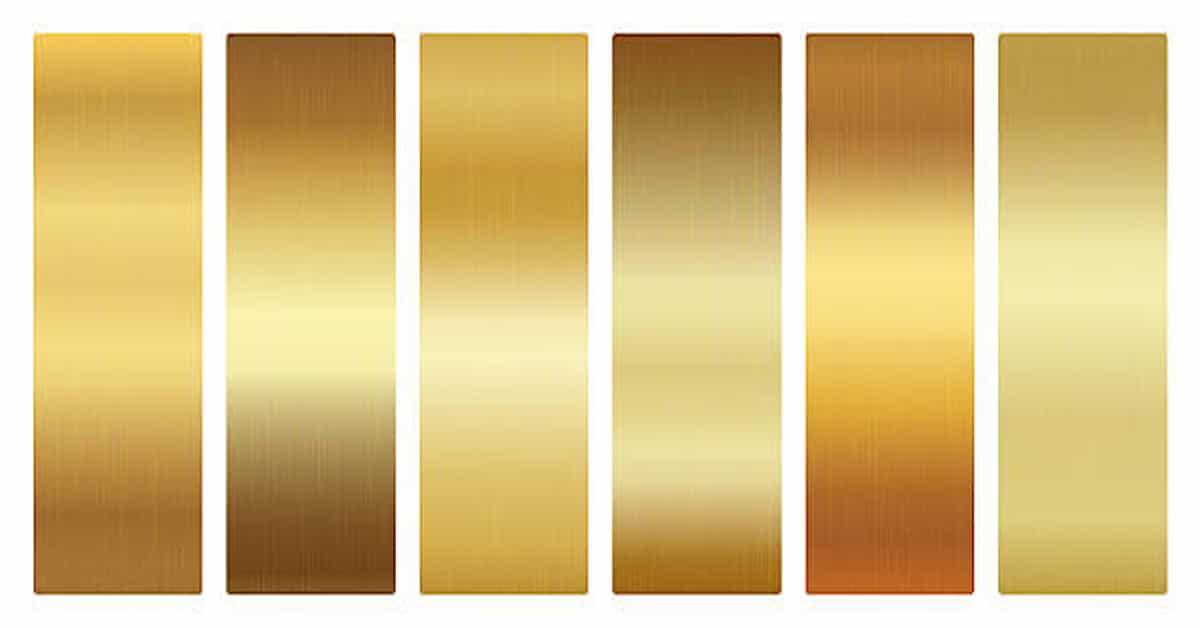
Brass Surface Finishes: From Polish to Powder Coat for Function & Aesthetics
Why Does Brass Finishing Matter?
Brass Finishing Improves Appearance, Protection, and Performance
Brass is valued for its warm golden colour, good machinability, corrosion resistance, and versatility. It is used in architectural hardware, marine components, musical instruments, plumbing fixtures, decorative parts, consumer products, and precision components. However, raw brass is only the starting point. Without the right surface finish, brass can tarnish, show machining marks, lose visual appeal, or fail to meet the performance needs of demanding applications.
Surface finishing transforms brass from a basic machined material into a finished component with improved durability, appearance, corrosion resistance, wear performance, and cleanability. The right finish can preserve the natural brass look, create a modern satin texture, add a protective coating, or completely change the surface for industrial use.
Common reasons for finishing brass include:
- Improving visual appeal
- Reducing tarnishing
- Increasing corrosion resistance
- Improving wear resistance
- Creating a specific texture or colour
- Making the surface easier to clean
- Preparing the part for outdoor, marine, medical, or decorative use
Choosing the correct finish depends on how the brass part will be used. A decorative indoor handle may only need polishing and lacquer, while outdoor architectural hardware may need powder coating or PVD coating. A marine component may need saltwater protection, while a medical or food service component may need a cleanable, non-toxic surface.
Why Is Brass Composition Important Before Finishing?
Brass Grade Affects Finish Quality and Durability
Brass is mainly made from copper and zinc. The ratio of these metals affects the material’s colour, strength, machinability, corrosion resistance, and finishing behaviour. Different brass grades respond differently to polishing, plating, coating, and chemical treatment.
- C260 Cartridge Brass: Contains around 70% copper and 30% zinc. It is suitable for polishing and plating and offers good corrosion resistance.
- C360 Free-Cutting Brass: Known for excellent machinability, but it may contain lead, which can affect plating and regulatory requirements.
- C464 Naval Brass: Contains added tin for better corrosion resistance, making it suitable for marine applications.
- C485 Leaded Brass: Offers improved machinability, but some environmental regulations may limit its finishing options.
Understanding the brass grade matters because finishing is not only about appearance. The metal composition can affect coating adhesion, colour consistency, corrosion performance, and compatibility with different finishing processes.
As-Machined Brass Is Usually the Starting Surface
As-machined brass often has tool marks, small imperfections, and a raw metallic appearance. In some industrial applications, this may be acceptable. However, most decorative, architectural, and consumer-facing brass parts require additional finishing to improve appearance and performance.
The as-machined surface typically has a roughness of around 32-125 microinches Ra, depending on machining conditions. From this starting point, the surface can be polished, brushed, bead blasted, lacquered, plated, powder coated, patinated, or treated with advanced coatings.
What Mechanical Finishes Are Used for Brass?
Polished Brass Creates a Classic Mirror Finish
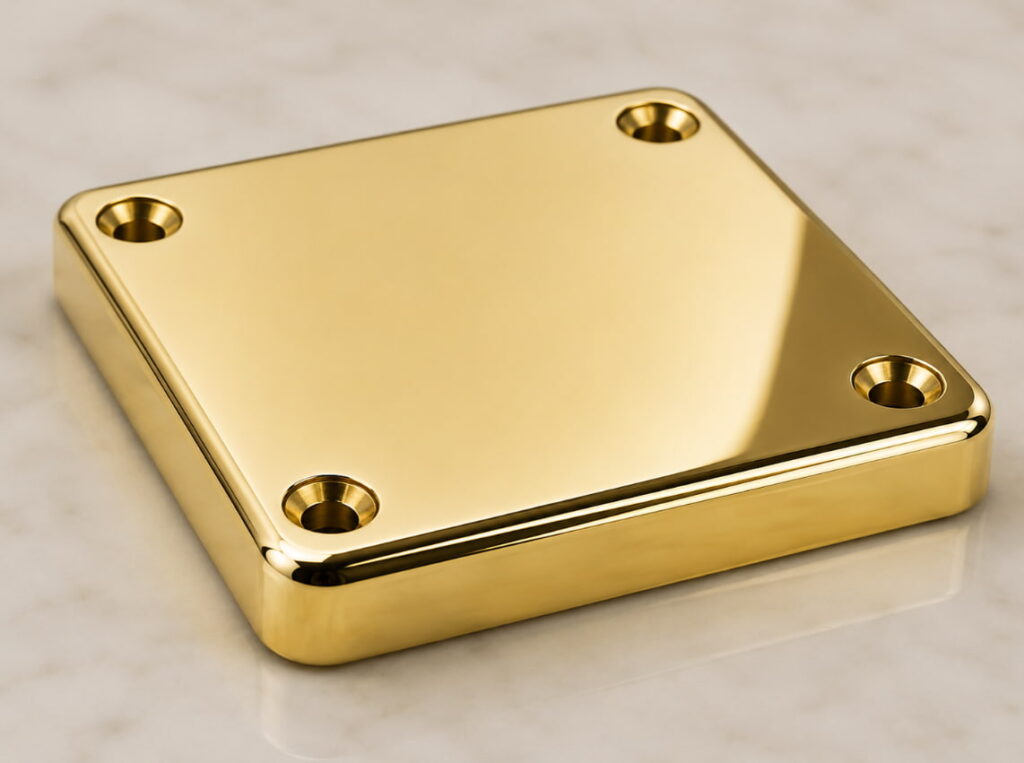
Polished brass is one of the most recognisable brass finishes. It creates a bright, reflective, mirror-like surface that highlights the natural golden colour of the material. This finish is common in luxury hardware, decorative parts, musical instruments, architectural details, and premium fixtures.
The polishing process uses progressive abrasion. It usually starts with coarser compounds, such as 80-120 grit, before moving to finer polishing compounds that can reach up to 10,000 grit. Modern facilities may use automated buffing wheels, robotic polishing arms, and polishing compounds designed specifically for brass.
Key features of polished brass include:
- Bright mirror-like appearance
- High reflectivity, usually around 85-95% gloss
- Surface roughness of around 2-8 microinches Ra
- Premium decorative appeal
- Improved cleanability
- Higher maintenance compared to matte finishes
Functionally, polishing can improve cleanability, reduce friction, minimise bacterial adhesion, and support optical or decorative applications. However, polished brass requires regular maintenance because exposed brass can tarnish over time. Mild soap, soft cloths, brass wax, clear lacquer, and reduced exposure to humidity or salt air can help preserve the finish.
Brushed Brass Creates a Satin Directional Finish
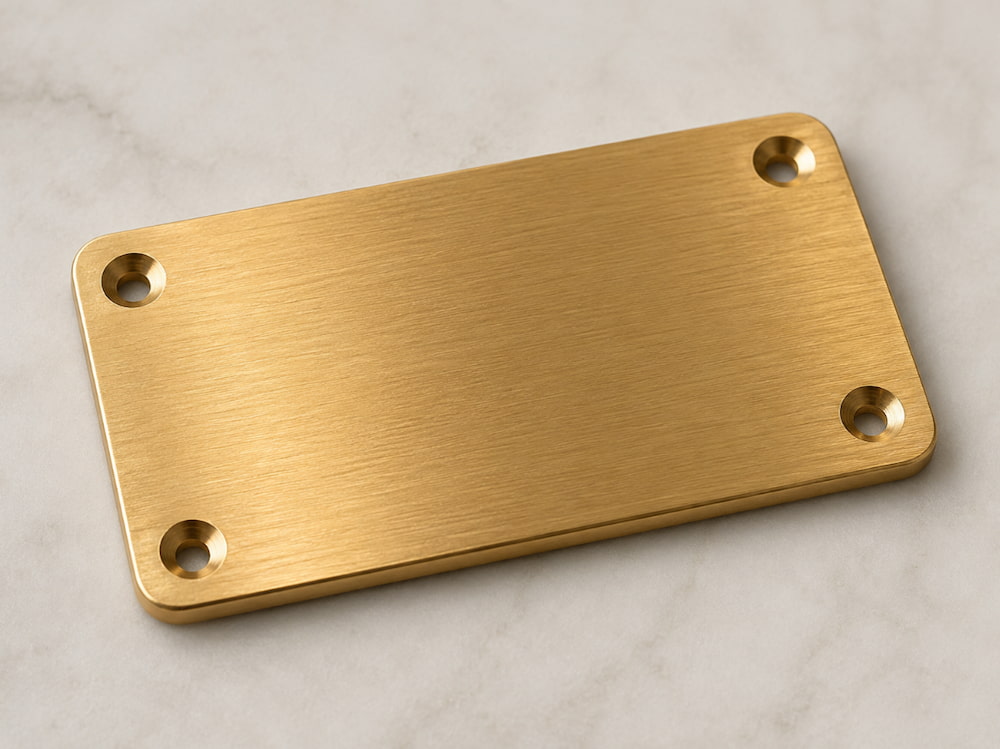
Brushed brass, also called satin brass, creates a softer and more modern appearance than mirror-polished brass. Instead of being highly reflective, it has fine directional lines across the surface. This gives the brass a contemporary look while helping to hide fingerprints, small scratches, and everyday wear.
The brushing process uses abrasive belts, wheels, or hand tools to create uniform directional scratches. A fine satin finish may use 180-240 grit abrasives, while a coarser brushed finish may use 80-120 grit materials. The final surface roughness is usually around 16-64 microinches Ra.
Brushed brass is often chosen because it:
- Creates a modern satin look
- Reduces glare
- Hides fingerprints better than polished brass
- Conceals minor scratches more effectively
- Offers better grip
- Requires less maintenance than mirror-polished brass
Brushed brass is popular in kitchen fixtures, consumer electronics, automotive interiors, commercial hardware, and modern architectural details. However, brushed finishes can show wear patterns over time, especially in high-contact areas. For the best appearance, the brushing direction should remain consistent across the full part.
Bead Blasting Creates a Uniform Matte Texture

Bead blasting uses small glass, ceramic, or stainless steel beads propelled at high velocity against the brass surface. This creates a uniform matte texture without directional grain. Unlike brushed brass, bead blasted brass has a more even, non-directional appearance.
Typical media size ranges from 50-200 microns, while pressure may range from 40-100 psi depending on the desired texture. The resulting surface roughness is usually around 32-125 microinches Ra.
Bead blasted brass is useful when the goal is to create:
- A non-directional matte surface
- Reduced glare
- Better coating adhesion
- A consistent finish on complex shapes
- Better concealment of manufacturing imperfections
Bead blasted brass is often used for scientific instruments, industrial controls, marine hardware, architectural parts, and components that need reduced glare. Another major benefit is coating adhesion. Because bead blasting creates a lightly textured surface, it is often used before painting, powder coating, or other protective coatings.
What Chemical and Electrochemical Finishes Are Available for Brass?
Clear Lacquering Preserves the Natural Brass Appearance
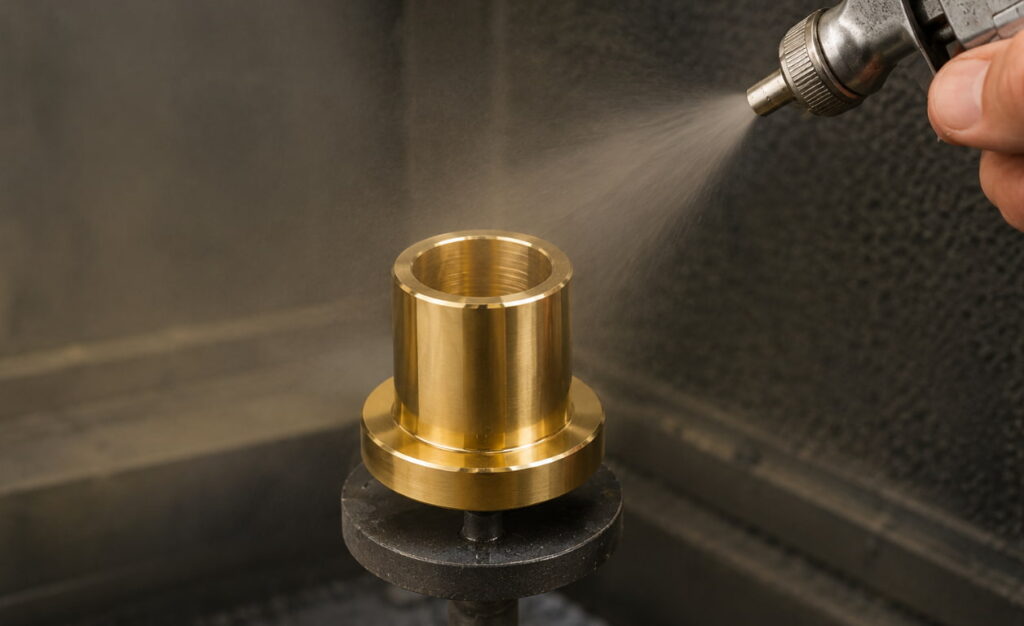
Clear lacquering involves applying a transparent protective coating over brass. The coating is usually acrylic, polyurethane, or epoxy-based. Its purpose is to slow tarnishing while allowing the natural brass colour to remain visible.
Common application methods include:
- Spray coating for thin, uniform films
- Dip coating for complex parts that need full coverage
- Electrostatic spray for efficient application and reduced overspray
Typical film thickness ranges from 0.5-2.0 mils, or 12-50 microns. Depending on the formulation, the coating may air dry, thermally cure, or UV cure. With proper surface preparation, clear lacquer can achieve strong adhesion ratings.
Clear lacquer maintains most of the underlying brass appearance and can be produced in gloss, semi-gloss, or matte finishes. Its main limitation is durability. Outdoors, quality clear lacquer may last around 2-5 years before showing yellowing, cracking, peeling, or wear. Indoors, it may last around 5-10 years with proper care. For longer-lasting protection, clear powder coating or PVD coating may be better.
Electroplating Adds a Durable Metallic Surface
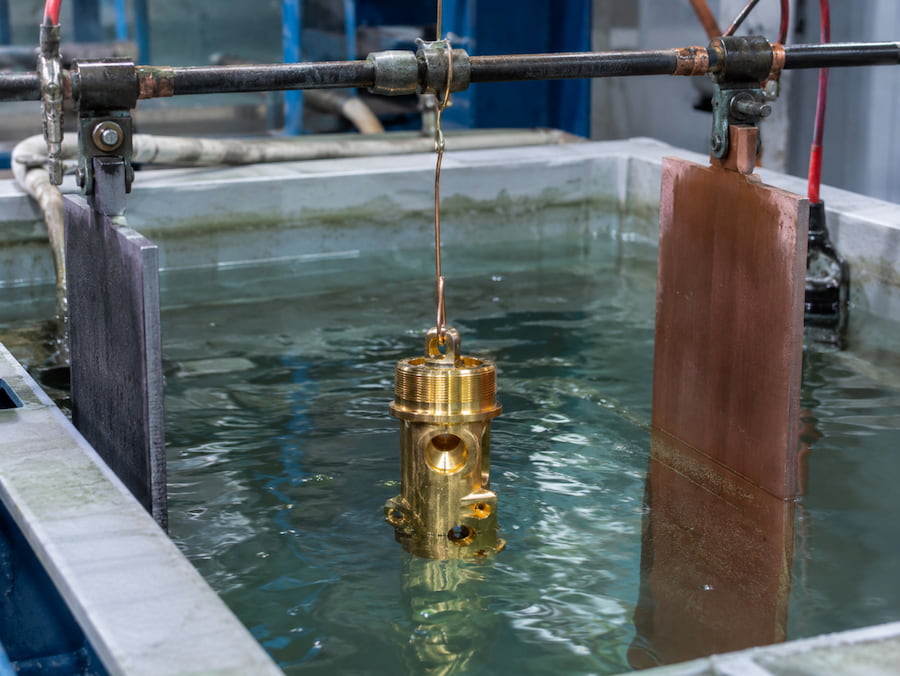
Electroplating deposits a thin metal layer onto brass through an electrochemical process. Nickel plating is one of the most common choices because it provides a bright, durable, corrosion-resistant surface. It can also act as an undercoat for chromium plating.
Nickel plating is valued because it provides:
- A bright or satin metallic appearance
- Good corrosion resistance
- Good wear resistance
- Increased surface hardness
- Better durability for plumbing, marine, and automotive parts
- Metallic conductivity compared to powder coating
A typical nickel plating bath may contain nickel sulfate, nickel chloride, and boric acid. Current density may range from 20-50 amps per square foot, while deposition rates may range from 0.0005″-0.002″ per hour. Decorative nickel plating thickness is usually around 0.0002″-0.001″.
Compared to powder coating, nickel plating keeps a metallic finish and maintains conductivity. Powder coating usually provides stronger outdoor protection, better UV resistance, and more colour flexibility, but it is thicker and electrically insulating. The better option depends on whether the part needs appearance, conductivity, wear resistance, or environmental protection.
Chemical Patinas Create Controlled Aging Effects
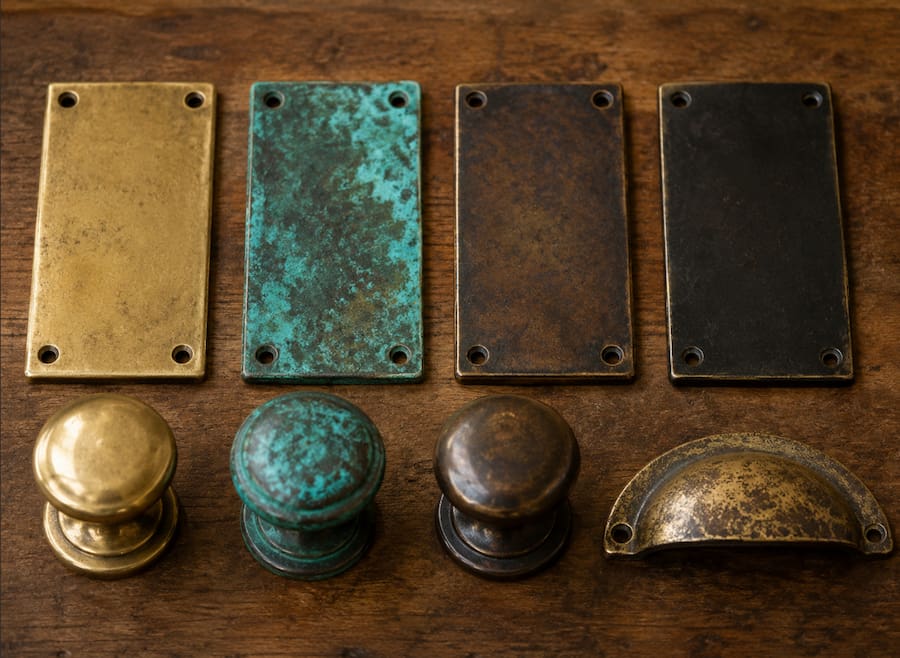
Chemical patinas use controlled reactions to create aged, darkened, or artistic brass finishes. They are often used in restoration work, decorative arts, architectural details, custom hardware, and artistic installations.
Common patina types include:
- Verdigris: Creates blue-green aged effects
- Antique brown: Creates brown-black tones
- Heat patina: Creates iridescent oxide colours
- Selective patina: Creates decorative contrast on specific areas
Patina results depend on surface preparation, chemical concentration, temperature, exposure time, and application method. Because patinas can wear unevenly in high-contact areas, they are usually sealed with lacquer, wax, polyurethane, epoxy clear coat, or clear powder coating. This helps preserve the aged appearance while improving durability.
What Advanced Coating Technologies Are Used for Brass?
Powder Coating Provides Durable Protection and Colour Flexibility
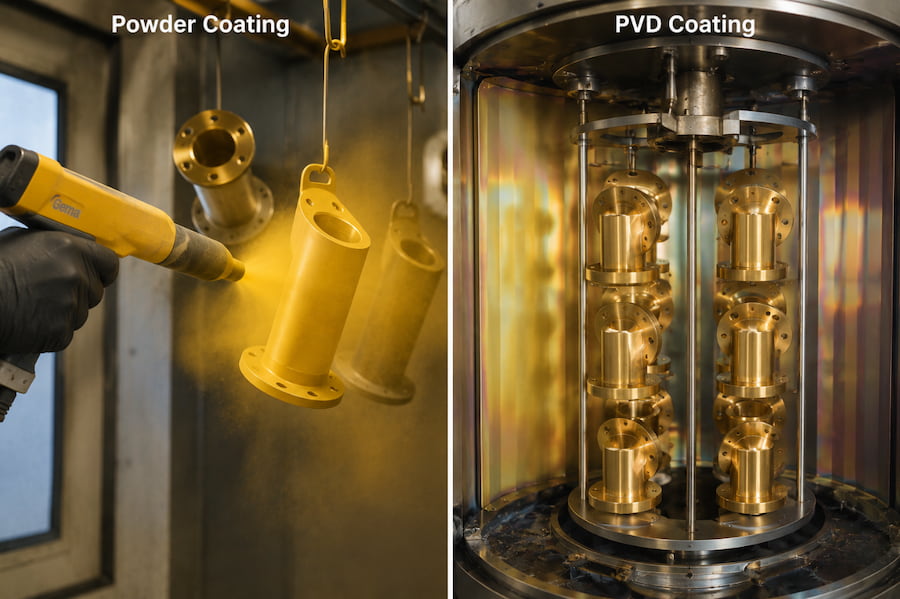
Powder coating uses dry powder particles that are electrostatically applied to grounded brass parts. The coated part is then heated so the powder melts, flows, and cures into a continuous protective film.
Powder coating is one of the strongest options for outdoor brass. Super durable polyester formulations offer good UV resistance, corrosion protection, mechanical durability, and design flexibility. In harsher environments, a two-coat system may be used, such as an epoxy primer for corrosion resistance and a polyester topcoat for UV stability.
Good surface preparation is essential before powder coating. The usual steps include:
- Degreasing to remove oils and contaminants
- Mechanical profiling using glass beads or aluminium oxide
- Chemical pretreatment using zirconium or silane coatings
- Outgassing for cast brass parts
- Controlled curing at the correct part metal temperature
Brass presents some technical challenges during powder coating. Its high electrical conductivity can create Faraday cage effects in corners or recessed areas. Its high thermal conductivity means it heats faster than steel, so cure profiles may need adjustment. Zinc migration can also affect adhesion if pretreatment is poor.
Powder formulations for brass include TGIC polyester, epoxy-polyester hybrids, clear powders, and metallic powders. Clear powder coatings can protect brass while maintaining its natural golden colour, but the surface must be prepared carefully because imperfections may remain visible beneath the clear coating.
PVD Coating Provides High-Tech Wear Resistance
PVD, or Physical Vapor Deposition, creates ultra-thin, hard coatings in a vacuum environment. These coatings improve hardness, wear resistance, friction performance, and appearance while adding very little thickness.
Common PVD coatings for brass include:
- Titanium Nitride (TiN): Gold-coloured and extremely hard
- Chromium Nitride (CrN): Silver-gray with good corrosion resistance
- Diamond-Like Carbon (DLC): Black, low-friction, and highly wear-resistant
PVD coating thickness is usually around 1-5 microns. Process temperatures may range from 400-900°F, or 204-482°C. These coatings can reach very high hardness levels, such as 2000-3000 HV.
Compared to traditional plating, PVD is thinner, harder, and more wear-resistant. Traditional electroplating can provide good corrosion resistance and may cover internal surfaces more effectively, but PVD is better for precision components where dimensional accuracy, low friction, and hardness matter.
What Functional Finishes Are Used for Specialized Brass Applications?
Specialized Finishes Can Add Antimicrobial, Low-Friction, or Thermal Properties
Some brass parts require more than appearance and corrosion protection. Functional finishes can improve hygiene, reduce friction, or control heat transfer.
Specialized brass finishes may include:
- Antimicrobial finishes for high-touch healthcare or food service surfaces
- PTFE-based low-friction coatings for sliding or moving parts
- Thermal control finishes for electronics, aerospace, and energy systems
- Food-safe coatings for cleanable, non-toxic surfaces
For healthcare and food service, antimicrobial finishes can enhance brass’s natural copper-based antimicrobial properties. Surface treatments such as micro-roughening, porous coatings, or ion-exchange treatments can increase copper ion availability.
For mechanical applications, low-friction coatings may be used. PTFE, commonly known as Teflon, can be embedded in nickel or other coating matrices to create self-lubricating surfaces. These coatings are useful for bearings, seals, sliding parts, fasteners, and molds.
For food service applications, brass finishes must be non-toxic, cleanable, and corrosion-resistant. Suitable options may include FDA-compliant powder coatings, food-safe nickel plating, certified clear lacquers, and approved PVD coatings.
How Do You Choose the Right Brass Finish?
Match the Finish to Environment, Function, Appearance, and Cost
The right brass finish depends on the environment, performance needs, appearance goals, budget, and regulatory requirements.
Before selecting a finish, consider:
- Environment: Indoor, outdoor, marine, chemical, or high-humidity exposure
- Function: Corrosion resistance, wear resistance, low friction, conductivity, or cleanability
- Appearance: Bright, brushed, matte, aged, coloured, or metallic
- Maintenance: How often the surface can be cleaned, polished, or refinished
- Cost: Initial finishing cost versus long-term maintenance
- Compliance: RoHS, REACH, FDA, NSF, or industry-specific requirements
For example, powder coating is strong for outdoor durability, nickel plating is useful for metallic appearance and wear resistance, and PVD works well for precision wear applications. Polished brass creates a bright luxury look, brushed brass creates a modern satin finish, bead blasting creates a matte industrial texture, and patinas create aged or artistic effects.
How Do Brass Finishes Compare?
Each Finish Offers a Different Balance of Durability, Maintenance, and Cost
| Finish Type | Cost Index | Durability | Maintenance | Aesthetic Range | Best Applications |
| Polished | 1.0 | Medium | High | Natural brass | Decorative, optical, luxury |
| Brushed | 1.2 | Medium-High | Medium | Moderate | Commercial, consumer, automotive |
| Clear Lacquer | 1.5 | Medium | Low | Natural brass | Indoor decorative, collectibles |
| Nickel Plate | 2.0 | High | Low | Metallic silvers | Plumbing, marine, automotive |
| Powder Coat | 2.5 | Very High | Very Low | Unlimited colours | Architectural, outdoor, industrial |
| PVD Coating | 5.0+ | Extreme | Very Low | Metallic colours | Precision, wear, medical |
| Chemical Patina | 3.0 | Low-Medium | Medium | Artistic effects | Restoration, decorative arts |
A finish with a lower upfront cost may not always be the most economical choice. Total cost of ownership includes the initial cost, annual maintenance, expected service life, and possible replacement cost.
For example, polished brass with lacquer may cost less at first but require more maintenance. Powder coated brass may cost more initially but last longer with less maintenance. PVD coating may have the highest initial cost, but its durability may justify the expense for critical or high-wear applications.
What Quality Tests Are Used for Brass Finishing?
Testing Confirms Adhesion, Corrosion Resistance, and Surface Durability
Quality control ensures that the finish performs as expected. The most common tests check adhesion, corrosion resistance, wear resistance, and outdoor durability.
Important brass finishing tests include:
- Cross-hatch testing to check coating adhesion
- Pull-off testing to measure bond strength
- Salt spray testing to assess corrosion resistance
- Humidity testing to evaluate blistering or adhesion loss
- Abrasion testing to measure wear resistance
- Pencil hardness testing to check scratch resistance
- Weathering tests to simulate UV exposure and outdoor aging
These tests help confirm whether the finish can survive handling, cleaning, environmental exposure, and long-term use.
Which Brass Finishes Work Best by Industry?
Different Applications Require Different Surface Priorities
Different industries require different brass surface priorities. A decorative product may need visual appeal, while an outdoor component may need corrosion resistance. A food service part must be cleanable and safe, while a precision component may need hardness and low friction.
Common industry choices include:
- Architectural hardware: Powder coating, PVD coating, nickel plating, brushed brass, or lacquered brass
- Marine applications: Powder coating with epoxy primer, electroplated nickel, antifouling coatings, or copper-nickel alloys
- Medical devices: PVD coatings, epoxy powder coatings, antimicrobial copper finishes, or cleanable certified coatings
- Food service equipment: FDA-compliant powder coatings, food-safe nickel plating, certified clear lacquers, or approved PVD coatings
- Consumer electronics: Brushed brass, PVD coatings, textured powder coating, or fingerprint-resistant finishes
Each industry should select a finish based on exposure, cleaning methods, handling frequency, safety requirements, and expected service life.
What Is the Environmental Impact of Brass Finishing?
Environmental Impact Depends on Chemicals, Energy, Wastewater, and Dust
Different brass finishing processes have different environmental impacts. Electroplating can generate hazardous wastewater and may use toxic chemicals, so proper treatment and disposal are required. Powder coating is VOC-free and allows overspray recovery, but it requires energy for curing. PVD produces minimal waste and avoids many hazardous chemicals, but it uses significant energy. Mechanical finishing uses fewer chemicals but creates dust that must be collected.
Modern finishing facilities reduce environmental impact through:
- Closed-loop water systems
- Powder overspray recovery
- Improved filtration
- Safer pretreatment chemistry
- Energy-efficient curing ovens
- Dust collection systems for mechanical finishing
Sustainable finishing is becoming more important as manufacturers look for lower-waste and lower-emission processes.
What Future Trends Are Shaping Brass Finishing?
Brass Finishing Is Moving Toward Sustainability and Smarter Coatings

Brass finishing is moving toward cleaner, smarter, and more controlled processes. Sustainable coatings aim to reduce VOCs, wastewater, and chemical hazards. Water-based coatings and bio-based polymers are becoming more important as manufacturers look for environmentally responsible options.
Smart and advanced developments include:
- Self-healing coatings that release repair agents when scratched
- Thermochromic coatings that change colour with temperature
- Photochromic finishes that respond to light exposure
- Anti-fingerprint nanocoatings for high-touch products
- Digital colour matching for better consistency
- Machine vision inspection for automated quality control
- IoT equipment monitoring for predictive maintenance
These technologies help improve durability, reduce waste, and make finishing quality more consistent across production runs.
Conclusion
Brass surface finishing combines appearance, engineering, and long-term performance. Polishing, brushing, bead blasting, lacquering, electroplating, powder coating, patinas, PVD coatings, and functional finishes all offer different advantages. The best choice depends on where the part will be used, what it must withstand, how it should look, how much maintenance is acceptable, and what standards apply.
At Align Manufacturing, we understand that surface finishing is not just about making parts look better. It is about helping components perform reliably in real working conditions. For demanding sectors such as industrial manufacturing and energy, especially when producing oil and gas gears, we focus on precision, durability, and quality control so each component can meet the needs of harsh operating environments. Align MFG provides precision gears for drilling and processing in the oil and gas sector, including worm, bevel, helical, internal, and spur gears.
As finishing technology improves, brass can be adapted for more demanding applications. However, the fundamentals remain the same: proper surface preparation, correct finish selection, controlled processing, and quality testing are essential for achieving a durable, attractive, and functional brass finish.