
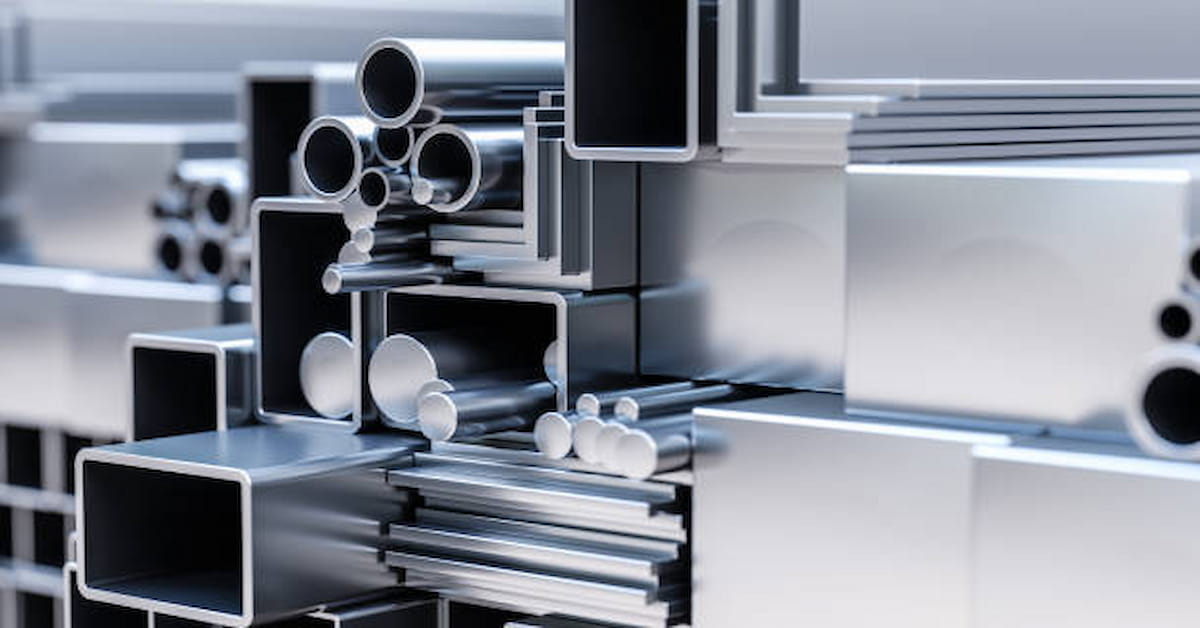
What is Martensitic Steel? Strength, Structure, Grades, and Applications
When engineers need exceptional strength without excessive weight, martensitic steel often becomes their material of choice. This specialised class of steel can deliver tensile strengths ranging from around 900 MPa to more than 1,700 MPa, making it one of the strongest commercially available steel varieties while still remaining practical for manufacturing.
Unlike conventional carbon steels or austenitic stainless grades, martensitic steel achieves its properties through a unique crystal structure and heat treatment process. The steel is heated, rapidly cooled, and often tempered to transform it from a softer, workable material into a hard, strong engineering material.
From electric vehicle battery enclosures to surgical instruments, martensitic steel has become important across industries where strength, hardness, wear resistance, and durability matter. This guide explains what martensitic steel is, how it works, where it is used, and how to decide whether it is the right material for your application.
What Is Martensitic Steel in Simple Terms?
Martensitic steel is a type of steel that becomes very hard and strong through heat treatment. It is heated to form a high-temperature structure called austenite, then rapidly cooled through a process known as quenching. This rapid cooling traps carbon atoms inside the steel’s crystal structure, forming martensite.
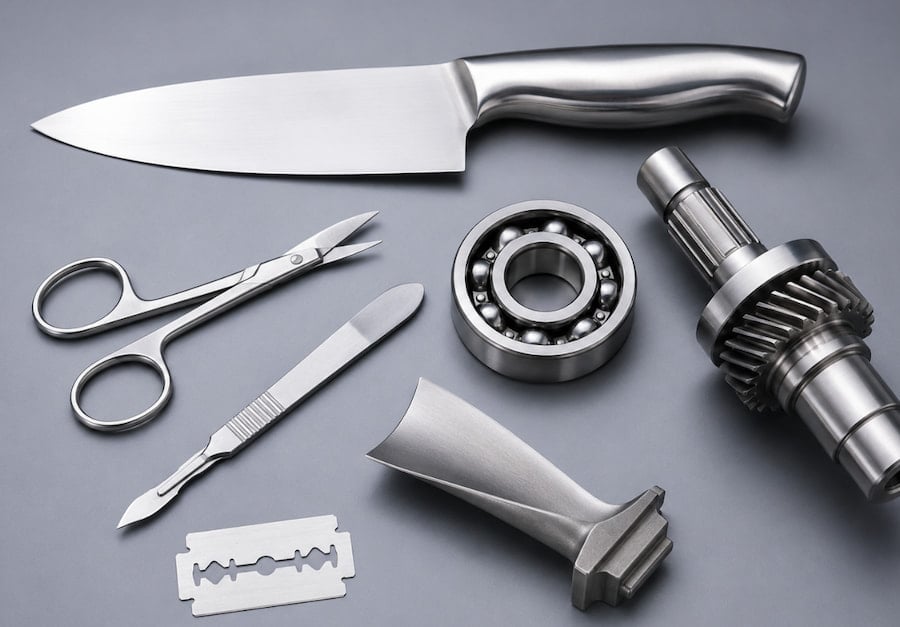
In simple terms, martensitic steel is chosen when manufacturers need a material that can resist wear, carry high loads, and maintain strength in demanding conditions. It is commonly used in automotive safety parts, cutting tools, surgical instruments, turbine components, pump shafts, bearings, and other precision-engineered parts.
Martensitic stainless steel is a specific type of martensitic steel that contains enough chromium to provide corrosion resistance. However, its corrosion resistance is usually lower than austenitic stainless steels such as 304 or 316.
What Makes Martensitic Steel Different?
Body-Centered Tetragonal Crystal Structure
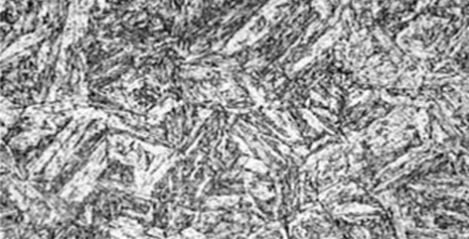
The defining feature of martensitic steel is its body-centered tetragonal, or BCT, crystal structure. This is the atomic arrangement that gives martensitic steel its high hardness and strength.
| Steel Type | Crystal Structure | Key Properties |
| Ferritic | Body-Centered Cubic (BCC) | Soft, magnetic, moderate strength |
| Austenitic | Face-Centered Cubic (FCC) | Non-magnetic, excellent corrosion resistance, not heat-treatable |
| Martensitic | Body-Centered Tetragonal (BCT) | Very hard, very strong, magnetic, heat-treatable |
In the BCT structure, iron atoms form a distorted cube-like pattern. One axis is stretched while the other two are compressed. This distortion happens when carbon atoms become trapped in the iron lattice during rapid cooling.
The trapped carbon creates internal strain inside the crystal structure. This strain makes it difficult for dislocations, which are tiny defects in the metal structure, to move. Since dislocation movement is what allows metals to deform, restricting that movement makes martensitic steel much harder and stronger.
It Forms Through Quenching
Martensitic steel begins as austenite, a high-temperature phase where carbon atoms are dissolved in the iron matrix. To form martensite, the steel must be cooled quickly enough to prevent softer structures such as ferrite, pearlite, or bainite from forming.
The quenching process usually involves four stages:
- Heating, or austenitizing: The steel is heated to around 815-900°C, depending on its carbon content and grade.
- Rapid cooling, or quenching: The hot steel is cooled quickly in water, oil, air, or polymer solutions.
- Martensitic transformation: Rapid cooling prevents carbon atoms from diffusing out of the structure.
- Final result: The steel forms hard martensite, often with a needle-like or plate-like microstructure.
The cooling speed is critical. If the steel cools too slowly, carbon atoms have time to move and form softer phases. The quenching medium is therefore selected based on the steel grade, the component shape, and the final properties required.
Its Composition Controls Its Final Performance
Martensitic steels typically contain carbon, chromium, and other alloying elements. Carbon is the primary hardening element, usually ranging from around 0.1% to 1.2%. Chromium is commonly used in martensitic stainless grades, usually between 11% and 18%, to improve corrosion resistance. Other elements such as molybdenum, vanadium, nickel, and manganese may be added to improve toughness, hardenability, wear resistance, or corrosion performance.
Carbon content has a major influence on the final hardness. Low-carbon martensitic steels, usually around 0.1% to 0.3% carbon, provide moderate hardness with better toughness and weldability. Medium-carbon grades, around 0.3% to 0.6%, provide a balanced combination of hardness and toughness. High-carbon grades, around 0.6% to 1.2%, offer maximum hardness and wear resistance, but they are also more brittle and more difficult to weld or form.
What Mechanical Properties Does Martensitic Steel Offer?
It Provides Very High Strength
Martensitic steel is used when high tensile strength is a priority. Some grades offer minimum tensile strengths from 900 MPa to more than 1,700 MPa.
| Grade | Minimum Tensile Strength | Typical Applications |
| 900M | 900 MPa | Structural components and general engineering |
| 1100M | 1,100 MPa | Automotive structural parts and machinery |
| 1300M | 1,300 MPa | High-stress components and performance parts |
| 1500M | 1,500 MPa | Safety-critical automotive and aerospace components |
| 1700M | 1,700 MPa | Armour, intrusion protection, and ultra-high-strength applications |
To put this into perspective, mild steel typically sits around 250-400 MPa, while many standard structural steels sit around 400-550 MPa. Martensitic steel can therefore provide much higher strength in thinner sections.
This is one reason it is valuable in automotive and electric vehicle applications. A component made from ultra-high-strength martensitic steel can sometimes be made thinner than an equivalent mild steel component while still carrying the required load.
It Can Achieve High Hardness
Martensitic steel can reach very high hardness levels after quenching. High-carbon martensitic grades can exceed 60 HRC on the Rockwell C scale, making them suitable for cutting tools, bearings, blades, valve components, and other wear-resistant applications.
However, high hardness also creates a trade-off. After quenching, martensitic steel can be brittle and prone to cracking under impact. To improve toughness, the material is usually tempered.
Tempering is a controlled reheating process, commonly carried out between 200°C and 700°C. It reduces hardness slightly but significantly improves toughness, making the steel more useful for structural and engineering applications. Lower tempering temperatures retain more hardness, while higher tempering temperatures produce softer but tougher material.
How Is Martensitic Steel Different from Other Stainless Steels?
Martensitic steel is different from austenitic and ferritic stainless steels because it can be hardened through heat treatment. Austenitic stainless steels, such as 304, are known for excellent corrosion resistance and weldability, but they cannot be hardened by heat treatment. Ferritic stainless steels, such as 430, are magnetic and corrosion-resistant, but they do not reach the same strength and hardness levels as martensitic grades.
This makes martensitic steel the preferred option when strength, hardness, and wear resistance are more important than maximum corrosion resistance.
| Property | Martensitic | Austenitic 304 | Ferritic 430 |
| Strength | Very high, often 900-1700 MPa | Moderate, around 515 MPa | Moderate, around 450 MPa |
| Hardness | Very high after heat treatment | Low to moderate | Moderate |
| Corrosion resistance | Moderate | Excellent | Good |
| Heat treatable | Yes | No | Limited |
| Magnetic | Yes | No | Yes |
| Weldability | Difficult | Excellent | Good |
| Common use case | Strength and wear resistance | Corrosion resistance and weldability | Cost-effective corrosion resistance |
The key point is that martensitic steel is not selected because it is the easiest stainless steel to weld or the most corrosion-resistant. It is selected because it offers a strong combination of hardness, strength, and wear resistance.
What Are the Common Martensitic Steel Grades?
Type 410 Stainless Steel
Type 410 is one of the most widely used martensitic stainless steels. It typically contains around 11.5% to 13.5% chromium and up to 0.15% carbon. It offers good corrosion resistance, moderate strength, and good machinability.
Common applications include cutlery, turbine blades, pumps, valves, fasteners, shafts, and general-purpose industrial components. Type 410 is often chosen because it is economical, widely available, and versatile.
Type 420 Stainless Steel
Type 420 contains around 12% to 14% chromium and a higher carbon content than Type 410. This gives it greater hardness and wear resistance.
It is commonly used for surgical instruments, knives, molds, dies, machine parts, and other products where edge retention or hardness is important. Type 420 is useful when the application needs better hardness than Type 410 but does not require the maximum wear resistance of higher-carbon grades.
Type 440C Stainless Steel
Type 440C contains around 16% to 18% chromium and 0.95% to 1.20% carbon. It is one of the hardest martensitic stainless steel grades and offers excellent wear resistance.
Common applications include ball bearings, valve seats, cutting tools, surgical tools, and premium knife blades. It is a strong choice when high hardness and wear resistance are more important than formability or weldability.
1.4057 / AISI 431 Stainless Steel
1.4057, also known as AISI 431, contains chromium, nickel, and carbon. The nickel addition improves toughness and makes the grade more suitable for marine and high-stress applications.
Typical uses include marine hardware, aircraft fittings, pump shafts, and propeller shafts. It is often used where a combination of strength, toughness, and moderate corrosion resistance is needed.
1.4418 Stainless Steel
1.4418 is a low-carbon martensitic stainless steel with improved weldability and corrosion resistance. It is used in applications such as hydroelectric turbines, propeller shafts, and pump components.
This grade is useful when a component requires high strength but also needs better weldability than traditional high-carbon martensitic grades.
Which Martensitic Steel Grade Should You Choose?
The best grade depends on the application, strength requirement, corrosion exposure, and manufacturing method.
| Requirement | Recommended Martensitic Grade | Why It Fits |
| General-purpose strength and corrosion resistance | Type 410 | Economical, widely available, and suitable for pumps, valves, shafts, and turbine parts |
| Better hardness and edge retention | Type 420 | Higher carbon content improves hardness and wear resistance |
| Maximum wear resistance | Type 440C | High carbon and chromium content support very hard applications |
| Marine strength and toughness | 1.4057 / AISI 431 | Nickel improves toughness and performance in marine environments |
| Better weldability with high strength | 1.4418 | Lower carbon improves weldability while maintaining strength |
| Automotive crash protection | 1300M-1700M grades | Ultra-high tensile strength supports lightweight safety structures |
| EV battery protection | 1500M-1700M grades | Strong intrusion resistance with thinner material sections |
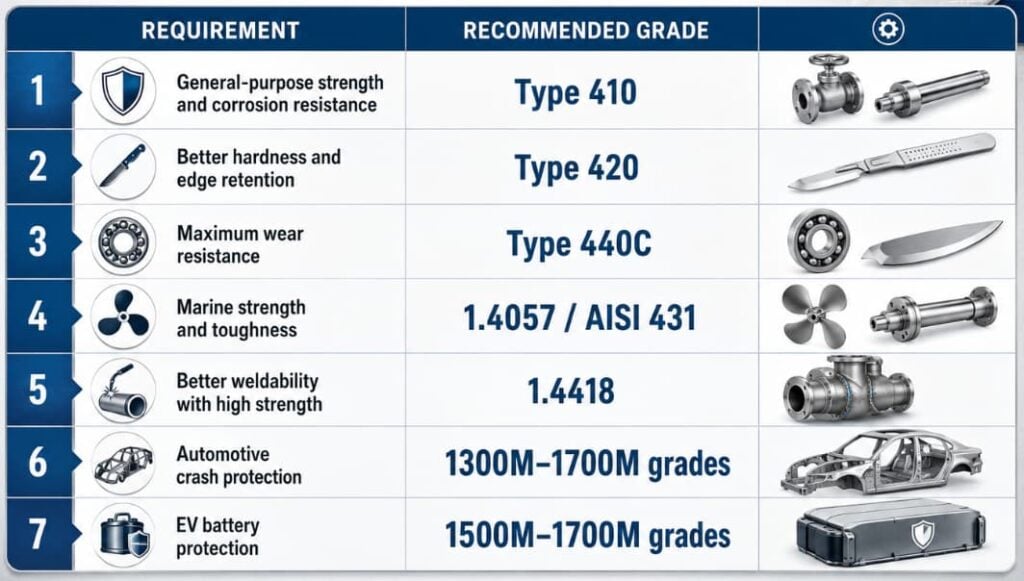
This selection table is a starting point. Final material choice should always consider part geometry, heat treatment, forming requirements, corrosion exposure, welding requirements, and cost.
Where Is Martensitic Steel Used?
Automotive and Electric Vehicles
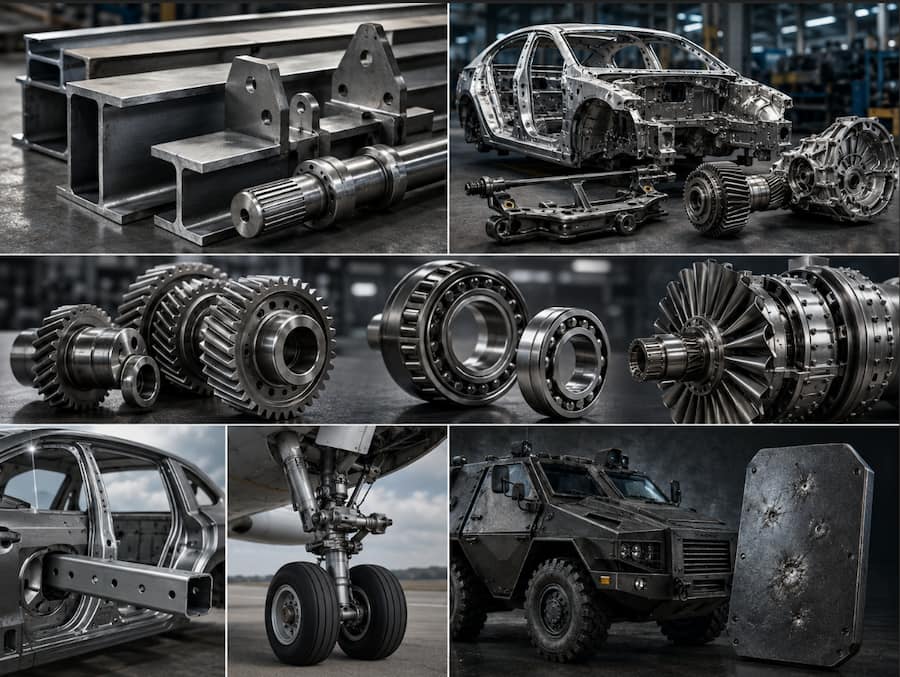
The automotive sector is one of the most important users of martensitic steel, especially in structural safety components. Its high strength allows manufacturers to improve crash protection while reducing unnecessary weight.
Common automotive applications include:
- Door beams
- Bumper systems
- Sill reinforcements
- B-pillars
- Cross members
- Safety cage components
- Battery enclosure protection in electric vehicles
In electric vehicles, battery protection is especially important. Martensitic steel grades such as 1500M and 1700M can help protect battery packs from intrusion while allowing thinner, lighter structures. This is valuable because reducing vehicle weight can help improve efficiency and range.
Aerospace Applications
Aerospace uses martensitic steels selectively where high strength, wear resistance, and heat treatability are important. Typical applications include landing gear components, fasteners, control surface hinges, engine mounts, and other high-stress parts.
Aerospace materials must be selected carefully because strength, fatigue resistance, corrosion exposure, and weight all matter. Martensitic steel is not used everywhere in aircraft, but it can be valuable where high mechanical performance is required.
Cutlery, Blades, and Surgical Instruments
Martensitic stainless steel is widely used in knives, razor blades, surgical instruments, and industrial cutting tools because it can be hardened and sharpened. Grades such as 420 and 440C are especially common in applications where edge retention and wear resistance are important.
For surgical instruments, the material must balance hardness, precision, corrosion resistance, and sterilisation requirements. Martensitic stainless grades are useful because they can achieve the sharpness and hardness needed for cutting and precision use.
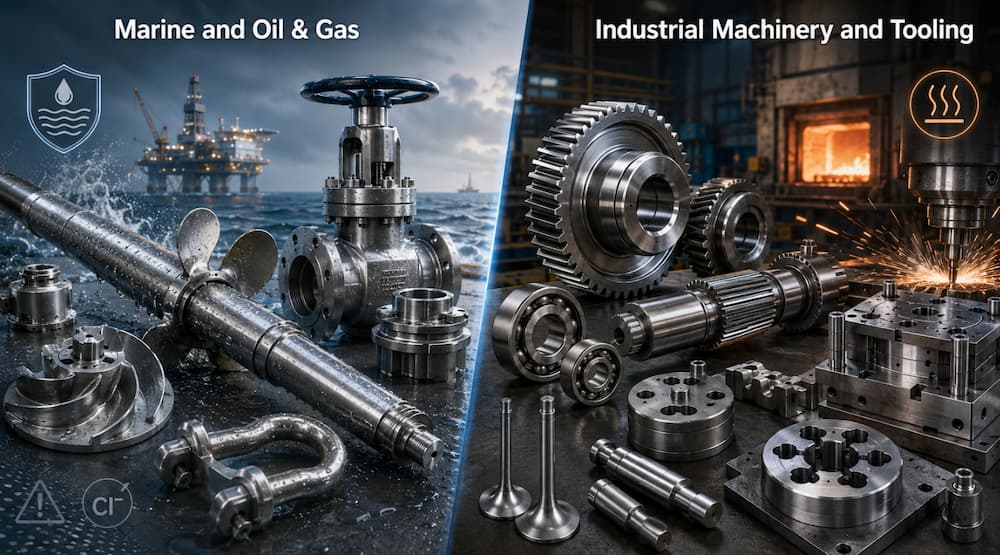
Marine and Oil & Gas
Martensitic stainless steels are used in marine and oil and gas applications where components require strength, toughness, and moderate corrosion resistance. Grades such as 1.4057 / AISI 431 are used in pump shafts, propeller shafts, valve parts, and offshore hardware.
However, martensitic stainless steel is not always suitable for highly corrosive environments. In aggressive chloride-rich conditions, austenitic, duplex, or precipitation-hardening stainless steels may be better options.
Industrial Machinery and Tooling
Martensitic steel is also used in industrial machinery, molds, dies, bearings, valves, shafts, and wear parts. Its ability to be hardened makes it suitable for components that experience repeated contact, friction, or mechanical loading.
In these applications, heat treatment control is especially important. The wrong hardness or toughness level can lead to premature wear, cracking, distortion, or failure.
What Are the Advantages and Limitations of Martensitic Steel?
Its Main Advantages Are Strength, Hardness, and Wear Resistance
Martensitic steel offers several advantages for demanding applications. Its biggest benefit is its ability to reach high strength and hardness through heat treatment. This makes it useful for parts that must resist wear, impact, deformation, cutting forces, or high mechanical loads.
It can also support lightweight design. In some applications, ultra-high-strength martensitic steel allows manufacturers to use thinner material sections without losing structural performance. This is valuable in automotive, aerospace, and electric vehicle design.
Another advantage is customisability. Through heat treatment and tempering, manufacturers can adjust the final balance of hardness, strength, and toughness to suit the application.
Its Main Limitations Are Brittleness, Welding Difficulty, and Moderate Corrosion Resistance
Martensitic steel also has limitations. High-carbon martensitic grades can become brittle if they are not properly tempered after quenching. This can lead to cracking or poor impact performance.
Welding can also be difficult because the heat-affected zone may harden during cooling, creating brittle areas that are prone to cracking. Preheating, low-hydrogen welding processes, and post-weld heat treatment may be required.
Corrosion resistance is another limitation. Martensitic stainless steels generally provide moderate corrosion resistance, but they usually do not match the corrosion performance of austenitic stainless steels such as 304 or 316. For harsh chemical, marine, or chloride-rich environments, another stainless steel family may be more appropriate.
What Manufacturing Considerations Matter for Martensitic Steel?
Heat Treatment Must Be Carefully Controlled
Martensitic steel’s properties depend heavily on proper heat treatment. The basic cycle involves austenitizing, quenching, tempering, and cooling.
If the steel is not heated properly, it may not transform correctly. If quenching is too slow, the steel may not achieve the required hardness. If quenching is too aggressive, the component may distort or crack. If tempering is insufficient, the steel may remain too brittle for service.
This is why martensitic steel parts often require close control of heat treatment temperature, cooling rate, and post-treatment inspection.
Machining Is Easier Before Hardening
Martensitic steel is generally easier to machine in the annealed condition. Once hardened, it becomes more difficult to cut and may require carbide tooling, grinding, or other finishing methods.
For this reason, many manufacturers complete most machining operations before final hardening. This helps reduce tool wear, improve dimensional accuracy, and lower production difficulty.
Welding Requires Extra Care
Welding martensitic steel requires careful planning. The main challenge is the heat-affected zone, which can harden and become brittle during cooling. This increases the risk of cracking.
Good welding practice may include preheating, using low-hydrogen welding consumables, maintaining interpass temperature, and applying post-weld heat treatment. For high-carbon grades, welding may be impractical, and alternative joining methods such as bolting, mechanical fastening, or adhesive bonding may be considered.
When Should You Use Martensitic Steel?
Martensitic steel is a good choice when the application requires high strength, high hardness, wear resistance, and heat-treatable performance. It is also suitable when magnetic properties are acceptable and moderate corrosion resistance is enough.
It is especially useful for components that need to resist deformation, cutting, impact, or wear. Examples include automotive safety structures, cutting tools, surgical instruments, pump shafts, valves, bearings, turbine parts, and EV battery protection components.
Martensitic steel may also be suitable when weight reduction is important. Because ultra-high-strength grades can carry high loads, engineers may be able to reduce material thickness in selected designs.
When Should You Avoid Martensitic Steel?
Martensitic steel may not be the best choice when the application requires maximum corrosion resistance, extensive welding, high ductility, or non-magnetic properties.
For highly corrosive environments, austenitic stainless steel, duplex stainless steel, or precipitation-hardening stainless steel may be better. For applications requiring excellent weldability, austenitic stainless steels are usually easier to work with. For low-cost applications where high strength is not needed, carbon steel may be more economical.
Martensitic steel should also be avoided when the manufacturing process cannot properly control heat treatment. Since its final properties depend heavily on quenching and tempering, poor process control can lead to cracking, distortion, brittleness, or inconsistent performance.
How Should Engineers Select Martensitic Steel?
Material selection should begin with the performance requirement. Engineers should first define the load, tensile strength, hardness, wear resistance, and toughness required for the component. The next step is to assess the operating environment, including corrosion exposure, temperature, moisture, chemicals, and impact conditions.
Manufacturing requirements should also be reviewed. If the part requires extensive welding, complex forming, tight machining tolerances, or post-heat-treatment finishing, these factors may influence the grade selection.
A practical decision process should consider:
- Strength requirement: What load must the part carry?
- Hardness requirement: Does the part need edge retention or wear resistance?
- Corrosion exposure: Will the part face moisture, chemicals, salt, or high temperatures?
- Manufacturing route: Will the part be machined, formed, welded, heat treated, or ground?
- Toughness requirement: Does the part need to resist impact or fatigue?
- Cost balance: Is the performance benefit worth the material and processing cost?
The best grade is not always the hardest grade. In many applications, the best choice is the grade that offers the right balance of strength, toughness, corrosion resistance, manufacturability, and cost.
Why Does Martensitic Steel Remain Important?
Martensitic steel occupies a valuable position in the materials world. It delivers high strength and hardness while still offering the practical advantages of steel, including machinability in the annealed condition, heat treatability, magnetic behaviour, and availability across many grades.
Its importance is also increasing because modern industries need materials that can support lighter, stronger, and safer designs. Automotive lightweighting, electric vehicle battery protection, precision tooling, and advanced manufacturing all benefit from materials that can provide high strength without excessive bulk.
The relationship between composition, quenching, tempering, and final properties makes martensitic steel highly adaptable. Whether the priority is maximum strength, balanced toughness, wear resistance, or moderate corrosion resistance, martensitic steel offers practical options for demanding engineering challenges.
Conclusion
Because martensitic steel performance depends heavily on grade selection, heat treatment, and manufacturing method, choosing the right production partner matters. Align Manufacturing helps customers evaluate whether martensitic steel is suitable for their component, or whether another steel, stainless steel, aluminium, or specialty alloy may be a better fit.
For companies looking for cost-effective, high-quality precision manufacturing, Align Manufacturing offers engineering-focused support and dependable production capabilities from Thailand. If your project requires strong, wear-resistant, or precision-machined components, our team can help you move from material selection to finished parts with confidence.
Align Manufacturing provides precision metal fabrication in Thailand and CNC machining services for companies that need reliable metal components for demanding applications. For projects involving martensitic steel, our team can support material selection, manufacturability review, machining planning, tolerance control, and production feasibility.
Related Resources:
- Grades of Stainless Steel: Types, Properties, and Applications
- Stainless Steel: Strength and Corrosion Resistance
- Tempering vs Hardening: What’s the Difference?
Frequently Asked Questions
Is martensitic steel stainless steel?
Martensitic steel can be stainless steel if it contains enough chromium, usually around 11% to 18%. Martensitic stainless steels combine heat-treatable strength with moderate corrosion resistance.
Is martensitic steel magnetic?
Yes, martensitic steel is generally magnetic in both the annealed and hardened conditions. This is one of the features that separates it from many austenitic stainless steels.
Is martensitic steel stronger than stainless steel?
Martensitic steel is stronger than many common stainless steels, especially austenitic grades such as 304. However, it usually has lower corrosion resistance than austenitic stainless steel.
Can martensitic steel be welded?
Martensitic steel can be welded, but it requires care. Preheating, low-hydrogen welding processes, and post-weld heat treatment may be needed to reduce cracking risk and restore toughness.
What is the main weakness of martensitic steel?
The main weakness of martensitic steel is that it can become brittle if not properly heat treated. It also has more difficult weldability and lower corrosion resistance than many austenitic stainless steels.
What is the difference between martensitic and austenitic stainless steel?
Martensitic stainless steel can be hardened through heat treatment and is usually magnetic. Austenitic stainless steel has better corrosion resistance and weldability, but it cannot be hardened by heat treatment and is usually non-magnetic.
What is the difference between martensitic and ferritic stainless steel?
Both martensitic and ferritic stainless steels are generally magnetic. The main difference is that martensitic steel can be hardened through heat treatment, while ferritic stainless steel has lower strength and is not normally heat-treatable in the same way.