
Partial vs Full First Article Inspection: Complete Decision Guide for Aerospace Suppliers
First article inspection (FAI) requirements confuse even experienced aerospace suppliers. When do you need a full FAI versus a partial FAI? What triggers each type? How do you satisfy different customer requirements from Boeing, Airbus, and other OEMs?
This guide provides clear answers. You will learn the exact triggers for partial and full first article inspections, understand the documentation requirements for each, and discover how to align your FAI process with customer expectations. Whether you are a quality manager, program manager, or supplier quality engineer, this resource eliminates the confusion surrounding FAI requirements.
What Is First Article Inspection and Why It Matters
First article inspection verifies that manufacturing processes can produce conforming parts. Before full production begins, suppliers inspect and document all characteristics of a representative part. This process catches errors early, prevents costly rework, and demonstrates compliance to aerospace quality standards.
The AS9102 standard governs FAI in aerospace manufacturing. This standard defines three types of first article inspection: full FAI, partial FAI, and delta FAI. Each serves a specific purpose and applies under different circumstances.
Understanding these distinctions protects your business. Submitting the wrong FAI type delays approvals, strains customer relationships, and risks production shutdowns. Conversely, performing unnecessary full FAIs wastes resources and extends lead times unnecessarily.
Full First Article Inspection: Complete Verification
A full first article inspection examines every design characteristic on every drawing, specification, and purchase order requirement. This comprehensive verification applies to new parts, new suppliers, or significant process changes.
When Full FAI Is Required
Full FAIs are mandatory in these situations:
- New part introduction – First production of a part number never manufactured at your facility
- New supplier – First delivery from a new subcontractor or material source
- Process change – Manufacturing location, method, or tooling changes that affect form, fit, or function
- Design revision – Engineering changes affecting dimensions, materials, or performance
- Production lapse – Manufacturing interruption exceeding 24 months
Full FAI Documentation Requirements
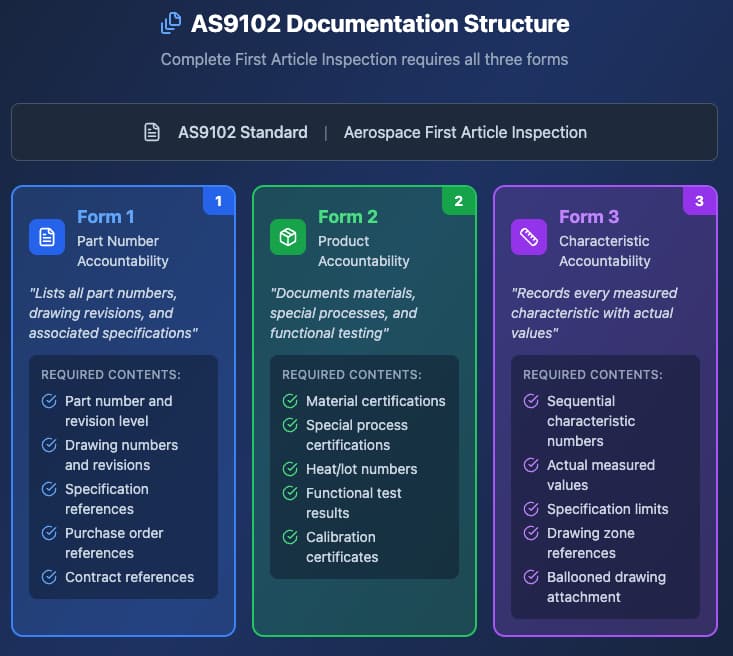
Full first article inspection requires complete AS9102 documentation:
| Form | Purpose | Content |
| Form 1 | Part Number Accountability | Lists part numbers, drawing revisions, and associated specifications |
| Form 2 | Product Accountability | Documents materials, special processes, and functional testing |
| Form 3 | Characteristic Accountability | Records every measured characteristic with actual values |
Each characteristic requires actual measurement against specification limits. Design characteristics include dimensions, tolerances, notes, and surface finish requirements. Special processes require certification from approved suppliers.
Partial First Article Inspection: Selective Verification
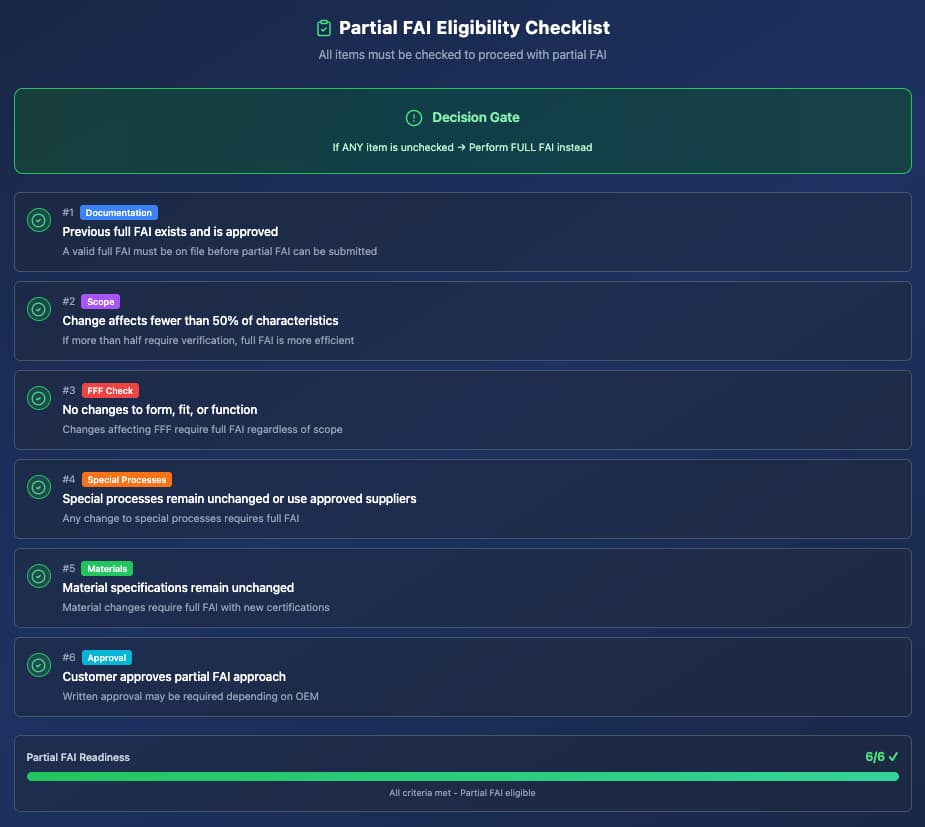
A partial first article inspection examines only characteristics affected by a change. This streamlined approach applies when previous full FAIs exist and only specific aspects of the part have changed.
When Partial FAI Is Allowed
Partial FAIs are appropriate when:
- Engineering changes affect limited characteristics (not form, fit, or function)
- Tooling modifications change specific dimensions without affecting overall design
- Process adjustments improve capability on select features
- Material lot changes from qualified suppliers with established traceability
- Minor drawing clarifications that do not change requirements
Delta FAI vs Partial FAI: Critical Distinctions
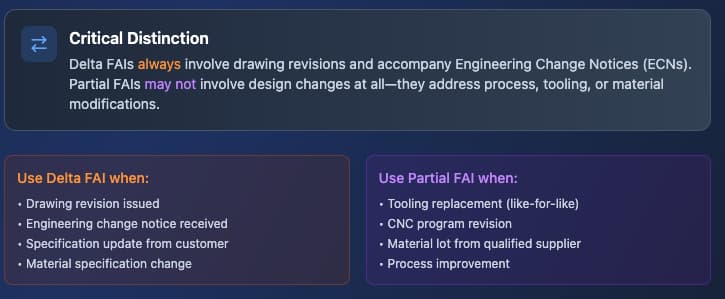
Many suppliers confuse delta FAI with partial FAI. While both involve limited inspection scope, they serve different purposes and apply in different scenarios.
Delta FAI Definition
A delta FAI verifies only characteristics affected by an engineering change. The term “delta” refers to the difference between design revisions. Delta FAIs accompany engineering change notices (ECNs) and demonstrate that modified characteristics meet new requirements.
Partial FAI Definition
A partial FAI verifies characteristics affected by any change and not just engineering changes. This includes process changes, tooling changes, or material changes that do not involve design revisions.
Comparison Table: Delta FAI vs Partial FAI
| Factor | Delta FAI | Partial FAI |
| Trigger | Engineering change (ECN) | Any change (process, tooling, material) |
| Scope | Changed characteristics only | Affected characteristics only |
| Form 1 | Updated with new revision | Updated with change reference |
| Form 2 | Revised special processes if changed | Updated processes/materials |
| Form 3 | Only changed characteristics | Only affected characteristics |
| Customer notification | Always required | Often required |
Understanding this distinction prevents documentation errors and customer rejections.
FAI Trigger Events: Complete Catalog
Knowing what triggers each FAI type prevents compliance gaps. This catalog covers common aerospace manufacturing scenarios.
Design-Related Triggers
| Event | FAI Type | Notes |
| New part number | Full FAI | First production at your facility |
| Drawing revision | Delta FAI | If previous FAI exists; Full FAI if not |
| Specification change | Delta FAI | Affects Form 2 and possibly Form 3 |
| Material specification update | Delta FAI | Requires new material certification |
| Surface treatment change | Delta FAI | New special process approval needed |
Process-Related Triggers
| Event | FAI Type | Notes |
| New manufacturing location | Full FAI | Even for existing part numbers |
| Equipment replacement (like-for-like) | Partial FAI | If capability maintained |
| Equipment replacement (different type) | Full FAI | New process capability required |
| Tooling replacement (worn/damaged) | Partial FAI | Verify affected dimensions only |
| Tooling redesign | Partial FAI | Verify all tooling-controlled features |
| CNC program revision | Partial FAI | Verify affected characteristics |
Supplier-Related Triggers
| Event | FAI Type | Notes |
| New raw material supplier | Full FAI | Unless pre-approved by customer |
| New special process supplier | Full FAI | NADCAP/approved supplier status |
| Material lot from qualified supplier | Partial FAI | Traceability documentation only |
| Subcontractor change | Full FAI | For any value-added operations |
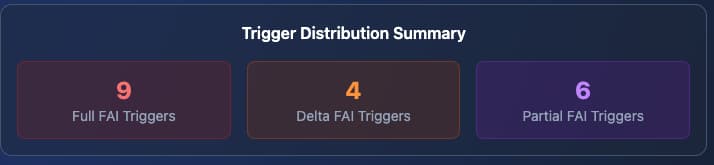
Customer-Specific FAI Requirements
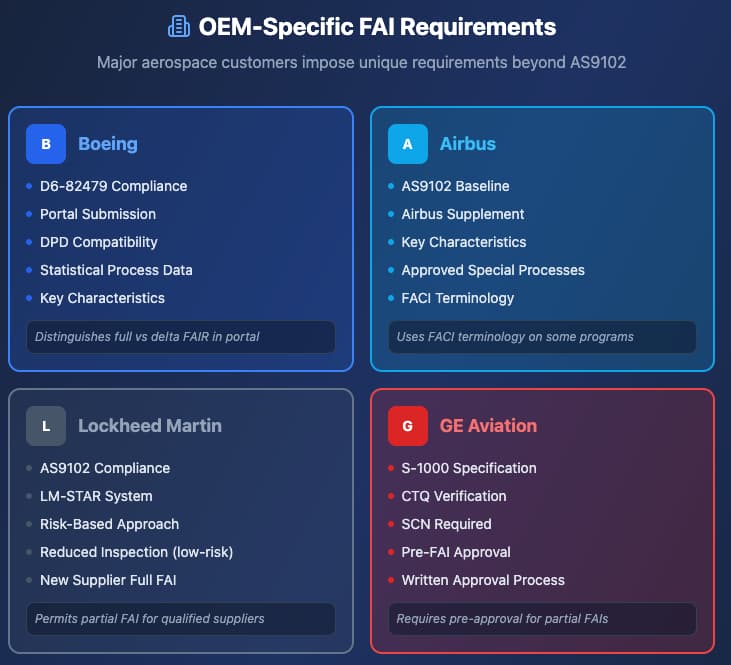
Major aerospace OEMs impose additional requirements beyond AS9102. Understanding these prevents approval delays.
Boeing FAI Requirements
Boeing requires:
- D6-82479 compliance for all FAIR
- First Article Inspection Report (FAIR) submission through Boeing Portal
- Digital Product Definition (DPD) compatibility for model-based definitions
- Statistical process data for critical characteristics (Key Characteristics)
Boeing distinguishes between full FAIR and delta FAIR clearly in their supplier portal. Suppliers must indicate FAI type at submission.
Airbus FAI Requirements
Airbus specifies:
- AS9102 compliance as baseline
- Airbus Supplement requirements for specific programs
- Key Characteristics (KC) identification and statistical reporting
- Special process validation from approved sources only
Airbus uses First Article Conformance Inspection (FACI) terminology for some programs. The requirements parallel AS9102 but include additional Airbus-specific forms.
Lockheed Martin FAI Requirements
Lockheed Martin mandates:
- AS9102 compliance
- LM-STAR system entry for certain commodities
- Risk-based FAI approach allowing reduced inspection for low-risk changes
Lockheed Martin permits partial FAIs for qualified suppliers with demonstrated process capability. New suppliers must perform full FAIs for initial deliveries.
General Electric Aviation FAI Requirements
GE Aviation requires:
- S-1000 specification compliance
- Critical to Quality (CTQ) characteristic verification
- Supplier Change Notification (SCN) before any FAI-triggering change
GE Aviation emphasizes pre-FAI approval for partial FAIs. Suppliers must obtain written approval before submitting partial documentation.
Risk-Based FAI Planning
Smart suppliers apply risk assessment to FAI decisions. This approach optimizes resources while maintaining compliance.
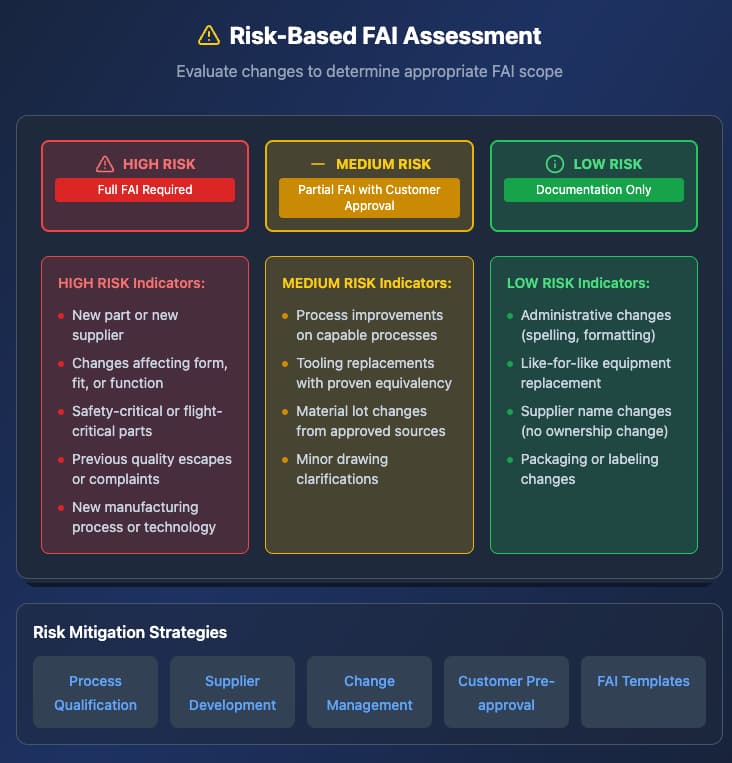
Risk Assessment Framework
Evaluate each potential FAI using these factors:
High Risk (Full FAI Required):
- New part or new supplier
- Changes affecting form, fit, or function
- Safety-critical or flight-critical parts
- Previous quality escapes or customer complaints
- New manufacturing process or technology
Medium Risk (Partial FAI with Customer Approval):
- Process improvements on capable processes
- Tooling replacements with proven equivalency
- Material lot changes from approved sources
- Minor drawing clarifications
Low Risk (Documentation Only):
- Administrative changes (spelling, formatting)
- Like-for-like equipment replacement
- Supplier name changes without ownership change
- Packaging or labeling changes
Risk Mitigation Strategies
Reduce FAI burden through:
1. Process qualification – Establish statistical capability before production
2. Supplier development – Qualify multiple approved sources
3. Change management – Implement robust ECN processes
4. Customer pre-approval – Seek partial FAI approval before changes
5. FAI templates – Standardize documentation for efficiency
Documentation Best Practices
Clear, complete documentation accelerates FAI approval. Follow these practices for every submission.
Form 1: Part Number Accountability
- List all associated drawings with current revisions
- Include purchase order and contract references
- Document software/firmware versions if applicable
- Reference previous FAI numbers for partial submissions
Form 2: Product Accountability
- Attach material certifications with full traceability
- List all special processes with supplier certifications
- Include functional test results and acceptance criteria
- Document calibration certificates for inspection equipment
Form 3: Characteristic Accountability
- Number every characteristic sequentially
- Record actual measured values (not “pass/fail”)
- Include drawing zone references for traceability
- Attach ballooned drawings showing characteristic locations
- Note any characteristics requiring engineering approval
Common Documentation Mistakes
Avoid these errors that delay approvals:
- Missing revision levels on drawings or specifications
- Incomplete material certifications lacking heat/lot numbers
- Unapproved special processes from non-qualified suppliers
- Missing balloon drawings making characteristic location unclear
- Incorrect FAI type selection (partial when full required)
Real-World FAI Scenarios
These examples illustrate practical FAI decision-making.
Scenario 1: CNC Program Update
- Situation: Updating a CNC program to improve surface finish on one feature.
- Analysis: The change affects one characteristic (surface finish) on an existing part with prior full FAI approval.
- Decision: Partial FAI verifying only the surface finish characteristic.
- Documentation: Form 3 with updated surface finish measurement; reference to previous full FAI.
Scenario 2: New Material Supplier
- Situation: Sourcing aluminum bar stock from a new mill for an existing part.
- Analysis: Material changes affect material properties, traceability, and potentially machinability.
- Decision: Full FAI required despite existing part history.
- Documentation: Complete Forms 1, 2, and 3 with new material certification and full dimensional verification.
Scenario 3: Engineering Drawing Revision
- Situation: Customer issues drawing revision adding one new hole and tightening one tolerance.
- Analysis: Engineering change affecting limited characteristics.
- Decision: Delta FAI verifying the new hole location and the tightened dimension.
- Documentation: Forms 1, 2, and 3 updated for revision change; Form 3 includes only the two changed characteristics.
Scenario 4: Tooling Replacement
- Situation: Replacing a worn fixture with an identical replacement.
- Analysis: Like-for-like tooling replacement on a capable process.
- Decision: Partial FAI verifying fixture-controlled dimensions.
- Documentation: Form 3 with dimensions controlled by the replaced tooling; engineering approval for partial FAI approach.
Key Takeaways
- Full FAI verifies every characteristic and applies to new parts, new suppliers, and major changes
- Partial FAI verifies only affected characteristics when previous full FAIs exist
- Delta FAI specifically addresses engineering changes and drawing revisions
- Customer requirements from Boeing, Airbus, and other OEMs add specific requirements beyond AS9102
- Risk-based FAI planning optimizes resources while maintaining compliance
- Clear documentation accelerates approval and prevents rejection
Conclusion
Understanding partial vs full first article inspection requirements protects your aerospace manufacturing business from costly delays and compliance issues. Apply the decision frameworks in this guide to streamline your FAI process while satisfying customer expectations.
Understanding when to apply a full versus partial first article inspection is not just about compliance, it is a strategic decision that directly impacts lead time, cost efficiency, and customer trust. By applying a structured, risk-based approach, suppliers can ensure that every change is validated appropriately while avoiding unnecessary full re-inspections. This balance allows manufacturers to maintain rigorous quality standards without slowing down production, ultimately strengthening both operational performance and customer relationships.
At Align Manufacturing, we bring this disciplined approach to every project, combining deep expertise in machining and supply chain management with a clear understanding of aerospace quality requirements. Whether supporting complex inspection scenarios or managing evolving customer specifications, our team ensures the right level of validation at every stage. With extensive experience across global manufacturing networks, including forging in Vietnam, Align Manufacturing helps clients achieve reliable, compliant, and efficient production outcomes with confidence.
FAQ: Partial vs Full First Article Inspection
What is the difference between partial FAI and full FAI?
Full FAI inspects every design characteristic on a part. Partial FAI inspects only characteristics affected by a specific change. Full FAIs apply to new parts, new suppliers, or major changes. Partial FAIs apply when previous full FAIs exist and changes are limited in scope.
When is partial FAI allowed?
Partial FAI is allowed when a previous full FAI exists, the change affects fewer than 50% of characteristics, and the change does not affect form, fit, or function. Customer approval is often required before submitting a partial FAI.
What triggers a full first article inspection?
Full FAIs are triggered by new part introduction, new supplier qualification, manufacturing location changes, process changes affecting form/fit/function, design revisions, and production lapses exceeding 24 months.
What is a delta FAI?
A delta FAI verifies characteristics affected by an engineering change. The term “delta” represents the difference between design revisions. Delta FAIs accompany engineering change notices and demonstrate compliance to revised requirements.
How is delta FAI different from partial FAI?
Delta FAI specifically addresses engineering changes (ECNs). Partial FAI addresses any change including process changes, tooling changes, or material changes that do not involve design revisions. Delta FAIs always involve drawing revisions; partial FAIs may not.
Do Boeing and Airbus accept partial FAIs?
Yes, both Boeing and Airbus accept partial FAIs when properly justified. Boeing requires portal submission with clear FAI type indication. Airbus requires compliance with their supplement requirements. Both may require pre-approval for partial FAIs depending on the program and part criticality.
What percentage of characteristics can a partial FAI cover?
Industry practice suggests partial FAIs should cover fewer than 50% of characteristics. If more than half of characteristics require verification, a full FAI is typically more efficient and less risky.
Can I perform a partial FAI for a new supplier?
No. New suppliers always require full FAIs for initial deliveries. Partial FAIs apply only when a previous full FAI exists for the same part manufactured at your facility.
How long is an FAI valid?
Full FAIs remain valid indefinitely unless triggered events occur. However, production lapses exceeding 24 months typically require new full FAIs. Customer-specific requirements may impose shorter validity periods.
What happens if I submit the wrong FAI type?
Submitting the wrong FAI type results in rejection, delays, and potential production holds. Customers may require corrective action plans and additional documentation. Repeated errors can affect supplier ratings and future business.
Is customer approval required for partial FAI?
Customer approval requirements vary by OEM and program. Boeing, Airbus, and Lockheed Martin typically require notification or approval for partial FAIs. Always check your specific contract and supplier quality requirements.
What documentation supports a partial FAI decision?
Support partial FAI decisions with change impact analysis, risk assessment, previous FAI references, and process capability data. Document why unaffected characteristics do not require re-verification.