
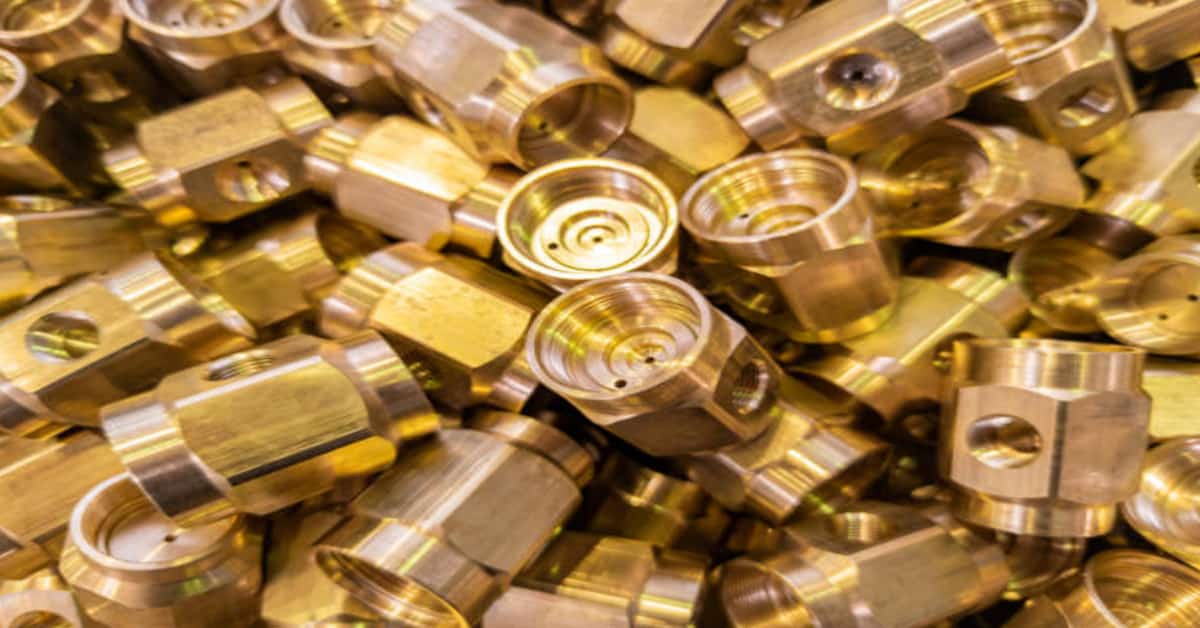
High-Volume Brass Parts: When to Choose Stamping Over CNC Machining
What Is the Best Process for High-Volume Brass Parts?
In brass component manufacturing, the choice between metal stamping and CNC machining can shape the cost, speed, and consistency of a production project. For high-volume applications, metal stamping is often the stronger option for cost efficiency, production speed, and material utilisation, while CNC machining is better suited for precision, flexibility, and complex geometries.
This guide explains the technical, economic, and practical factors that should guide process selection for brass parts produced in quantities above 5,000 units.
Why Is Brass Used for Stamping and CNC Machining?
Brass is an alloy of copper and zinc with properties that make it suitable for both stamping and machining. Its ductility, corrosion resistance, and attractive finish make it common in plumbing, automotive, electronics, architectural hardware, and industrial components.
The workability of brass depends heavily on zinc content. Alpha brass, with less than 35% zinc, offers strong formability for stamping. Alpha-beta brass provides higher strength for more demanding applications.
Key Brass Properties That Affect Manufacturing
- Ductility: Brass can be formed into complex stamped shapes without cracking when the correct alloy and thickness are selected.
- Machinability: Free-machining brass alloys such as C360 provide strong chip formation and tool life.
- Thermal Conductivity: Heat transfer affects die design, tool wear, and machining parameters.
- Corrosion Resistance: Natural resistance to tarnish and corrosion can reduce post-processing needs.
Why Is Metal Stamping Often Better for High-Volume Brass Parts?
Metal stamping transforms flat brass sheets or coils into finished components through controlled deformation. Custom dies and punches are mounted in hydraulic, mechanical, or servo presses to cut, bend, draw, or form the material.
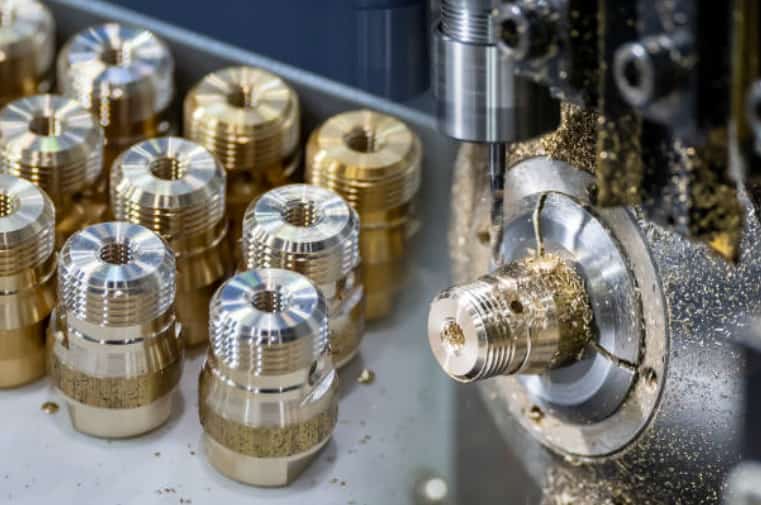
Stamping Turns Sheet Brass into Repeatable Parts
Common stamping operations include:
- Blanking: Cutting the basic outline from sheet metal.
- Piercing: Creating holes and cutouts.
- Bending: Forming angled features.
- Drawing: Stretching material into deeper shapes.
- Coining: Creating precise surface details through compression.
Progressive dies can perform several operations in sequence, making stamping highly efficient once tooling is complete.
Stamping Reduces Unit Cost at Scale
Once tooling is established, the cost per part drops significantly. For large production runs, stamping is usually more economical than CNC machining because it reduces cycle time, labour input, and material waste.
Stamping Supports Faster Production
Stamping operations can produce parts in seconds or fractions of a second. A single stamping line can often match the output of several CNC machines for simple or moderately complex parts.
Stamping Improves Material Utilisation
Because stamping forms parts from sheet or coil stock, it typically creates less waste than subtractive machining. Nesting optimisation can further improve material use by arranging parts efficiently on the strip.
Stamping Delivers Consistency Across Large Runs
Modern stamping presses can maintain repeatable dimensions across long production runs. For many functional brass components, stamped tolerances are accurate enough without needing every feature to be CNC-machined.
Stamping Has Clear Design Limits
Stamping works best for parts that can be formed from flat patterns. Internal features, complex three-dimensional contours, deep pockets, and very tight tolerance requirements may be difficult or uneconomical to stamp.
Other limitations include:
- High upfront tooling cost.
- Tooling development lead time.
- Springback after forming.
- Less flexibility if the design changes after tooling is made.
When Is CNC Machining Better for Brass Components?
CNC machining removes material from solid brass stock using computer-controlled cutting tools. It is a subtractive process that offers strong precision and design flexibility.
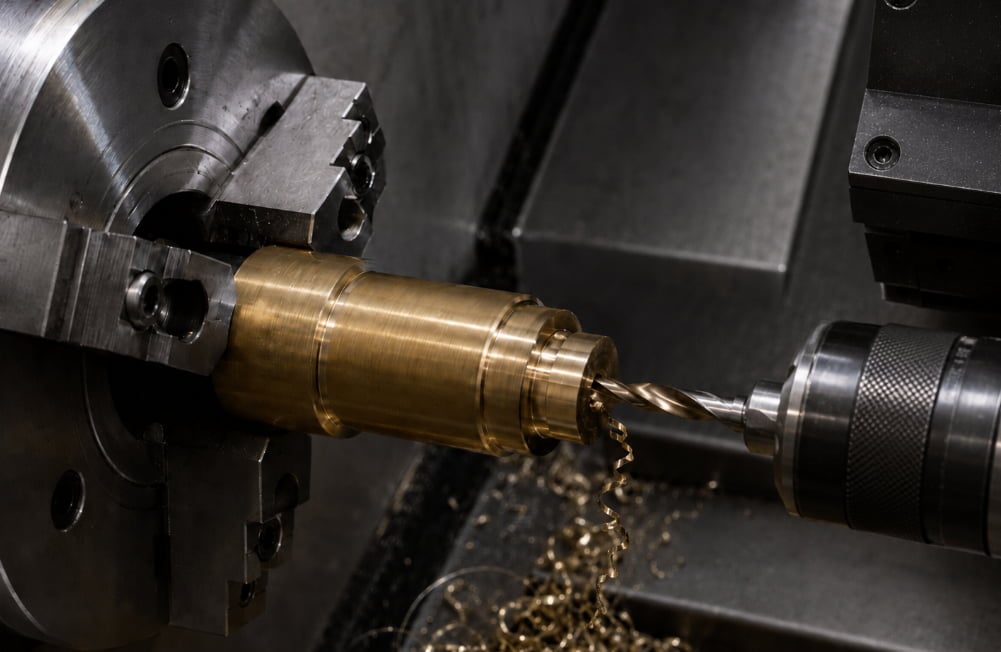
CNC Machining Delivers Tight Tolerances
CNC machining is ideal when brass parts require tight dimensional control, precision threads, complex internal profiles, or fine surface finishes. It is often the better choice for small batches, prototypes, and parts with geometries that cannot be stamped.
CNC Allows More Design Flexibility
Multi-axis CNC machines can create complex contours, internal features, precise angular relationships, and detailed surfaces that are difficult or impossible to achieve through stamping alone.
CNC Is Faster for Prototypes and Design Changes
Because CNC machining does not require dedicated dies, parts can often be produced soon after the design is finalised. This makes it useful for engineering validation, early production, and parts that may still change.
CNC Becomes Expensive at High Volume
For large-volume brass production, CNC machining has higher per-unit costs because it requires more machine time and creates more material waste. Skilled programming, machine setup, tooling wear, and labour also add to the total cost.
How Do Stamping and CNC Machining Compare for Brass Parts?
| Factor | Metal Stamping | CNC Machining | Better for High Volume |
| Cost per unit | Very low after tooling is amortised | Higher due to machine time and waste | Stamping |
| Production speed | Very fast | Slower per part | Stamping |
| Initial investment | High tooling cost | Lower setup cost | CNC |
| Precision | Good for many functional parts | Higher precision capability | CNC |
| Design flexibility | Limited to formable shapes | Very flexible | CNC |
| Material utilisation | Strong with nesting optimisation | Lower due to material removal | Stamping |
| Setup time | Longer due to tooling | Shorter for simple setups | CNC |
| Design changes | Expensive after tooling | Easier to update | CNC |
| Surface finish | Good, may need secondary finishing | Strong directly from machining | CNC |
| Best volume range | Medium to high volume | Prototype to low volume | Stamping for scale |
What Volume Makes Brass Stamping Cost-Effective?
The break-even point between stamping and CNC machining depends on part complexity, material cost, tolerance requirements, tooling cost, and expected lifecycle volume. For simple brass brackets, clips, terminals, and housings, stamping can become attractive at relatively modest production volumes. For more complex formed parts, higher volumes may be needed to justify the tooling investment.
A Practical Volume Decision Framework
- Under 500 units: CNC machining usually makes more sense.
- 500 to 5,000 units: A detailed cost comparison is needed.
- 5,000 to 50,000 units: Stamping often becomes more competitive.
- Above 50,000 units: Stamping is usually the stronger economic option for suitable designs.
Cost Comparison Example
Consider a brass electrical connector housing measuring 2″ × 1″ × 0.5″:
- CNC machining: Higher unit cost, lower upfront investment.
- Stamping: Higher tooling cost, lower unit cost after production begins.
- Break-even: Depends on tooling complexity, material thickness, tolerance requirements, and annual volume.
- At higher quantities: Stamping usually reduces the total cost significantly if the part is designed for forming.
What Should Engineers Consider When Stamping Brass?
Not all brass alloys behave the same during stamping. Alloy selection, material thickness, grain direction, lubrication, and die design all affect the final result.
Choose the Right Brass Alloy for Stamping
- C260 Cartridge Brass: Strong ductility and corrosion resistance. Often suitable for deep drawing and formed parts.
- C360 Free-Cutting Brass: Excellent machinability but lower formability. Better suited to CNC machining or secondary machined features.
- C464 Naval Brass: Improved corrosion resistance due to tin content. Common in marine-related applications.
- C485 Leaded Brass: Good machinability, though lead content may be restricted depending on regulations and end-use requirements.
Design Dies Around Brass Behaviour
Springback Compensation: Brass partially returns toward its original shape after forming, so dies may need over-bending to achieve final dimensions.
Grain Direction: Rolled brass sheet has directional properties. Material orientation can affect bend quality and cracking risk.
Lubrication: Proper lubrication helps prevent galling, material pickup, and die wear during forming.
Tooling Materials: Tool steel, carbide, and specialised coatings can improve die life for high-volume stamping.
Where Are Stamped Brass Parts Commonly Used?
Stamped brass parts are used across industries where electrical conductivity, corrosion resistance, appearance, and repeatability matter.
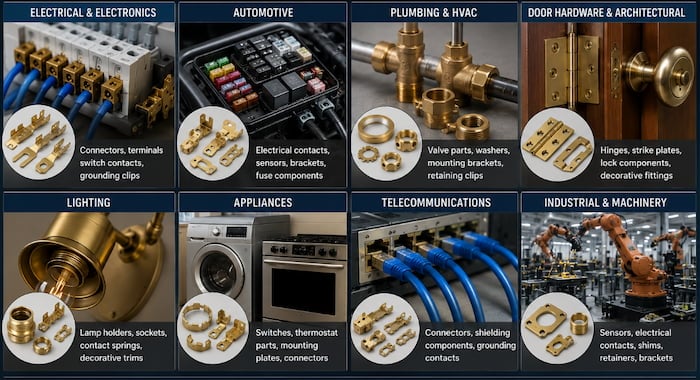
Automotive Components
Automotive suppliers often use stamped brass for terminals, connectors, clips, contacts, and small housings. Stamping is especially useful when designs are stable and annual volumes are high.
Electronics Connectors
Brass is widely used in connector shells, terminals, contacts, and shielding components. Progressive stamping is well suited to these parts because they often require consistent geometry, thin material, and high output.
Architectural Hardware
Brass door hardware, lock components, plates, trims, and decorative pieces may use stamping when the design can be formed from sheet stock. Secondary finishing can then create the desired appearance.
Can Stamping and CNC Machining Be Combined?
Yes. Many brass components benefit from a hybrid process where stamping creates the main shape and CNC machining adds precision features.
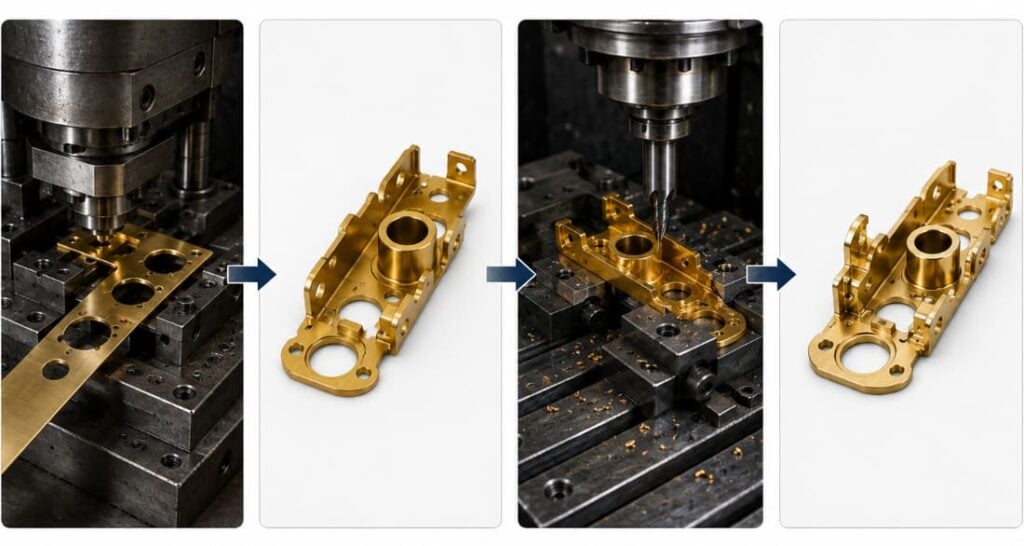
Hybrid Manufacturing Balances Cost and Precision
A common hybrid process includes:
- Primary forming: Stamping creates the basic shape, bend features, flanges, and cutouts.
- Secondary machining: CNC adds precision holes, threads, sealing surfaces, or complex internal features.
- Finishing: Plating, polishing, coating, or deburring is added when required.
This approach combines the speed and cost advantages of stamping with the accuracy of CNC machining.
Example: Brass Valve Body Production
A brass valve body may be formed or cast into its basic shape first, then CNC-machined for threads, sealing faces, and internal passages. For readers comparing brass processes beyond stamping and CNC, our guide to brass valve manufacturing provides useful context on casting and forging choices for pressure-related parts.
What Trends Are Changing Brass Component Manufacturing?
Manufacturing technology continues to improve both stamping and CNC machining. The biggest changes involve automation, digital simulation, quality monitoring, and sustainability.
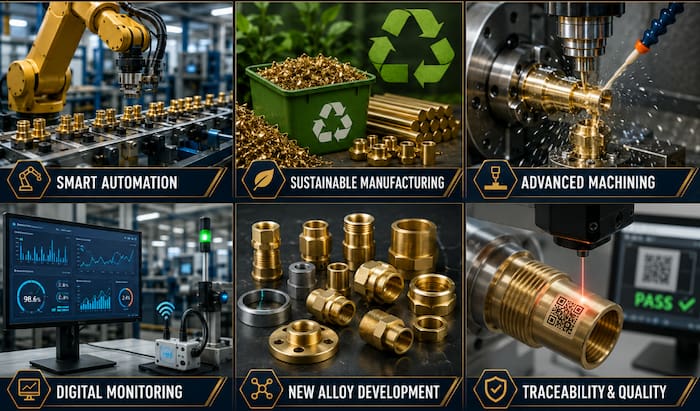
Smart Presses Improve Stamping Control
Modern stamping presses can monitor force, alignment, tool condition, and production variation in real time. This helps reduce defects and improve preventive maintenance.
Digital Simulation Reduces Tooling Risk
Digital forming simulations help engineers predict springback, thinning, cracking, and die performance before physical tooling is built. This can reduce trial-and-error during die development.
Sustainable Manufacturing Is Becoming More Important
Brass scrap from both stamping and CNC machining can be recycled. Stamping often produces less waste per part, while CNC machining generates chips that must be collected and processed efficiently.
Energy-efficient presses, improved tool coatings, and better lubricant management can also reduce environmental impact.
How Should You Choose Between Stamping and CNC Machining?
The best process depends on volume, geometry, tolerance, timeline, material, and long-term design stability.
Follow a Practical Selection Process
- Assess production volume: Estimate annual demand and product lifecycle.
- Review part geometry: Identify whether the design can be formed from sheet or coil stock.
- Model total cost: Include tooling, material, labour, scrap, maintenance, and secondary operations.
- Check timeline: CNC is faster for prototypes, while stamping requires tooling lead time.
- Match quality requirements: Use CNC for critical tight-tolerance features.
- Evaluate design stability: Avoid expensive stamping dies if the part is likely to change.
Ask These Questions Before Choosing
- Will the design stay stable throughout the product lifecycle?
- What is the realistic annual production volume?
- Which features truly require tight precision?
- Can the part be redesigned for stamping?
- Is the timeline long enough for tooling development?
- Would a hybrid stamping and CNC process reduce cost without sacrificing quality?
Conclusion
The choice between stamping and CNC machining for high-volume brass parts is a strategic manufacturing decision. CNC machining offers excellent precision, flexibility, and speed for prototypes or low-volume production. Metal stamping, however, delivers stronger economics when volumes increase and the part geometry is suitable for forming.
For manufacturers, the best path starts with honest volume forecasting, design-for-manufacturability review, and total cost modelling. In many cases, a hybrid approach offers the best balance by using stamping for the main shape and CNC machining for precision details.
At Align Manufacturing, we help customers assess the most suitable production route for metal parts across Vietnam, Thailand, and India. Whether the project involves CNC machining, fabrication, casting, or gravity casting Vietnam, our role is to connect engineering requirements with reliable manufacturing execution.
Frequently Asked Questions
What is the minimum volume that makes brass stamping cost-effective compared to CNC machining?
The break-even point depends on part complexity, tooling cost, material thickness, and tolerance requirements. Simple brass parts may justify stamping at lower volumes, while complex formed parts usually need higher volumes to offset tooling investment.
Can stamped brass parts achieve the same precision as CNC-machined parts?
Stamped brass parts can be highly repeatable, but CNC machining is generally better for very tight tolerances, precision threads, and complex internal features. For demanding parts, stamping can be combined with secondary CNC machining.
How do lead times compare between stamping and CNC machining?
CNC machining usually has a shorter initial lead time because it does not require dedicated dies. Stamping needs tooling development, but once tooling is approved, production speed is much faster.
What brass alloys are best suited for high-volume stamping?
C260 cartridge brass is commonly suitable for forming because of its ductility. C360 is better for machining, while C464 may be selected for improved corrosion resistance in marine applications.
How does material thickness affect the choice between stamping and CNC machining?
Thinner brass sheet is generally more suitable for stamping. Thicker brass stock may require more forming force or may be more practical to machine, depending on the shape and tolerance requirements.
What are the main quality control challenges with brass stamping?
Common challenges include die wear, springback variation, galling, lubrication control, and dimensional consistency during long runs. These are managed through die maintenance, process monitoring, inspection, and proper material control.
Can stamped brass parts be plated or finished after forming?
Yes. Stamped brass parts can be plated, polished, coated, or finished after forming. The design should account for edge condition, recess access, and finish coverage.
How does part complexity affect the economics of brass stamping?
More complex stamped parts require more complex tooling, which increases upfront cost. If the part needs many forming stations or tight precision features, CNC machining or a hybrid process may be more suitable.
What environmental considerations differ between stamping and CNC machining?
Stamping often creates less waste per part, while CNC machining generates recyclable brass chips. Both processes can be managed responsibly through scrap recycling, lubricant control, and energy-efficient equipment.
How has automation changed stamping and CNC machining?
Automation improves both processes. Stamping benefits from automated presses, feeding systems, inspection, and die change systems. CNC benefits from pallet systems, robotic loading, and automated inspection.
What design changes can make brass parts easier to stamp?
Useful design changes include adding generous bend radii, avoiding deep draws where possible, maintaining consistent wall thickness, reducing unnecessary hole sizes, and designing features that suit progressive die production.
How do maintenance costs compare between stamping and CNC machining?
Stamping maintenance is mainly tied to die sharpening, repair, and replacement. CNC maintenance involves cutting tools, calibration, spindle condition, and machine upkeep. The better option depends on volume, part complexity, and production schedule.