

Material Certifications and IMDS Integration for Manufacturing Suppliers
Introduction: The Documentation Imperative
In modern manufacturing supply chains, producing quality parts is no longer sufficient, suppliers must prove quality through comprehensive documentation. Material certifications and the International Material Data System (IMDS) have become gatekeepers to doing business with automotive, aerospace, and medical OEMs. Understanding these requirements isn’t just about compliance; it’s about market access.
This guide demystifies material certification requirements and IMDS integration, providing actionable frameworks for suppliers seeking to meet and exceed their customers expectations.
Understanding Material Certifications
Types of Material Certifications
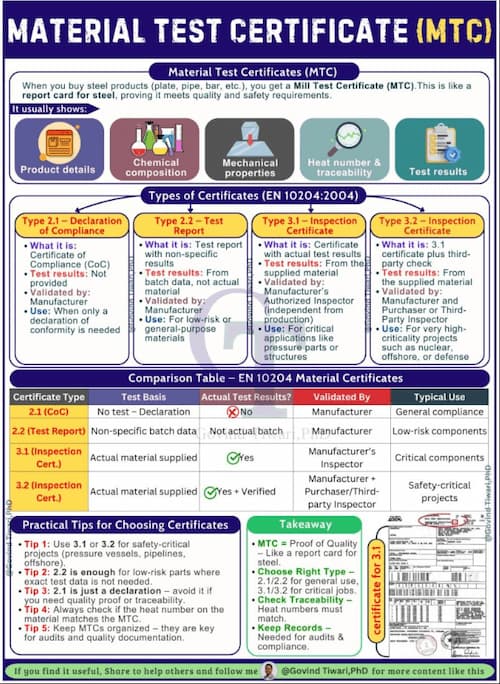
1. Mill Test Report (MTR) / Mill Certificate
The foundational document from the raw material producer:
| Information Included | Purpose |
| Heat/lot number | Traceability |
| Chemical composition | Alloy verification |
| Mechanical properties | Performance validation |
| Production date | Age-sensitive materials |
| Specification compliance | Standard conformance |
| Mill identification | Source verification |
2. Certificate of Compliance (C of C)

Supplier declaration that material meets specified requirements:
- May be based on MTR review
- Typically issued by distributor or converter
- Less comprehensive than full MTR
3. Certificate of Analysis (C of A)
Detailed chemical composition analysis:
- Element-by-element breakdown
- May include trace element reporting
- Often required for critical applications
4. Third-Party Inspection Certificates
Independent verification by accredited bodies:
- SGS, Bureau Veritas, TÜV, Lloyd’s Register
- Often required for international shipments
- Adds credibility and reduces customer inspection
Industry-Specific Certification Requirements
Automotive (IATF 16949)
| Document | Requirement | Retention |
| Material certifications | Full MTR for all production materials | Production life + 1 year |
| PPAP submissions | PSW with material data | Current + 1 revision |
| IMDS reporting | 100% of supplied materials | Indefinite |
| MSDS/SDS | Current safety data sheets | Current version + 30 years |
| RoHS/REACH | Compliance declarations | Current + 5 years |
Aerospace (AS9100 / AS9120)
| Document | Requirement | Retention |
| Material certifications | Full chemical and mechanical | 40 years minimum |
| Test reports | All testing performed | 40 years minimum |
| Supplier certifications | Approved source documentation | Duration of approval |
| Traceability records | Heat/lot to finished part | 40 years minimum |
| NADCOM / customer special | Process certifications | Per customer requirements |
Medical (ISO 13485)
| Document | Requirement | Retention |
| Biocompatibility | ISO 10993 testing | Device lifetime + 2 years |
| Material certifications | Full traceability | Device lifetime + 2 years |
| Sterilization validation | Gamma, EO, or autoclave data | Device lifetime + 2 years |
| Change control | Material change notifications | Indefinite |
Reading and Validating Mill Test Reports
Key Elements to Verify
1. Specification Alignment
Compare MTR specification to purchase order:
| Purchase Order Spec | MTR Claim | Verification |
| ASTM B16 | ASTM B16 Rev 2021 | Match exact revision |
| C36000 | C36000 | Verify UNS number |
| H02 Temper | H02 | Confirm temper |
| 1/2″ diameter | 0.500″ | Check dimensional |
2. Chemical Composition Analysis
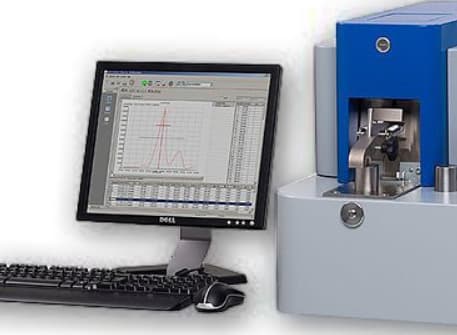
Typical brass composition table from MTR:
| Element | Specification Range | MTR Result | Status |
| Copper (Cu) | 60.0-63.0% | 61.8% | ✓ Accept |
| Lead (Pb) | 2.5-3.7% | 3.1% | ✓ Accept |
| Iron (Fe) | Max 0.35% | 0.12% | ✓ Accept |
| Zinc (Zn) | Remainder | 34.5% | ✓ Accept |
Red Flags:
- Elements outside specification range
- Missing required elements
- “Typical values” instead of actual test results
- No test method cited (e.g., ASTM E415 for spectroscopy)
3. Mechanical Property Verification
| Property | Specification | MTR Result | Tolerance |
| Tensile Strength | 58,000 PSI min | 62,400 PSI | +9% |
| Yield Strength | 45,000 PSI min | 48,200 PSI | +7% |
| Elongation | 25% min | 28% | +12% |
| Hardness | 80-90 HRB | 85 HRB | Mid-range |
4. Traceability Elements
Verify the MTR connects to your material:
- Heat number matches material marking
- Quantity received matches MTR quantity (or is subset)
- Date aligns with production schedule
The IMDS System Explained
What is IMDS?
The International Material Data System is the automotive industry’s global standard for collecting and managing material information:
- Created by: OEM consortium (Audi, BMW, Daimler, EDS, Ford, Opel, Porsche, VW, Volvo)
- Purpose: Track substances of concern; meet ELV, REACH, and other regulations
- Scope: All materials and substances in automotive products
- Current: Over 100,000 users; 400,000+ companies
Regulatory Drivers
| Regulation | Region | IMDS Role |
| ELV Directive 2000/53/EC | EU | Track and report recyclability; banned substance compliance |
| REACH | EU | SCIP database integration; SVHC reporting |
| China Standard GB/T | China | Material substance disclosure |
| K-REACH | Korea | Similar to EU REACH |
| Proposition 65 | California | Substance disclosure for warnings |
| GADSL | Global | Global Automotive Declarable Substance List compliance |
IMDS Structure
The Hierarchy
MDS (Material Data Sheet)
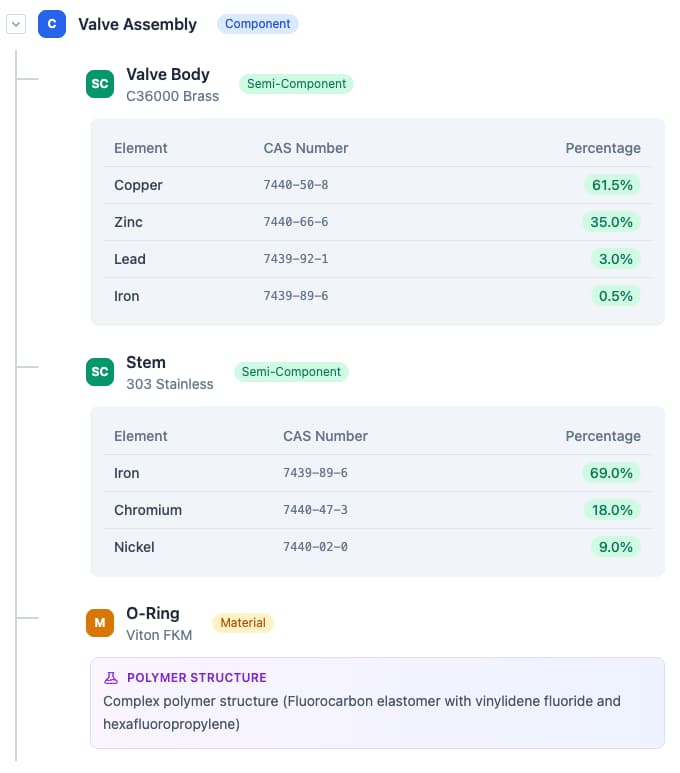
Each Node Contains:
- Identification (part number, name, weight)
- Classification (IMDS code)
- Application (where used in vehicle)
- Substances with CAS numbers and weights
Supplier IMDS Requirements
Who Must Report
| Tier | Responsibility |
| Tier 1 | Report complete assemblies to OEM |
| Tier 2 | Report components to Tier 1 |
| Tier 3+ | Report materials to upstream customers |
| Material Suppliers | Create base material MDSs |
Data Requirements
| Element | Required Information |
| Component name | As on drawing/PBOM |
| Part number | Customer part number |
| Weight | Grams (accurate to 0.001g for small parts) |
| Material classification | IMDS standard codes |
| Substances | All >0.1% by weight (REACH threshold) |
| CAS numbers | Chemical Abstracts Service registry |
| Recyclability | Percentage recyclable content |
Creating IMDS Entries
Step-by-Step Process
Step 1: Gather Information
Required data collection:
- Complete Bill of Materials (BOM)
- Material certifications for all materials
- Weights for each component and material
- Supplier MDS IDs (if available)
- Drawing specifications
Step 2: Request Supplier MDSs
Best practice: Don’t create materials from scratch if supplier already has MDS:
- Request MDS ID and version from material supplier
- Reference in your component MDS
- Ensures consistency and reduces workload
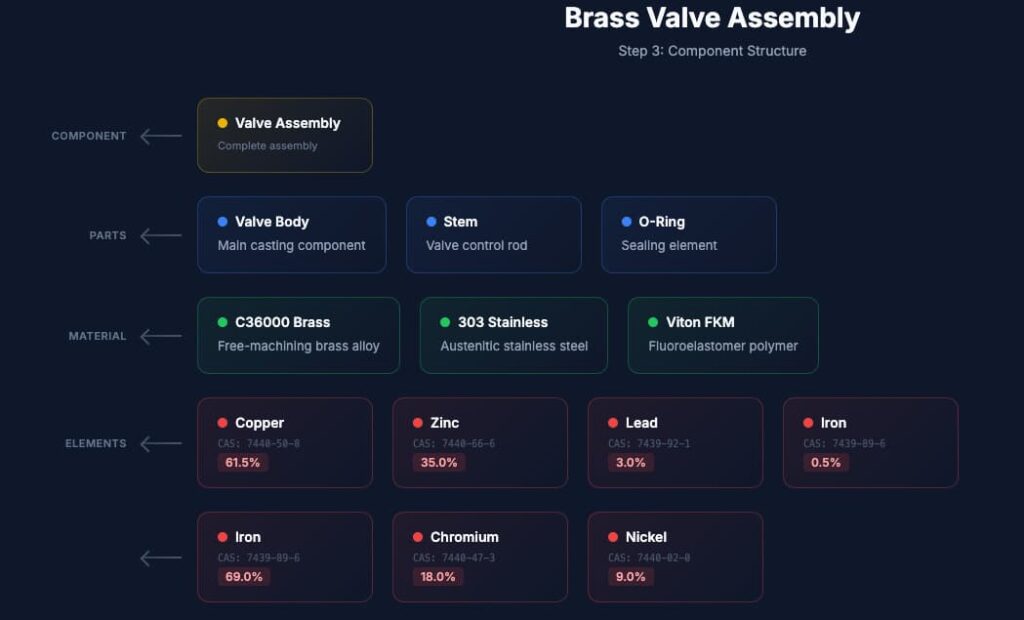
Step 3: Create Component Structure
Example: Brass Valve Assembly
Step 4: Classify and Code
IMDS uses standardized classification codes:
| Code Range | Category |
|---|---|
| 1.x | Steel and iron materials |
| 2.x | Light alloys, cast and wrought alloys |
| 3.x | Heavy metals, cast and wrought alloys |
| 4.x | Special metals |
| 5.x | Polymer materials |
| 6.x | Process polymers |
| 7.x | Other materials and material compounds |
| 8.x | Electronics / electrics |
| 9.x | Fuels and auxiliary means |
Step 5: Validate and Submit
IMDS checks include:
- Weight balance (components sum to parent weight)
- Prohibited substance screening
- Missing information flags
- Customer-specific validation rules
Common IMDS Errors and Solutions
| Error | Cause | Solution |
| Weight mismatch | Components don’t sum to parent | Recalculate and correct weights |
| Jokers | Unknown substances as placeholders | Replace with actual substances or analysis |
| Missing CAS | Substance without CAS number | Look up in IMDS substance list |
| Rejected substance | Banned or restricted material | Find alternative material |
| Application code error | Wrong location classification | Verify against IMDS code list |

Integrating IMDS into Quality Systems
Process Integration Points
1. New Product Introduction (NPI)
- IMDS required before PPAP approval
- Include in APQP timing plan
- Assign IMDS responsibility in project team
2. Supplier Management
- Require IMDS capability in supplier selection
- Include IMDS data in supplier quality agreements
- Audit supplier IMDS processes
3. Engineering Change Control
- Any material change requires IMDS update
- Change board must review IMDS implications
- Customer notification for significant changes
4. Production
- Material lot traceability connects to IMDS
- Ensure actual materials match IMDS declaration
- Control substitution risks
Documentation Control
Required Records
- All submitted MDS IDs and versions
- Supporting material certifications
- Supplier MDS references
- Customer acceptance confirmations
- Change history
Retention Requirements
- Production life + 15 years (automotive typical)
- Verify specific customer requirements
- Some OEMs require 30+ years
Southeast Asia Implementation
Regional Challenges
Supplier Base Limitations
- Many Tier 2/3 suppliers unfamiliar with IMDS
- Limited access to testing for substance verification
- Language barriers in system navigation
Solutions
- Provide IMDS training to key suppliers
- Offer template MDSs for common materials
- Engage IMDS service providers for support
- Consider English-Chinese-Thai system translations
Local Regulatory Considerations
Thailand Automotive Standards
- TISI (Thai Industrial Standards Institute) alignment with international standards
- Board of Investment (BOI) incentives for EV supply chain participation
- Increasing IMDS requirements from Japanese OEMs with Thai operations
ASEAN Integration
- ASEAN Automotive Federation harmonization efforts
- Cross-border data sharing challenges
- Mutual recognition of certifications developing
Working with Regional OEMs
| OEM | IMDS Requirements | Special Considerations |
| Toyota (Thailand) | Full IMDS required | Japanese material standards |
| Honda (Thailand) | Full IMDS required | Strict change control |
| Ford (Thailand) | Full IMDS required | Aligned with global Ford |
| MG/SAIC (Thailand) | Growing IMDS adoption | Chinese material databases |
| Local Assemblers | Varies | Often less stringent |
Best Practices for Material Documentation
1. Supplier Qualification
Before approving material suppliers:
- Verify certification capability
- Review sample MTRs for completeness
- Confirm IMDS experience (for automotive)
- Audit traceability systems
2. Incoming Inspection
For each material lot:
- Compare MTR to specification
- Verify marking matches paperwork
- Check for certificate authenticity
- Retain samples if required
3. Material Traceability
Maintain lot tracking:
- Heat/lot number linked to finished parts
- First-in-first-out (FIFO) stock rotation
- Segregation of different lots
- Computerized tracking systems preferred
4. Customer Communication
Proactive documentation sharing:
- Provide certifications with shipments
- Maintain customer portals for document access
- Notify of any certificate delays
- Offer pre-submission review for critical parts
Conclusion
In today’s documentation-driven manufacturing environment, mastering material certifications and IMDS integration is no longer optional, it is a critical requirement for maintaining compliance, ensuring traceability, and securing long-term customer trust. From validating mill test reports to building accurate IMDS submissions, suppliers that implement structured, repeatable documentation processes position themselves as reliable partners within global supply chains.
For companies operating in highly competitive sectors such as automotive and industrial manufacturing, this level of discipline becomes even more important when supporting processes like forging in Vietnam, where international buyers increasingly expect full transparency, material traceability, and regulatory alignment. By combining strong documentation practices with robust manufacturing capabilities, suppliers can not only meet compliance standards but also unlock greater market access and long-term growth opportunities.
FAQ
Q1: How long must we retain material certifications?
A: Retention periods vary by industry:
- Automotive (IATF 16949): Production life + 1 year (minimum)
- Aerospace (AS9100): 40 years from shipment
- Medical (ISO 13485): Device lifetime + 2 years (often 10-15+ years)
- General Industrial: Typically 7-10 years
Always verify specific customer requirements, which may exceed industry standards.
Q2: Can we use “typical” values from MTRs instead of testing each lot?
A: Generally no for critical applications:
- “Typical” or “nominal” values don’t represent actual lot
- Most automotive and aerospace requires actual test results
- Some non-critical applications may accept typical values with customer approval
- When in doubt, require actual test results
Q3: What if our material supplier won’t provide IMDS data?
A: Options:
- Find alternative supplier with IMDS capability
- Create material yourself from composition data (requires accurate analysis)
- Use IMDS service provider to create entries
- Request customer assistance for critical sole-source materials
Note: Creating materials from scratch requires accurate substance analysis and estimates not acceptable.
Q4: Do we need IMDS for prototype parts?
A: Typically yes:
- Most OEMs require IMDS before PPAP approval
- Prototype phase IMDS often marked “for prototype only”
- Production IMDS must be updated for any material changes
- Early IMDS submission prevents production delays
Q5: How do we handle confidential material formulations?
A: IMDS provides protection mechanisms:
- Pseudo-substances: Hide exact formulation while declaring regulated substances
- Joker system: For complex polymers where exact formula confidential
- Supplier MDS: Reference supplier’s confidential MDS without disclosure
- OEM agreement: Some customers accept offline disclosure for highly confidential materials
Q6: What substances trigger IMDS reporting requirements?
A: Two thresholds:
- REACH SVHC: >0.1% by weight (reportable but not prohibited)
- GADSL: Declarable substances at specified thresholds
- ELV banned: Lead, mercury, cadmium, hexavalent chromium which is prohibited with limited exceptions
Q7: Can we update an IMDS entry after customer acceptance?
A: Yes, through versioning:
- New version supersedes old
- Customer must accept new version
- Always increment version for any change
- Maintain history of all versions
Q8: What’s the penalty for incorrect IMDS data?
A: Consequences can be severe:
- PPAP rejection: Cannot ship production parts
- Stop shipments: Existing business halted until corrected
- Fines: For regulatory non-compliance (REACH, ELV)
- Recall liability: If non-compliant products reach market
- Supplier score impact: Affects future business opportunities