
Utilizing Brass Thermal Conductivity in Heat Exchanger Manufacturing
Suggested URL: /brass-thermal-conductivity-heat-exchanger-manufacturing
Heat exchangers form the thermal backbone of HVAC systems, marine cooling, power generation, and industrial process equipment. Material selection for heat exchanger tubes and components directly impacts thermal efficiency, corrosion resistance, service life, and manufacturing economics. Brass alloys, particularly copper-zinc alloys, offer a strong balance of thermal performance, fabricability, and cost-effectiveness that has made them reliable materials in heat transfer applications for over a century.
Understanding how brass thermal conductivity changes with alloy composition, temperature, and manufacturing processes helps engineers optimise heat exchanger designs for specific operating environments. This guide examines brass thermal properties, alloy selection criteria, and manufacturing considerations for heat exchanger applications.
What Is Thermal Conductivity in Heat Exchanger Materials?
Thermal conductivity measures a material’s ability to conduct heat, quantified in watts per metre-kelvin (W/m·K). Higher values indicate more efficient heat transfer. Thermal conductivity depends on atomic structure, electron mobility, temperature, and material purity.
Metals Conduct Heat Through Electron Transport and Lattice Vibrations
Metals conduct heat through two primary mechanisms:
Electron transport: Free electrons in metallic bonds carry thermal energy efficiently. According to the ASM Handbook, pure copper’s high thermal conductivity, around 398 W/m·K at room temperature, is linked to its free electron structure.
Lattice vibrations, or phonons: Atomic vibrations move through the crystalline structure and contribute to thermal transport. This mechanism is more dominant in non-metallic materials, but it still contributes to heat transfer in metals.
Alloying elements disrupt regular crystalline structures and scatter electrons, generally reducing thermal conductivity compared to pure metals. However, alloying is often necessary to improve strength, corrosion resistance, machinability, or other performance requirements.
What Is the Thermal Conductivity Range of Brass?
Commercial brass alloys typically exhibit thermal conductivities of approximately 100–150 W/m·K. This is substantially lower than pure copper and lower than aluminium, which is commonly around 205 W/m·K, but far above stainless steel, which is often around 15–25 W/m·K. This positions brass as a practical compromise between heat transfer, corrosion resistance, and manufacturing performance.
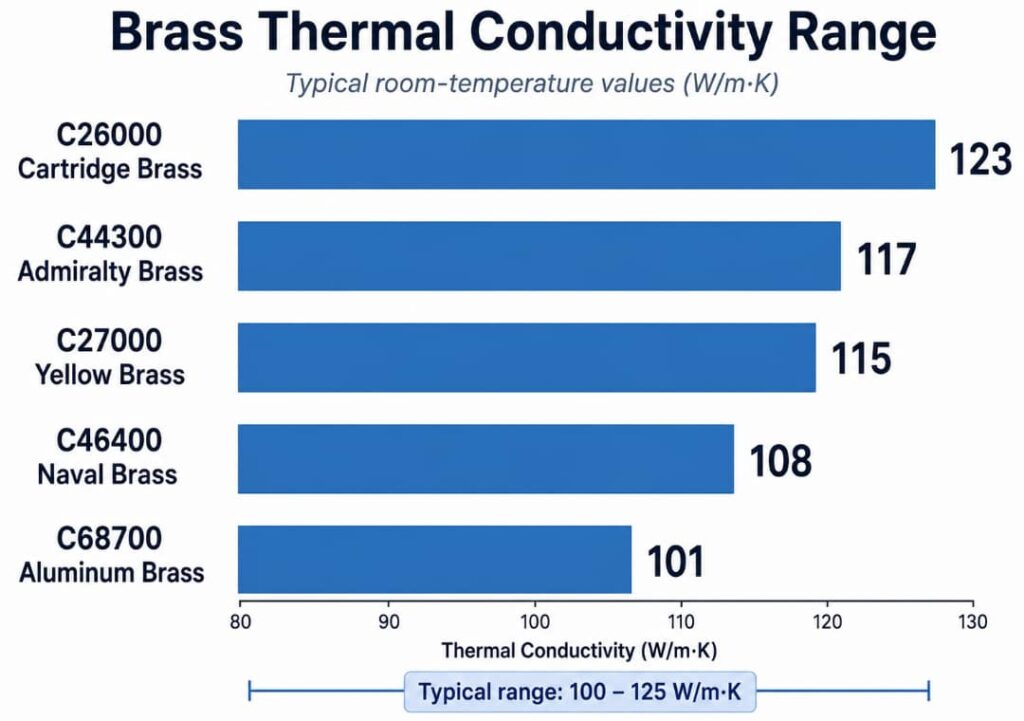
| Alloy | UNS | Thermal Conductivity (W/m·K) | Notes |
|---|---|---|---|
| Cartridge Brass | C26000 | 123 | Standard brass with good balance |
| Yellow Brass | C27000 | 115 | Similar to C26000 |
| Admiralty Brass | C44300 | 117 | Arsenic-inhibited for seawater |
| Naval Brass | C46400 | 108 | Higher strength, lower conductivity |
| Aluminum Brass | C68700 | 101 | Aluminum addition reduces conductivity |
Thermal conductivity generally decreases with increasing zinc content and additional alloying elements. Pure copper’s 398 W/m·K can drop to approximately 115–125 W/m·K in common brasses containing 30–40% zinc.
Brass Conductivity Can Increase at Higher Temperatures
Thermal conductivity varies with temperature. For brass alloys commonly used in heat exchangers:
At 20°C (68°F): 100–125 W/m·K
At 100°C (212°F): 115–140 W/m·K
At 200°C (392°F): 125–150 W/m·K
This positive temperature coefficient can benefit heat exchanger performance, as conductivity may increase where heat transfer is most intensive. However, designers still need to account for the full operating temperature range when calculating thermal performance.
Which Brass Alloys Are Used in Heat Exchangers?
Different brass alloys serve different heat exchanger applications depending on thermal requirements, corrosion environment, and mechanical property needs.
Admiralty Brass Balances Conductivity and Seawater Resistance
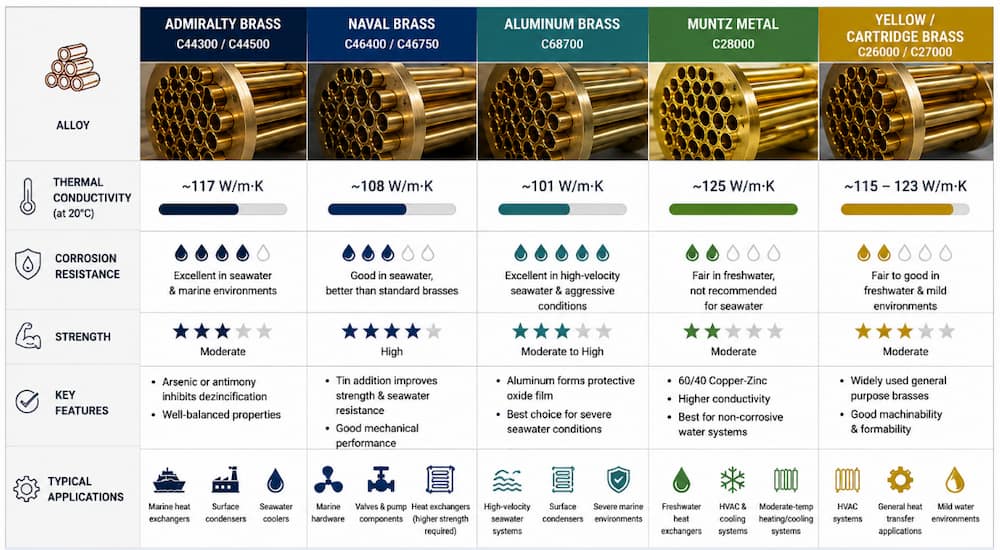
Admiralty brass, including C44300 and C44500, contains approximately 70–73% copper, 26–29% zinc, and small additions of tin and arsenic or antimony. The arsenic addition, typically 0.02–0.10%, helps inhibit dezincification corrosion in seawater and other aggressive environments.
Thermal properties:
- Thermal conductivity: around 117 W/m·K at 20°C
- Moderate thermal performance with excellent corrosion resistance
- Suitable for moderate-temperature applications
Applications:
- Surface condensers for power plants
- Distiller units in marine applications
- Heat exchangers handling seawater or brackish water
- Oil coolers and evaporators
Admiralty brass is a workhorse alloy for marine and coastal heat exchanger applications where seawater corrosion strongly influences material selection.
Naval Brass Offers Higher Strength for Loaded Components
Naval brass, including C46400 and C46750, contains approximately 59–62% copper, 0.5–1.0% tin, and the balance zinc. Tin improves strength and seawater corrosion resistance compared to standard brasses.
Thermal properties:
- Thermal conductivity: around 108 W/m·K at 20°C
- Lower conductivity due to higher tin content
- Improved mechanical strength
Applications:
- Propeller shafts and marine hardware
- Valve stems and pump components
- Heat exchanger components requiring higher strength
- Applications with moderate thermal requirements and mechanical loading
The strength advantage of naval brass may allow thinner wall designs, partially compensating for reduced thermal conductivity in certain applications.
Aluminum Brass Performs Well in Severe Seawater Conditions
Aluminum brass, including C68700, contains approximately 76–79% copper, 1.8–2.5% aluminum, and the balance zinc. Aluminum helps create a protective oxide film, improving corrosion resistance in high-velocity seawater.
Thermal properties:
- Thermal conductivity: around 101 W/m·K at 20°C
- Lower conductivity than admiralty brass
- Strong corrosion resistance for severe environments
Applications:
- High-velocity seawater heat exchangers
- Surface condensers with aggressive water conditions
- Applications where corrosion would limit the service life of other brasses
Although aluminum brass has lower thermal conductivity, it can provide better life-cycle performance in severe environments by reducing the risk of premature tube failure.
Muntz Metal Provides Higher Conductivity for Freshwater Systems
Muntz metal, or C28000, contains approximately 59–62% copper and the balance zinc. It is essentially a 60/40 brass without additional alloying elements.
Thermal properties:
- Thermal conductivity: around 125 W/m·K at 20°C
- Higher conductivity than admiralty or aluminum brass
- Lower corrosion resistance, making it more suitable for freshwater applications
Applications:
- Freshwater heat exchangers
- Moderate-temperature heating and cooling systems
- Applications where thermal performance outweighs corrosion concerns
What Design Factors Matter for Brass Heat Exchangers?
Effective heat exchanger design balances thermal performance, pressure drop, structural integrity, corrosion resistance, and manufacturing feasibility.
Tube Wall Thickness Controls Heat Transfer and Strength
Thinner walls improve thermal performance by reducing conductive resistance, but they must still withstand pressure, erosion, vibration, and corrosion. Typical heat exchanger tube wall thicknesses range from 0.5–2.0 mm, depending on diameter and service conditions.
Thermal resistance through the tube wall can be expressed as:
R_wall = ln(r_outer / r_inner) / (2 × π × k × L)
Where k is thermal conductivity and L is tube length. Higher conductivity reduces wall resistance, supporting improved heat transfer or reduced surface area requirements.
Tube Diameter Affects Surface Area and Pressure Drop
Smaller tube diameters provide higher surface area per unit volume and may increase heat transfer coefficients. However, they can also increase pressure drop and fouling susceptibility. Common brass heat exchanger tubes range from 6–50 mm in diameter.
Surface Enhancements Improve Heat Transfer
Internal or external surface enhancements, including grooves, fins, and turbulators, increase heat transfer area and promote turbulence. Manufacturing processes must accommodate these features while maintaining material integrity and dimensional consistency.
How Does Fouling Affect Brass Heat Exchanger Performance?
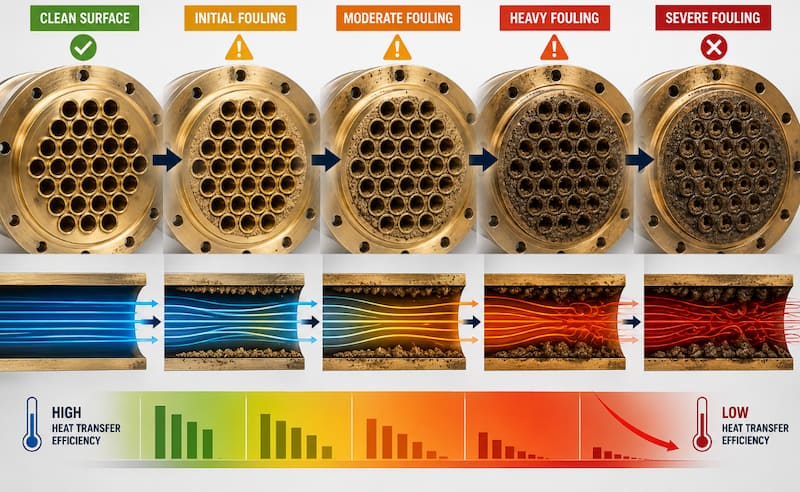
Fouling, or the deposition of materials on heat transfer surfaces, degrades performance over time. Brass’s smooth surface finish and corrosion resistance can reduce certain fouling mechanisms.
Particulate fouling: Smooth brass surfaces shed particles more readily than rougher materials.
Corrosion fouling: Proper brass alloy selection minimises corrosion product accumulation.
Biological fouling: Copper content provides natural biofouling resistance.
Biofouling resistance is especially valuable in marine and coastal applications, where biological growth can otherwise require frequent cleaning or chemical treatment.
Brass Helps Maintain Higher Overall Heat Transfer Coefficients
Heat exchanger thermal design uses overall heat transfer coefficients, or U-values, combining convective resistances and wall conduction:
1/U = 1/h_inner + R_wall + 1/h_outer + R_fouling
Where h represents convective heat transfer coefficients and R_fouling accounts for fouling layer resistance. Brass’s favourable thermal conductivity reduces R_wall, enabling higher U-values and more compact designs.
According to Begell House Publishers’ Heat Exchanger Design Handbook, brass tubes in typical water-to-water or water-to-air applications may achieve U-values of around 500–1,500 W/m²·K, depending on flow conditions and fouling state.
How Are Brass Heat Exchanger Components Manufactured?
Brass heat exchanger manufacturing includes tube production, component fabrication, assembly, and quality verification.
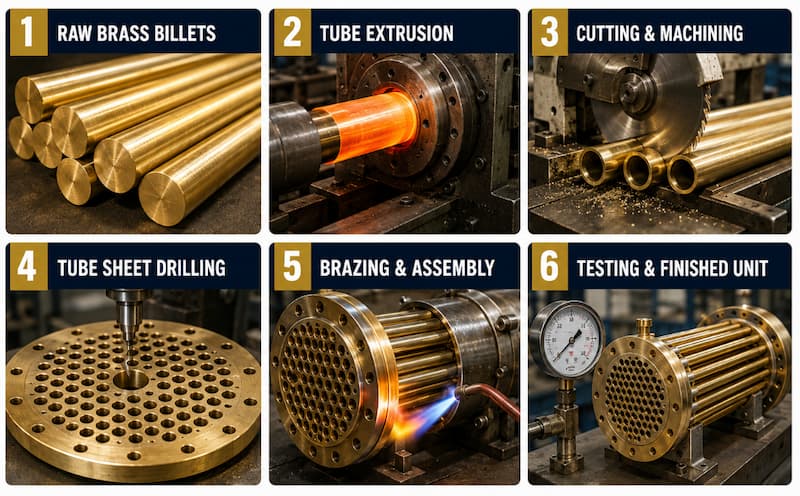
Seamless Tube Extrusion Supports High-Quality Tubing
High-quality heat exchanger tubes typically use seamless extrusion processes. Brass billets are heated to approximately 600–750°C and extruded through dies to form hollow tubes. Subsequent cold drawing achieves precise dimensional tolerances and surface finishes.
Manufacturing processes must preserve thermal conductivity through:
- Controlled annealing to relieve work hardening without excessive grain growth
- Minimising residual stresses that could affect thermal performance
- Maintaining alloy chemistry within specification limits
Heat exchanger tubes require tight dimensional tolerances, typically around ±0.05 mm on diameter, and defect-free surfaces. Eddy current and ultrasonic testing are commonly used to verify tube integrity.
Headers, Baffles, and Support Plates Require Accurate Fabrication
Heat exchanger headers, baffles, and support plates are typically fabricated from brass plate or castings.
Stamping and forming: Brass sheet can be stamped into header shapes, tube sheets, and baffles. Progressive dies help produce high volumes of components with consistent quality.
Machining: CNC machining produces complex features in headers and connections. Free-machining brass grades support drilling, tapping, and surface machining, while tool selection and chip control help manage brass’s thermal conductivity and tendency to gall.
Joining: Brazing is widely used for heat exchanger assembly because it creates metallurgical bonds with strong thermal and mechanical properties. Silver-based brazing alloys from the BAg series are often used for high-strength joints with good corrosion resistance.
How Can Corrosion Be Controlled in Brass Heat Exchangers?
Heat exchanger longevity depends on corrosion management during both manufacturing and service.
Surface Treatments Help Improve Corrosion Resistance
Common corrosion protection methods include:
Passivation: Chemical treatments that support protective oxide formation
Coatings: Organic or metallic coatings for severe environments
Cathodic protection: Sacrificial anodes for critical applications
Manufacturing cleanliness is also critical. Residual lubricants, fluxes, or contaminants can accelerate corrosion initiation, so thorough cleaning before shipment helps protect components during storage and early service.
Which Brass Alloys Work Best for Marine and HVAC Applications?
Heat exchanger service environments dictate alloy selection and design practice.
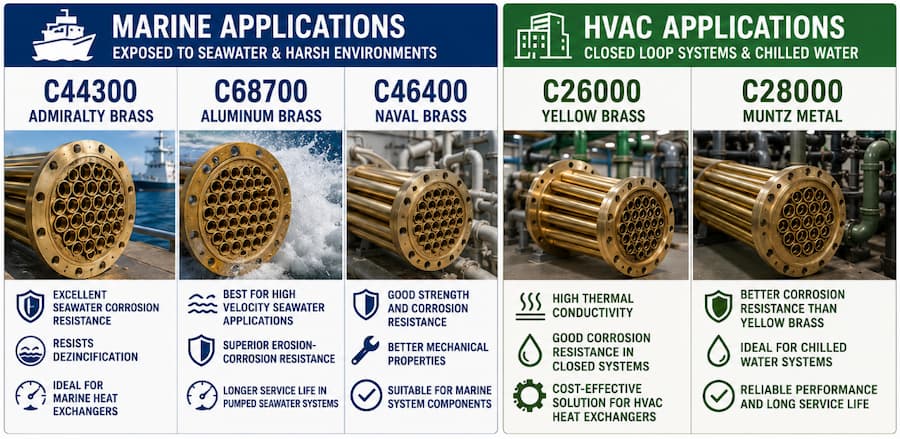
Marine Systems Need Strong Seawater Corrosion Resistance
Marine heat exchangers face severe corrosion challenges from seawater exposure.
Recommended alloys:
- Seawater cooling: Admiralty brass C44300 or aluminum brass C68700
- High-velocity seawater: Aluminum brass preferred for velocity above 2.5 m/s
- Seawater with sediment: Admiralty brass with enhanced wall thickness
Design considerations:
- Maintain water velocity between 1–3 m/s to reduce erosion-corrosion
- Avoid crevices where differential aeration corrosion can begin
- Design for inspection and tube replacement access
- Specify corrosion allowance in wall thickness calculations
According to CRC Press’ Heat Transfer Engineering: Design and Applications, properly designed and maintained brass marine heat exchangers can often achieve long service lives, with tube replacement extending total system life.
HVAC Systems Can Use Higher-Conductivity Standard Brasses
HVAC heat exchangers typically operate in freshwater or closed-loop glycol systems with lower corrosion severity.
Recommended alloys:
- Freshwater heating and cooling: C26000, C27000, or C28000
- Chilled water systems: Standard brasses with proper water treatment
- Steam heating: Admiralty brass for condensing applications
Design considerations:
- Check compatibility with water treatment chemicals
- Allow for thermal expansion in long tube bundles
- Provide venting for non-condensable gases in steam systems
- Consider freeze protection for exposed installations
HVAC brass heat exchangers commonly achieve long service lives with proper water chemistry control, and lower corrosion severity may allow the use of higher-conductivity standard brasses.
What Corrosion Mechanisms Cause Brass Heat Exchanger Failure?
Understanding corrosion helps prevent premature heat exchanger failure.
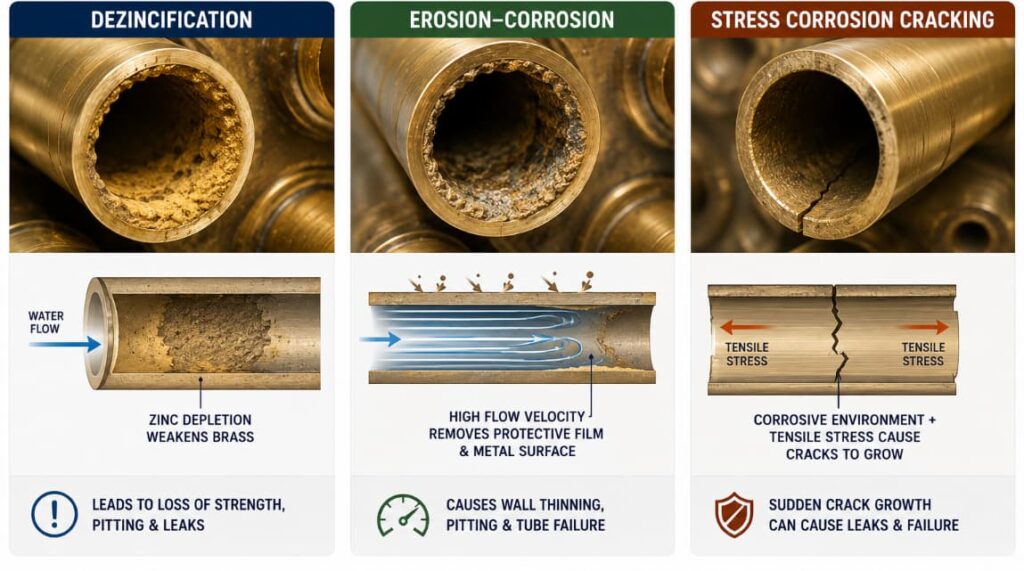
Dezincification Weakens Brass by Removing Zinc
Dezincification selectively removes zinc from brass, leaving porous copper with degraded mechanical properties. It is especially problematic in stagnant seawater or mildly acidic conditions.
Prevention:
- Specify inhibited admiralty brass with arsenic or antimony additions
- Maintain water velocity to avoid stagnant conditions
- Control pH within recommended ranges
- Use cathodic protection for critical applications
Erosion-Corrosion Occurs in High-Velocity Flow
Erosion-corrosion combines mechanical wear and electrochemical attack. It often occurs in high-velocity flows, especially where turbulence or particulates are present.
Prevention:
- Limit water velocity to alloy-specific maximums
- Design smooth flow paths without abrupt direction changes
- Filter particulates from cooling water
- Select aluminum brass for high-velocity seawater applications
Stress Corrosion Cracking Can Occur Around Ammonia
Ammonia and certain sulfur compounds can induce stress corrosion cracking in brass under tensile stress.
Prevention:
- Avoid ammonia-bearing atmospheres
- Stress-relieve components after fabrication
- Select alternative materials when ammonia exposure is unavoidable
How Can Brass Heat Exchanger Performance Be Optimised?
Engineers can optimise heat exchanger designs by using brass’s thermal properties strategically.
Higher Conductivity Supports Compact Designs
Brass thermal conductivity enables several design trade-offs:
- Compact heat exchangers achieving the same duty
- Closer approach temperatures
- Reduced tube count in suitable designs
Enhanced Surfaces Can Offset Conductivity Limits
Surface enhancements can compensate for conductivity limitations:
- Internally grooved tubes increase surface area and turbulence
- Corrugated tubes promote mixing without external fins
- Twisted tube inserts generate secondary flow patterns
Manufacturing must balance thermal benefits against production complexity, cost, and inspection requirements.
Brass Can Reduce Fouling Maintenance
Copper’s natural biofouling resistance gives brass several operational advantages:
- Reduced cleaning frequency compared to steel or aluminium in some water systems
- Lower chemical treatment requirements
- More stable performance over extended operating periods
Designers may still use conservative fouling factors, but brass can help maintain better long-term thermal performance in suitable applications.
Conclusion
Brass remains a valuable material for heat exchanger manufacturing because it combines practical thermal conductivity, good corrosion resistance, strong fabricability, and long service potential. While pure copper and aluminium offer higher conductivity, brass often delivers a better overall balance for marine, HVAC, condenser, and industrial cooling applications. The best alloy choice depends on the operating environment: standard brasses suit freshwater systems, admiralty brass balances conductivity and seawater resistance, and aluminum brass performs well in harsher marine conditions.
For engineers and sourcing teams, choosing a heat exchanger material is not only about conductivity. It also involves corrosion risk, manufacturing method, pressure requirements, joining quality, water chemistry, and long-term maintenance. Buyers comparing technical manufacturing partners rather than promotional products suppliers should prioritise proven alloy knowledge, process control, inspection capability, and practical design support.
At Align Manufacturing, we help customers turn engineered metal parts from print to reality across Southeast Asia, including Thailand, Vietnam, and India. Our experience across CNC machining, casting, stamping, forging, and fabrication allows us to support projects where material selection and process choice directly affect performance. For teams evaluating cast components, marine hardware, or industrial parts, our regional expertise also makes gravity casting in Vietnam a practical option for balancing quality, cost, and supply-chain flexibility.
Frequently Asked Questions
What brass alloy offers the best thermal conductivity for heat exchangers?
Standard brass alloys such as C26000 cartridge brass and C28000 Muntz metal offer some of the highest thermal conductivity values among common heat exchanger brasses, at around 120–125 W/m·K. However, they lack the corrosion resistance needed for seawater applications. For marine service, admiralty brass C44300 provides the best balance of thermal performance and corrosion resistance, while aluminum brass C68700 offers stronger corrosion resistance with lower conductivity.
How does brass thermal conductivity compare to copper and aluminum?
Pure copper has the highest conductivity at around 398 W/m·K. Aluminium is commonly around 205 W/m·K. Brass alloys are typically around 100–125 W/m·K, while stainless steel is much lower at around 15–25 W/m·K. Brass occupies a practical middle ground by offering better conductivity than stainless steel with stronger durability and corrosion performance than many alternatives in suitable water environments.
Why does thermal conductivity increase with temperature for brass?
In many brass alloys, thermal conductivity can increase as temperature rises due to changes in electron and lattice vibration interactions. This can benefit heat exchanger performance because conductivity may improve at higher operating temperatures, although engineers still need to calculate performance based on the actual service temperature range.
What causes brass heat exchanger tubes to fail prematurely?
Common failure modes include dezincification, erosion-corrosion, stress corrosion cracking, pitting corrosion, and fatigue from thermal cycling or vibration. Proper alloy selection, appropriate flow velocity, clean manufacturing, water treatment, and regular maintenance prevent most premature failures.
How do I select between admiralty brass and aluminum brass for marine heat exchangers?
Select admiralty brass C44300 when seawater velocity is moderate, sediment levels are low, cost optimisation is important, and service history supports satisfactory performance. Select aluminum brass C68700 when water velocity is high, sediment or abrasive particles are present, maximum service life is critical, or corrosion conditions are severe.
Can brass heat exchangers handle steam applications?
Yes. Brass heat exchangers are commonly used in steam heating and condensing applications. Admiralty brass performs well in surface condensers and steam heating systems. Important design considerations include pressure containment, condensate drainage, non-condensable gas venting, and compatibility with condensate chemistry.
What water chemistry conditions favour brass heat exchangers?
Brass performs best in neutral to mildly alkaline water, typically around pH 7.0–9.0, with low ammonia and controlled chloride levels. Aerated water can support protective oxide formation. Standard brasses should avoid high ammonia, high sulfides, and acidic conditions below pH 6.5.
How does fouling affect brass heat exchanger performance?
Brass offers natural biofouling resistance because of its copper content, reducing biological growth compared with steel or aluminium in some systems. Drawn brass tubes can also achieve smooth surfaces that reduce particulate adhesion. Mineral scaling can still occur, so water treatment and periodic cleaning may still be needed.
What manufacturing methods produce the best brass heat exchanger tubes?
Seamless extrusion followed by cold drawing is commonly used for high-quality heat exchanger tubes. This process eliminates weld seams, achieves tight tolerances, creates smooth surfaces, and provides uniform mechanical properties. ASTM B111 defines requirements for copper and copper-alloy seamless condenser tubes.
How do I calculate the heat transfer improvement from using brass instead of stainless steel?
The improvement depends on the controlling resistance. When tube wall conduction limits performance, the improvement can approximate the conductivity ratio between brass and stainless steel. In practical systems where convection often controls heat transfer, the improvement is less dramatic, but brass can still support higher U-values, smaller equipment size, or improved performance.
Can damaged brass heat exchanger tubes be repaired?
Yes. Individual tube replacement is the standard repair method for leaking tubes. Other methods include tube plugging, which reduces capacity, or local annealing for stress relief in limited areas. Heat exchangers should be designed with tube sheet layouts that allow inspection and tube replacement.
What is the maximum operating temperature for brass heat exchangers?
Brass heat exchangers typically operate below 200°C. Standard brasses such as C26000 and C27000 are often limited to around 150–175°C, admiralty brass C44300 to around 175–200°C, and aluminum brass C68700 to around 150–175°C. Above these ranges, strength decreases and corrosion rates may increase.
How does zinc content affect brass thermal conductivity?
Increasing zinc content generally lowers thermal conductivity compared with pure copper. Pure copper has around 398 W/m·K, while cartridge brass with roughly 30% zinc is closer to 123 W/m·K. Additional alloying elements such as tin and aluminum can further reduce conductivity, although exact values depend on alloy phase structure.
What brazing materials work best for brass heat exchanger assembly?
Silver-based brazing alloys, including BAg-1, BAg-5, and BAg-7 under AWS A5.8, are commonly used for brass heat exchanger assembly. They provide strong joints, good flow characteristics, and corrosion-resistant performance when paired with proper flux selection, joint design, and temperature control.
Are there environmental concerns with brass heat exchangers?
Brass contains copper and zinc, while some alloys include small additions of arsenic, tin, or aluminum. Environmental considerations include copper release in sensitive waters and responsible handling of alloying elements during manufacturing. However, brass is highly recyclable and can offer a favourable environmental profile because of its long service life and full recyclability.