
Posts Tagged ‘Brass’
C46400 Naval Brass: Corrosion Resistance for Marine Fittings
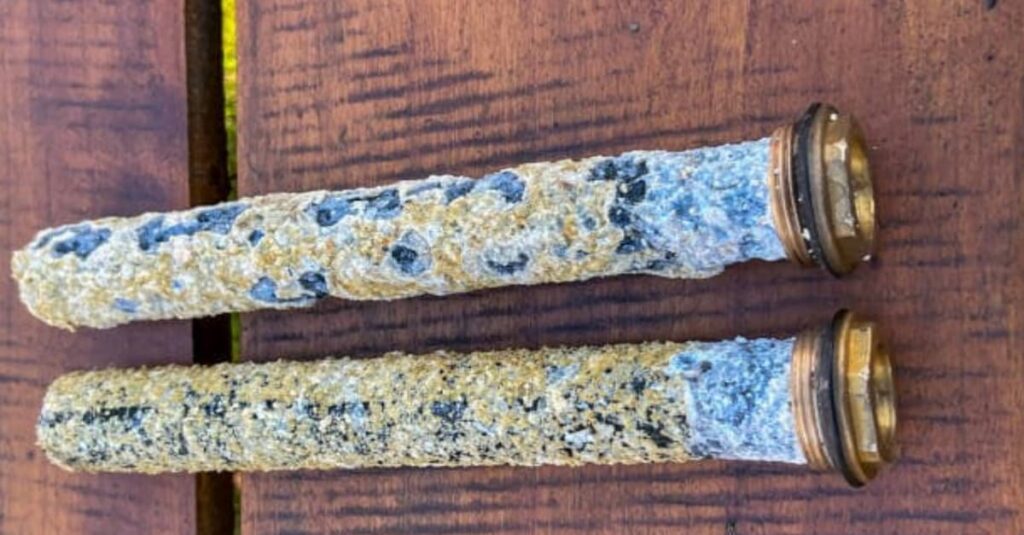
C46400 naval brass is a copper-zinc-tin alloy used for marine fittings, valve components, fasteners, condenser parts, and other equipment exposed to seawater or coastal conditions. Its tin content improves corrosion resistance compared with standard brasses, while its strength and hot-working characteristics support demanding marine applications.
However, C46400 is not suitable for every seawater system. Flow velocity, water chemistry, mechanical loading, manufacturing method, and galvanic compatibility should all be considered before specifying it.
This guide explains the alloy’s composition, specifications, applications, manufacturing considerations, sourcing requirements, and practical limitations.
Why Does Tin Improve C46400’s Marine Performance?
C46400 is a wrought naval brass with the following chemical composition, according to the Copper Development Association:
| Element | C46400 Range |
| Copper | 59.0–62.0% |
| Tin | 0.50–1.00% |
| Lead | 0.20% maximum |
| Iron | 0.10% maximum |
| Zinc | Remainder |
Tin helps reduce dezincification
Dezincification is a form of selective corrosion in which zinc is removed from brass, leaving a porous copper-rich structure with reduced mechanical strength.
The addition of tin improves C46400’s resistance to this process, making it more suitable for marine exposure than unstabilised high-zinc brasses.
Its performance still depends on:
- Water temperature and chemistry
- Flow velocity
- Oxygen and sulphide levels
- Mechanical stress
- Surface condition
- Contact with dissimilar metals
C46400 should therefore be selected according to the complete operating environment rather than its alloy name alone.
How much tin does C46400 contain?
C46400 contains 0.50–1.00% tin by weight, with copper at 59.0–62.0% and zinc making up most of the balance. The mill certificate should confirm that the supplied heat falls within these limits.
Which Specifications Apply to C46400 Naval Brass?
The correct material specification depends on the purchased product form.
| Product Form | Common Specification | Typical Use |
| Rod, bar, and shapes | ASTM B21/B21M | Machined fittings, stems, shafts, and hardware |
| Hot-forging material | ASTM B124/B124M | Forged valve and fitting components |
| Plate and sheet | Applicable specification stated on the drawing | Condenser plates, baffles, and fabricated components |
The drawing and purchase order should state:
- UNS alloy designation
- Applicable material specification
- Product form
- Temper
- Dimensions and tolerances
- Required mechanical properties
- Testing requirements
- Certification and traceability requirements
Avoid specifying only “naval brass,” as this may not provide enough information to control the exact alloy, form, and condition supplied.
How does temper affect C46400?
Temper describes the material condition created through cold working or thermal processing. It can affect:
- Tensile and yield strength
- Ductility
- Machining behaviour
- Formability
- Dimensional stability
The selected temper should match the manufacturing process and final component requirements. A harder condition may provide greater strength but less formability.
Where Is C46400 Naval Brass Used?
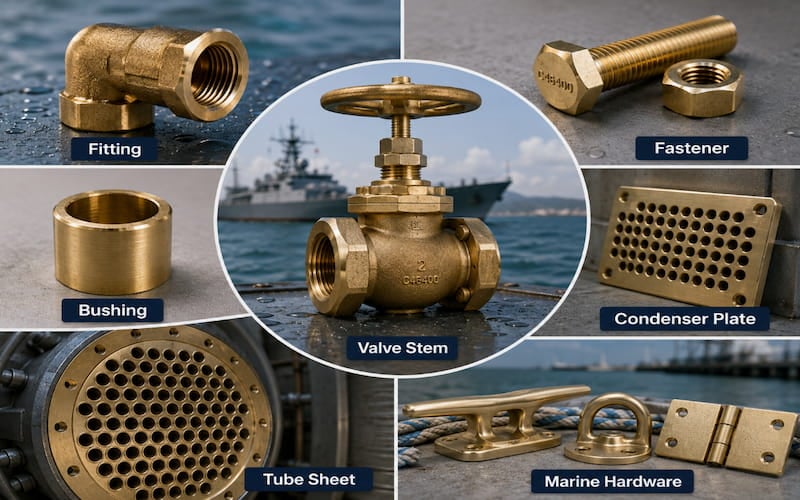
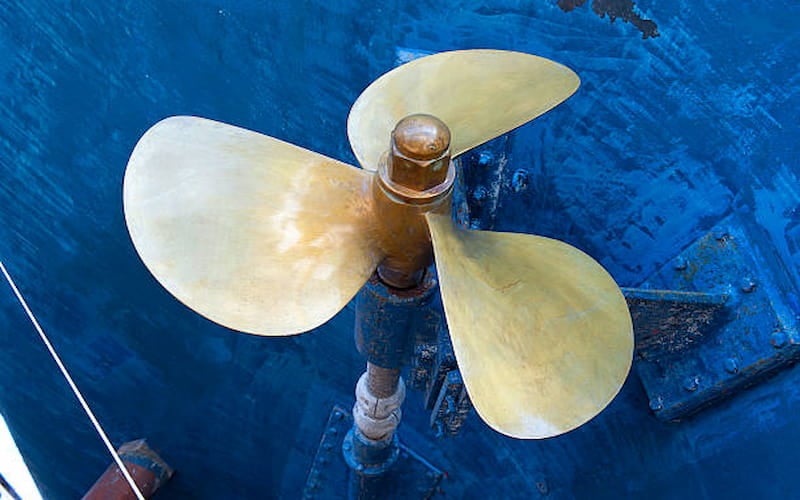
C46400 is generally selected for components requiring a combination of corrosion resistance, strength, formability, and reliable manufacturing performance.
Common applications include:
- Marine valve stems and internal components
- Fittings and couplings
- Fasteners and lock pins
- Propeller-shaft components
- Condenser and heat-exchanger parts
- Tube sheets and baffle plates
- Marine hardware
- Bushings and wear components
- Coastal architectural hardware
Valves and fittings benefit from marine corrosion resistance
Valve and fitting components may be exposed to seawater, salt spray, condensation, and marine atmospheres. C46400 offers better resistance to these conditions than standard free-machining brass while retaining useful machining and hot-working characteristics.
The selected material must also suit the component’s:
- Pressure rating
- Wall thickness
- Joining method
- Operating temperature
- Flow conditions
- Required service life
Heat exchangers require careful material matching
C46400 may be used in heat-exchanger and condenser components where both strength and moderate thermal conductivity are required.
Naval brass has lower thermal conductivity than some standard brass alloys because of its tin and zinc content, but it offers improved mechanical strength and marine corrosion performance. Align Manufacturing’s article on brass thermal conductivity in heat exchangers provides a wider comparison of heat-transfer brass grades.
Is C46400 Suitable for Potable-Water Components?
C46400 has a maximum specified lead content of 0.20%. However, the lead percentage of the brass body alone does not prove that a finished product complies with potable-water requirements.
A finished component may also contain:
- Solder or brazing filler
- Plating
- Coatings
- Seals
- Thread compounds
- Other wetted metal parts
The complete product must therefore be assessed against the applicable weighted-average lead and certification requirements.
Where potable-water compliance is required, C46400 should be compared with dedicated low-lead alternatives rather than selected only from its nominal composition. Align Manufacturing’s guide to lead-free brass standards for manufacturing explains the relationship between alloy selection, production controls, and finished-product compliance.
How Does C46400 Compare With C36000 Brass?
| Property | C46400 Naval Brass | C36000 Free-Machining Brass |
| Primary advantage | Marine corrosion resistance | High-speed machining |
| Tin | 0.50–1.00% | Not intentionally added |
| Lead | 0.20% maximum | Approximately 2.5–3.7% |
| Machinability | About 30% of C36000 | Industry benchmark |
| Typical use | Marine and corrosion-exposed hardware | High-volume machined components |
C46400 and C36000 are designed for different priorities.C36000 prioritises machining efficiency
C36000 contains lead that assists chip breaking and reduces cutting friction. It is widely used when fast machining, good surface finish, and economical production are the main priorities.
It should not be substituted for C46400 in a marine application without a proper corrosion assessment.
C46400 prioritises marine performance
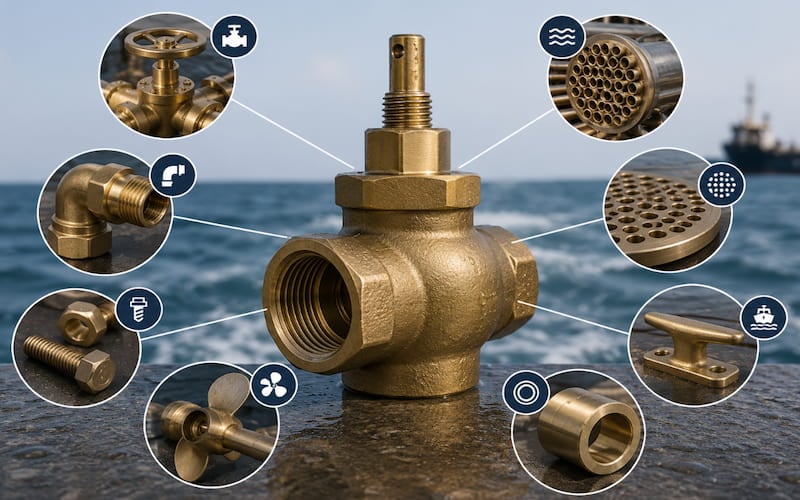
C46400 sacrifices machining speed in exchange for improved resistance to marine exposure. It may be more suitable for products exposed to:
- Seawater
- Brackish water
- Coastal spray
- Condensation
- Marine atmospheres
For a broader comparison of C36000, C46400, C48500, and other grades, refer to Align Manufacturing’s brass alloy guide for machining.
The final decision should consider material cost, machining time, expected service life, maintenance, and replacement risk.
When Should Another Marine Alloy Be Considered?
C46400 occupies a useful middle ground, but more demanding applications may require another copper alloy.
Aluminium bronze provides greater strength
Aluminium bronze may be more appropriate for highly loaded components, wear surfaces, propellers, or critical subsea equipment requiring greater strength and resistance to cavitation.
Align Manufacturing’s brass versus bronze material-selection guide compares the mechanical, corrosion, wear, and manufacturing characteristics of both alloy families.
Copper-nickel suits demanding seawater flow
Copper-nickel alloys are widely used for seawater piping, tube bundles, and cooling systems where uniform corrosion behaviour and resistance to flowing seawater are important.
Stainless steel may suit specific requirements
Selected stainless steel grades may provide greater strength or resistance to particular chemicals. However, chloride exposure, crevice conditions, and galvanic coupling still require careful evaluation.
For cast components, material selection should also reflect the process used to form the part. Align Manufacturing’s overview of investment casting materials explains how strength, corrosion resistance, castability, and finishing requirements affect alloy choice.
How Is C46400 Machined and Formed?
C46400 can be machined using conventional equipment, but it does not cut as quickly as free-machining C36000.
Machining parameters should be validated
Tooling and cutting conditions depend on:
- Product form and temper
- Component geometry
- Machine rigidity
- Tool material and coating
- Cutting depth
- Coolant strategy
- Surface-finish requirements
C46400 has a machinability rating of approximately 30% relative to C36000. It can also present work-hardening, galling, chip-control, and surface-finish risks when cutting conditions are poorly controlled.
Align Manufacturing’s article on brass PFMEA for CNC machining explains how alloy properties can be connected to tooling, dimensional, and machining-process risks.
Hot forming can reduce machining
Where the geometry and production volume justify it, hot forging can create a near-net shape before machining. This may reduce:
- Material waste
- Machining time
- Deep-pocket cutting
- Tool consumption
- Overall production cost
Tool design, forming temperature, material flow, trimming allowance, and final machining stock should be validated for the specific component.
Align Manufacturing’s guide to forging fundamentals provides additional context on material flow, grain structure, tooling, and near-net-shape manufacturing.
Casting may suit larger or more complex geometries
C46400 is primarily identified as a wrought alloy, so buyers should not assume that the same UNS designation is suitable for every casting process.
Where a complex marine part is produced as a casting, the engineering team should select an appropriate cast copper alloy and define:
- Alloy specification
- Casting process
- Pressure-integrity requirements
- Porosity acceptance
- Machining allowance
- Testing
- Heat and lot traceability
Buyers assessing regional foundry options can review Align Manufacturing’s overview of Sand casting in Thailand for additional process and sourcing context.
Joining requires control of zinc and filler materials
C46400 may be joined using suitable soldering or brazing processes. Welding requires greater care because zinc loss and porosity can affect joint quality.
The joining process should be supported by:
- Approved procedures
- Compatible filler materials
- Controlled heat input
- Qualified operators
- Inspection requirements
- Corrosion assessment
Surface treatments must also suit the alloy and marine environment. Align Manufacturing’s guide to brass surface finishes explains how polishing, plating, coating, and other treatments affect appearance, corrosion behaviour, and durability.
For complete assemblies involving cutting, forming, joining, machining, and finishing, experienced Metal Fabrication Thailand capabilities can help buyers assess the full production route rather than the raw alloy alone.
What Should Buyers Check When Sourcing C46400?
The purchase specification should state UNS C46400 together with the material standard relevant to the supplied product form.

Review the mill test report
The mill test report should include:
- Heat or lot number
- Copper content
- Tin content
- Lead content
- Iron content
- Zinc balance
- Mechanical properties where required
- Product form and temper
- Applicable material specification
- Manufacturer and testing location
The reported chemistry should remain within the specified C46400 limits.
Confirm material traceability
Traceability should continue from incoming material through finished production using:
- Material identification
- Cutting records
- Batch or work-order numbers
- Forming and machining records
- Inspection reports
- Final certification
- Packaging and shipment documents
Align Manufacturing’s guide to manufacturing documentation control and material traceability explains how drawings, material records, inspection results, revisions, and production evidence can be maintained as one controlled record.
Define the RFQ clearly
For custom components, the RFQ should identify:
- Alloy and material standard
- Drawing revision
- Annual and batch volumes
- Critical dimensions
- Surface finish
- Testing requirements
- Certification documents
- Machining allowances
- Packaging requirements
- Change-control expectations
Align Manufacturing’s guide to ordering custom castings provides a useful framework for preparing drawings, specifications, testing requirements, and supplier documentation before tooling begins.
Audit outsourced operations
Buyers should identify whether forging, machining, plating, heat treatment, testing, or assembly is performed by sub-suppliers.
Supplier qualification should review:
- Process capability
- Inspection equipment
- Material segregation
- Calibration
- Non-conformance controls
- Change management
- Document retention
What Are the Limitations of C46400?
C46400 should not be treated as a universal solution for every marine environment.
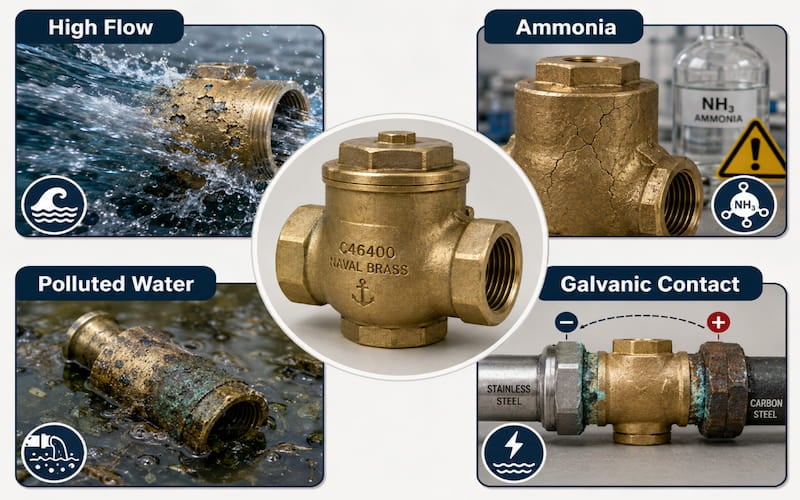
High flow can cause erosion-corrosion
Elevated water velocity, turbulence, entrained solids, and poor component geometry can remove protective surface films faster than they reform.
Pumps, elbows, restrictions, valve seats, and tube entrances deserve particular attention.
Ammonia can create cracking risk
Copper alloys can be vulnerable to stress-corrosion cracking in environments containing ammonia or related compounds, particularly when tensile stress is present.
The actual chemical environment should be reviewed before C46400 is used in systems containing ammonia or amines.
Polluted water may behave differently
Sulphides, biological activity, suspended solids, and low-oxygen conditions can change the corrosion behaviour of copper alloys.
Material selection should be based on representative water chemistry whenever the system handles polluted harbour water, industrial discharge, or stagnant seawater.
Dissimilar metals can create galvanic corrosion
Connecting C46400 directly to stainless steel, aluminium bronze, carbon steel, or other metals can create a galvanic couple.
The risk depends on:
- Relative surface areas
- Electrical contact
- Electrolyte conductivity
- Flow conditions
- Coatings
- Cathodic protection
- Position in the galvanic series
Insulating gaskets, sleeves, coatings, or compatible transition components may be needed.
Is C46400 Worth the Additional Cost?
C46400 may cost more to purchase and machine than standard brass, but the correct comparison should be based on total cost of ownership.
Its corrosion resistance can reduce:
- Premature replacement
- Unplanned shutdowns
- Leakage
- Emergency maintenance
- Labour and dry-docking costs
- Damage to surrounding equipment
The economic case is strongest when the component is:
- Difficult to access
- Expensive to replace
- Continuously exposed to seawater
- Safety-critical
- Required to remain in service for many years
For decorative, freshwater, or non-corrosive applications, a less specialised brass may be more economical.
How Should C46400 Be Specified on a Drawing?
A complete drawing note should identify:
- UNS C46400
- Applicable material specification
- Product form
- Temper
- Required dimensions and tolerances
- Mechanical-property requirements
- Chemical certification requirements
- Heat or lot traceability
- Inspection and testing requirements
- Surface finish and joining requirements
The specification should also identify restrictions on material substitution, manufacturing location, sub-suppliers, and process changes.
Align Manufacturing’s main brass manufacturing overview provides additional guidance on matching brass grades with machining, forming, forging, finishing, inspection, and production-documentation requirements.
Conclusion
At Align Manufacturing, we manufacture precision metal components for marine, industrial, oil and gas, railway, construction, and heavy-equipment applications through casting, forging, CNC machining, stamping, and metal fabrication. For marine brass parts, we focus on matching the alloy and product form to the actual corrosion environment, mechanical requirements, and production route. We also support material verification, process control, inspection, and traceable documentation so that C46400 components are manufactured to the required specification rather than selected by alloy name alone.
FAQ
What is C46400 naval brass?
C46400 is a wrought copper-zinc-tin alloy containing 59.0–62.0% copper and 0.50–1.00% tin, with zinc making up most of the balance.
Why is C46400 used in marine applications?
Its tin content improves resistance to dezincification and marine corrosion compared with standard high-zinc brasses.
Is C46400 completely resistant to seawater corrosion?
No. Its performance can still be affected by high flow velocity, polluted water, ammonia, mechanical stress, and galvanic contact with other metals.
What specification covers C46400 rod and bar?
ASTM B21/B21M is commonly used for naval brass rod, bar, and shapes.
Can C46400 be hot forged?
Yes. Material intended for hot forging should be purchased under the applicable product specification and supplied in a suitable condition.
Is C46400 lead-free?
Its specified lead content is 0.20% maximum, but the finished product must still meet the applicable weighted-average lead and certification requirements before being marketed for covered potable-water use.
Is C46400 easier to machine than C36000?
No. C36000 is designed for high machinability, while C46400 is selected primarily for improved marine corrosion resistance.
What should be checked on a C46400 mill certificate?
Confirm the heat number, alloy designation, chemical composition, applicable material standard, product form, temper, required mechanical properties, and complete traceability.
NSF/ANSI/CAN 61 Certified Brass: Lead-Content Standards for Drinking Water in 2026

Brass fittings, faucets, valves, and backflow preventers intended for drinking-water systems require more than a general “lead-free” claim. Buyers must verify that the finished product meets the applicable health-effects and lead-content requirements, not merely that the supplier used a recognised brass alloy.
This guide explains what NSF/ANSI/CAN 61 tests, how it differs from NSF/ANSI/CAN 372, how to review certification documents, and what procurement and engineering teams should check when sourcing potable-water brass components.
What Does NSF/ANSI/CAN 61 Test?
NSF/ANSI/CAN 61 establishes minimum health-effects requirements for materials, components, products, and systems that come into contact with drinking water. It covers products such as pipes, fittings, valves, faucets, coatings, joining materials, tanks, pumps, and mechanical plumbing devices.
The standard focuses on substances that may migrate from a product into drinking water. It generally involves three areas.
Extraction testing evaluates potential leaching
The product or material is exposed to controlled test water under conditions appropriate to its intended use. The water is then analysed to determine whether substances released from the product exceed the applicable health-effects criteria.
Testing conditions may vary according to:
- Product type
- Wetted surface area
- Water temperature
- Material formulation
- Intended application
Certification should therefore be reviewed for the specific product and conditions of use rather than treated as blanket approval for everything manufactured by the supplier.
Formulation review covers all wetted materials
The certification process evaluates the materials used on surfaces that contact drinking water. For a brass component, this may include:
- The brass body
- Internal waterways
- Stems and cartridges
- Plating and coatings
- Brazing or soldering materials
- Seals, gaskets, and elastomers
- Thread compounds and lubricants
A change to one of these materials may affect the product’s certification.
Ongoing surveillance maintains certification
Certification normally includes continued monitoring of the manufacturing facility and production controls. Buyers should confirm that the product remains actively listed in the certification body’s official database rather than relying only on an old certificate supplied by the manufacturer.
What Is the Difference Between NSF 61 and NSF 372?
NSF/ANSI/CAN 61 and NSF/ANSI/CAN 372 address different aspects of potable-water compliance.
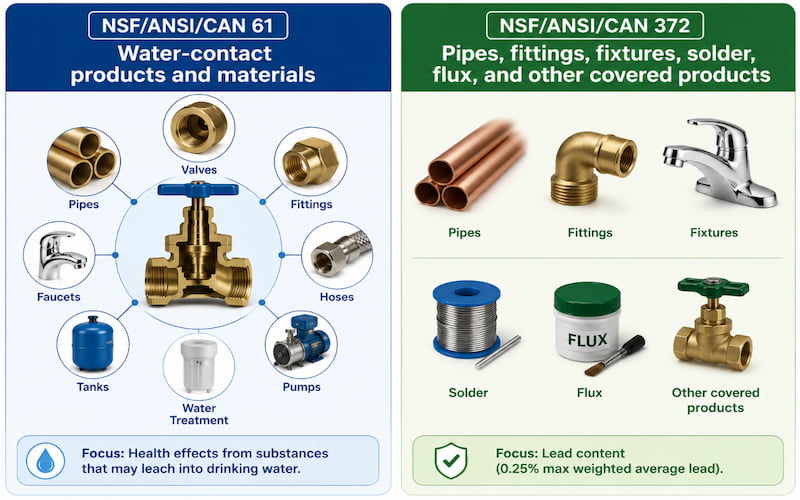
| Attribute | NSF/ANSI/CAN 61 | NSF/ANSI/CAN 372 |
| Primary purpose | Evaluates health effects from substances imparted to drinking water | Determines and verifies lead content |
| Main focus | Extraction and material-safety testing | Weighted-average lead calculation |
| Coverage | Water-contact products and materials | Pipes, fittings, fixtures, solder, flux, and other covered products |
| Lead requirement | Lead is assessed where applicable through health-effects criteria | Maximum 0.25% weighted-average lead for most covered wetted surfaces |
| Solder and flux | Evaluated under applicable product requirements | Maximum 0.2% lead |
NSF explains that NSF/ANSI/CAN 372 addresses lead content only. Most products also require an extraction or leaching standard, commonly NSF/ANSI/CAN 61.
A product should not be assumed to meet both requirements simply because it displays an NSF mark. The exact certification identifier and official product listing must be checked.
What Does “Lead-Free” Mean for Brass Components?
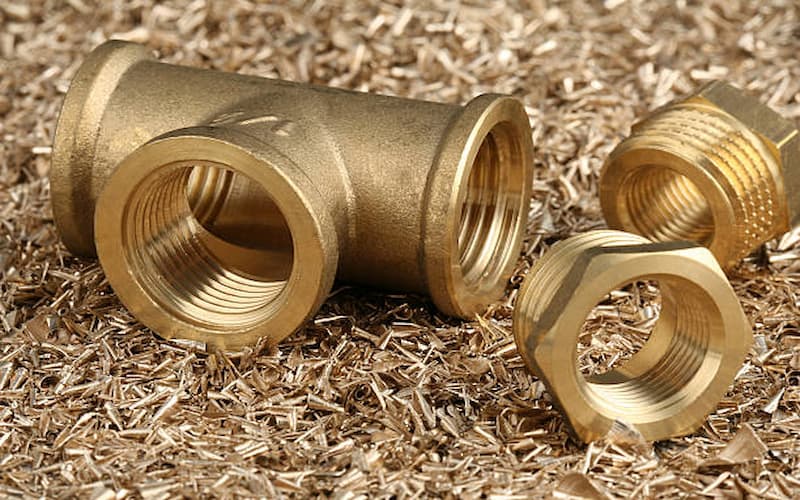
Under the U.S. Safe Drinking Water Act, “lead-free” generally means:
- No more than 0.25% weighted-average lead across the wetted surfaces of covered pipes, fittings, fixtures, and plumbing components
- No more than 0.2% lead in solder and flux
The calculation considers both the lead content and the proportional wetted surface area of each part in the assembly. It is not based only on the lead percentage of the main brass body.
Does lead-free mean zero lead?
No. “Lead-free” is a legal definition based on maximum permitted lead content. A material may contain a small amount of lead and still qualify when the complete product meets the weighted-average requirement.
Can a non-potable brass product contain more lead?
Products used exclusively for non-potable services, such as certain industrial processing, irrigation, or outdoor watering applications, may fall under exemptions. Their intended use must be clear, and they should not be marketed for potable-water applications.
How Should Buyers Review Brass Certification?
A compliance pack should prove that the exact finished product being purchased is covered. A certificate naming only the company, raw material, or alloy family may not be sufficient.
Confirm the exact product
Check whether the official listing identifies the relevant:
- Part number
- Model or series
- Product size
- Trade designation
- Water-contact temperature
- Manufacturing facility
Certification of a brass material does not necessarily transfer to every finished component produced from it. Machining, plating, joining, sealing, and assembly can introduce additional wetted materials.
Verify the standard and certification mark
The documentation should state whether the product is certified to:
- NSF/ANSI/CAN 61
- NSF/ANSI/CAN 372
- Both standards, where required
EPA guidance explains that a certification body’s mark should be reviewed together with its accompanying identifier text. A logo alone may not show which requirement the product satisfies.
Check limitations and footnotes
Official listings may include restrictions involving:
- Product dimensions
- Water temperature
- Surface-area-to-volume ratio
- Specific materials
- Coating thickness
- Product configuration
- Intended use
These limitations form part of the certification and should not be overlooked.
How Should Brass Alloys Be Selected for Potable Water?
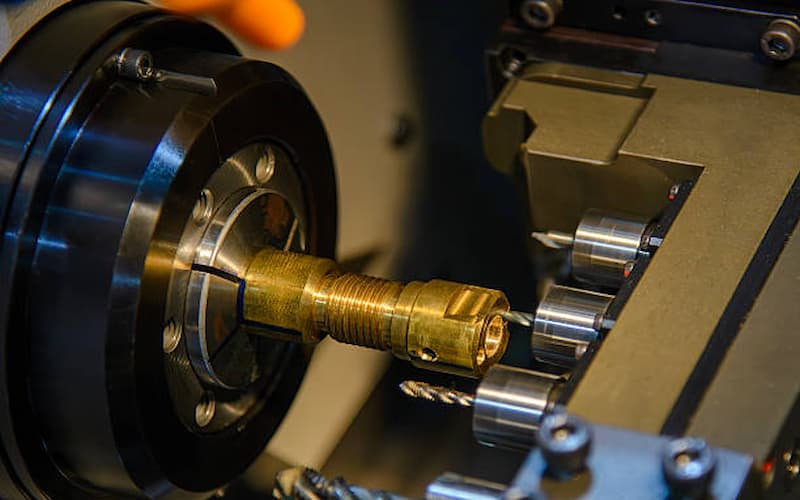
The alloy must meet the product’s regulatory, mechanical, manufacturing, and corrosion requirements. Lead content is only one part of material selection.
Important factors include:
- Lead-content compliance
- Castability or forgeability
- Machinability
- Strength and pressure rating
- Corrosion resistance
- Dezincification resistance
- Thread and sealing performance
- Plating compatibility
- Material availability
- Traceability
Leaded brass may remain suitable for non-potable use
Traditional leaded brass can provide excellent machinability and may still be appropriate for industrial valves, gas fittings, decorative hardware, and other non-potable products.
It should not be substituted into a potable-water assembly unless the finished product meets the relevant lead-content and health-effects requirements.
Lead-free brass requires manufacturing validation
Lead-free brass may use bismuth, silicon, or other alloying systems. Switching from conventional free-machining brass can affect:
- Tool wear
- Chip formation
- Cutting speeds
- Thread quality
- Casting fluidity
- Shrinkage behaviour
- Surface finish
- Pressure integrity
Production trials should therefore be completed using the actual component design and manufacturing equipment.
DZR and lead-free are not the same
Dezincification-resistant brass is designed to reduce the selective loss of zinc under certain water conditions. This is a separate property from lead-content compliance.
A product may satisfy the lead-free definition without providing the required level of dezincification resistance. Both requirements should be specified when relevant.
What Should Buyers Know About Annex N-2?
Annex N-2 of NSF/ANSI/CAN 61 includes material specifications that have undergone extraction testing and are considered acceptable materials within the conditions stated by the standard.
NSF reported that six brass rod alloys were added to Annex N-2 in the 2022 edition. However, appearing in the annex does not automatically certify every finished product made from that alloy.
When reviewing an alloy or supplier compliance pack, confirm:
- The alloy designation
- The applicable edition of the standard
- The certification scope
- The finished component covered
- Every wetted material in the assembly
- Any restrictions in the official listing
Buyers should avoid relying on unsupported claims about a “2025/2026 Annex N-2 update” unless they can verify the changes in the current controlled standard or through an accredited certification body.
How Can a Brass Supplier Be Qualified?
A practical qualification process should connect the product specification, certification, material traceability, and manufacturing controls.

Step 1: Define the requirement in the RFQ
The drawing, RFQ, and purchase order should identify:
- Required NSF/ANSI/CAN standards
- Intended potable-water application
- Maximum weighted-average lead content
- Approved brass alloy or alternatives
- Water-contact temperature
- DZR requirements where applicable
- Material traceability
- Restrictions on manufacturing changes
Avoid vague phrases such as “NSF compliant” or “lead-free brass” without defining the required certification.
Step 2: Request product-specific evidence
The supplier should provide:
- Current certification listing
- Exact part-number or model coverage
- Manufacturing-site details
- Material certificate
- Heat or lot traceability
- Wetted-material declaration
- Approved plating and sealing materials
- Certificate of conformity
The certification should cover the finished component rather than only the incoming brass bar, ingot, or casting.
Step 3: Audit the manufacturing process
The audit should review the controls used during:
- Incoming-material inspection
- Alloy verification
- Casting or forging
- Machining
- Plating and finishing
- Brazing or soldering
- Cleaning
- Assembly
- Final inspection
For cast brass products, the review may also cover charge materials, melt chemistry, pouring controls, porosity, pressure testing, and batch traceability. Buyers assessing casting suppliers can refer to Align Manufacturing’s overview of Sand casting in Thailand for more process context.
Step 4: Control production changes
The supplier should obtain approval before changing:
- Brass grade
- Raw-material source
- Manufacturing location
- Casting or forging process
- Machining subcontractor
- Plating system
- Seal material
- Wetted component
- Product design
The certification body may also need to evaluate the change before production continues.
Step 5: Maintain a compliance file
Keep the following records together:
- Approved drawing
- Purchase order
- Certification listing
- Material certificate
- Heat and batch records
- Inspection results
- Certificate of conformity
- Approved change records
- Receiving documentation
This creates a clear connection between the certified design and the parts received.
How Can a Certificate Be Verified?
Use the official database of the certification body shown on the product or documentation.
Confirm:
- Manufacturer name
- Manufacturing facility
- Product or model
- Applicable standard
- Current listing status
- Limitations and footnotes
- Whether the listing covers the finished product
EPA’s certification requirements for covered potable-water plumbing products became enforceable on September 1, 2023. Manufacturers and importers should therefore ensure that regulated products carry valid third-party lead-free certification before entering U.S. commerce.
When the listing cannot be found, buyers should contact the certification body instead of accepting an undated certificate or supplier screenshot.
What Engineering Trade-Offs Come With Lead-Free Brass?
Lead-free brass may require adjustments to production methods and tooling.
Machining parameters may need adjustment
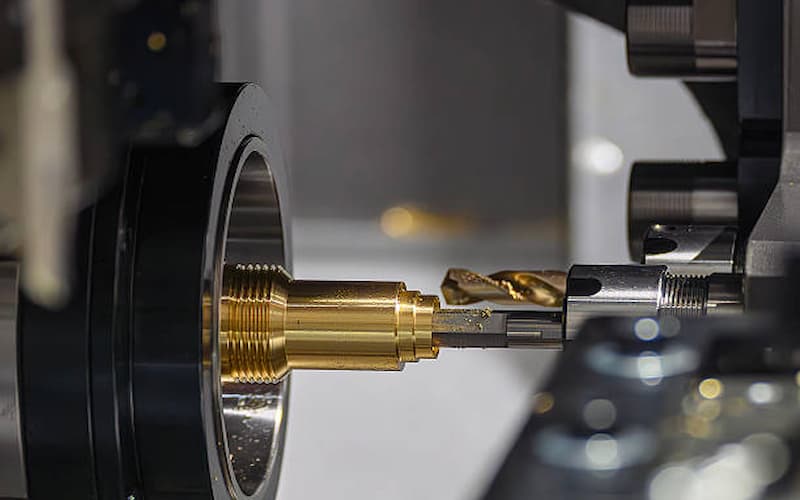
Cutting speed, tool geometry, lubrication, chip evacuation, and threading parameters should be validated for the selected alloy. Generic assumptions about cycle time or tool life should not replace production trials.
Casting controls should match the alloy
Lead-free alloys can behave differently during melting, pouring, solidification, and feeding. Gating design, temperature control, pressure testing, and inspection planning may need to be revised.
Material selection should also match the process and component requirements. Align Manufacturing’s overview of Investment casting materials explains how material choice affects corrosion resistance, strength, and component performance.
Secondary operations remain part of compliance
A compliant brass alloy can still form part of a non-compliant finished product if unapproved materials are introduced during:
- Plating
- Coating
- Brazing
- Soldering
- Sealing
- Cleaning
- Assembly
For assemblies requiring additional joining, finishing, or dimensional control, reviewing experienced Metal Fabrication Thailand capabilities can help buyers assess the complete manufacturing process rather than the brass material alone.
What Should a Brass Compliance Checklist Include?
Use this checklist when qualifying a new supplier or reviewing an existing potable-water component:
- Finished product has an active NSF/ANSI/CAN 61 listing where required
- Product meets the applicable lead-free certification requirement
- Listing identifies the correct product or approved series
- Manufacturing facility matches the production source
- Certification limitations have been reviewed
- Wetted materials match the certified design
- Weighted-average lead content has been addressed
- Solder and flux meet the applicable limit
- Material records are traceable to the production lot
- DZR requirements are specified where necessary
- Plating, seals, and joining materials are controlled
- Supplier changes require written approval
- Certification status is checked regularly
- Shipment records are retained
Compliance is not established by a certificate stamp alone. It depends on the exact product, its wetted materials, the manufacturing site, and the current certification listing.
Conclusion
At Align Manufacturing, we manufacture precision metal components through casting, forging, CNC machining, stamping, and metal fabrication across Thailand, Vietnam, and India. For brass valves, fittings, and other water-contact products, we focus on connecting the correct material with controlled production processes, traceable quality records, and the customer’s certification requirements. We believe potable-water compliance should be addressed from the drawing and supplier-qualification stage through manufacturing, inspection, and final documentation.
FAQ
What is NSF/ANSI/CAN 61?
NSF/ANSI/CAN 61 evaluates the health effects of materials and products that come into contact with drinking water.
Is NSF 61 the same as lead-free certification?
No. NSF/ANSI/CAN 61 addresses health effects and substance migration. NSF/ANSI/CAN 372 addresses weighted-average lead content.
Does lead-free brass contain no lead?
Not necessarily. U.S. law generally defines lead-free as no more than 0.25% weighted-average lead across the wetted surfaces of covered plumbing products.
Can a raw brass alloy certificate cover a finished valve?
Not automatically. The finished product may contain additional wetted materials introduced through machining, plating, joining, sealing, or assembly and may require its own certification.
Is DZR brass automatically lead-free?
No. Dezincification resistance and lead-content compliance are separate properties.
Can leaded brass be used for non-potable components?
Yes, depending on the application and applicable regulations. The product should be clearly intended and documented for non-potable use.
Does changing factories affect certification?
It can. Certification is connected to controlled production processes and authorised manufacturing locations. The certification body should review significant location or process changes.
How should buyers verify certification?
Check the certification body’s official product directory and confirm the manufacturer, facility, product designation, standard, current status, and any listing limitations.